Anchoring Faith and Identity: The Critical Importance of Teaching Quran, Arabic, and Islamic Studies to Children
📅
15 Jun 2026
•
Category: Islamic Learning
At Nour Center, we understand that these three pillars are not merely subjects to be learned; they are the essential elements that form the spiritual and intellectual framework of a young Muslim. This article explores why a comprehensive Islamic education is the greatest investment you can make in your child’s future.
The Holistic Trifecta: Why They Cannot Be Separated
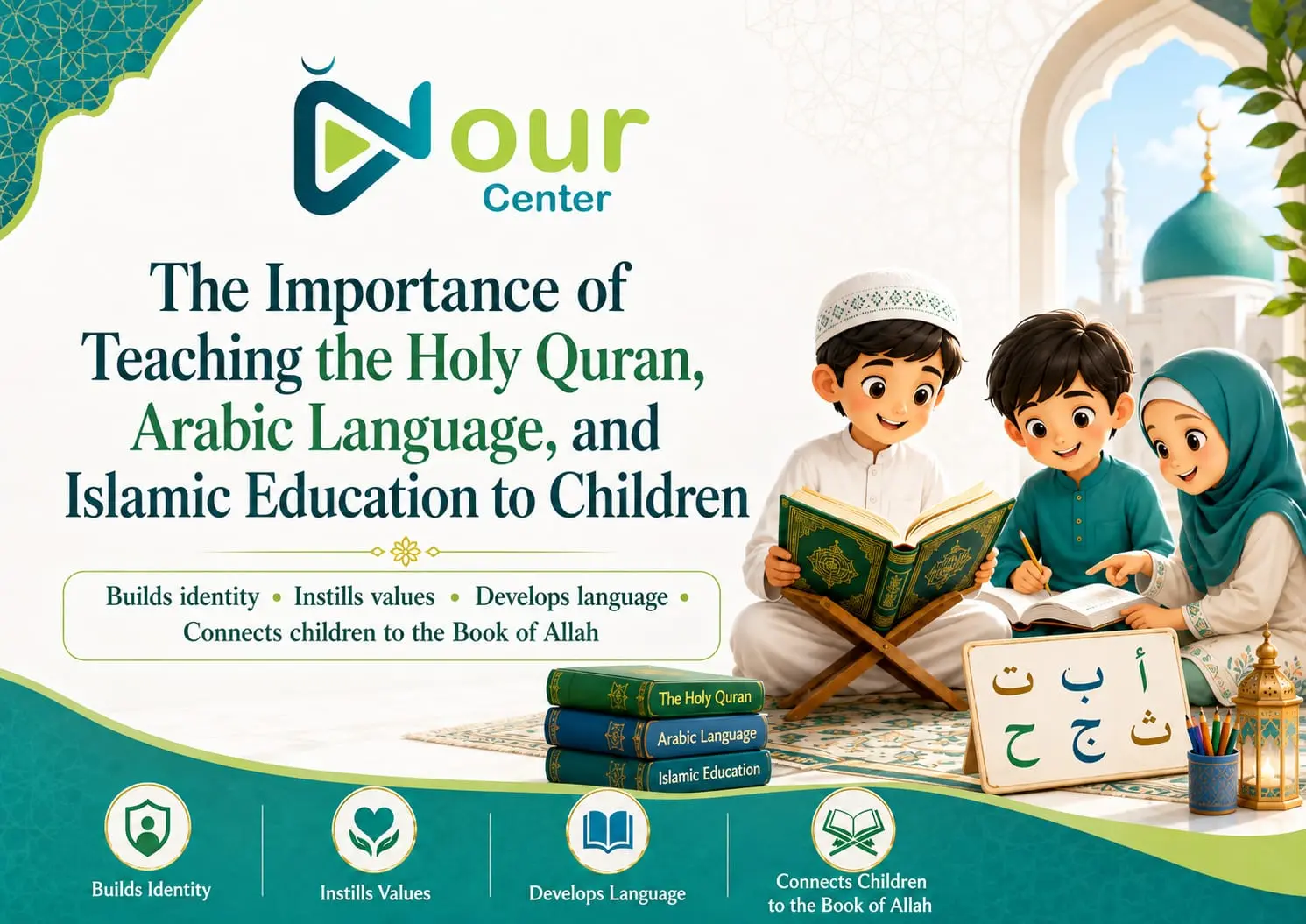
True understanding of Islam comes from a holistic approach. Separating the Quran from Arabic, or Arabic from Islamic Studies, creates gaps in comprehension and application.
The Quran is the ultimate source of guidance (Hidayah).
Arabic is the necessary key to unlock the depths of that guidance.
Islamic Studies provides the practical blueprint for living according to that guidance.
When taught together, they build a resilient structure of faith (Iman), knowledge (‘Ilm), and character (Akhlaq).
1. The Holy Quran: The Spiritual Anchor
Teaching children to recite, memorize, and understand the Quran is the cornerstone of their spiritual development.
Establishing a Divine Connection
From a young age, children need to know who their Creator is. The Quran introduces them to Allah’s attributes—His Mercy, Wisdom, and Power. By building a relationship with the Quran, children develop a sense of Taqwa (God-consciousness) that guides their actions even when parents are not present.
Character Building (Akhlaq)
The Quran is a manual for moral conduct. Through the stories of the Prophets and divine commandments, children learn values like honesty, patience, respect for parents, and compassion. They learn to distinguish between right and wrong according to divine standards, rather than shifting societal trends.
Cognitive and Psychological Benefits
Beyond the spiritual, memorizing the Quran (Hifz) significantly sharpens a child's memory, improves concentration, and develops cognitive abilities. Furthermore, reciting the Quran provides a sense of psychological peace and stability, helping children navigate the anxieties of modern life.
2. The Arabic Language: The Key to Authentic Understanding
While the message of Islam is universal, it was revealed in Arabic. For a child, learning Arabic is not just about acquiring a second language; it is about accessing their heritage without a mediator.
Unlocking Divine Meaning
Translations of the Quran can only convey the general meaning. The linguistic miracle, the nuance, and the deep emotional impact of the Quran can only be truly felt in Arabic. Teaching children Arabic allows them to understand Allah’s word in its purest form, preventing misconceptions that often arise from imperfect translations.
Performing Acts of Worship
Daily prayers (Salah), Adhkar (remembrances), and Duas (supplications) are all in Arabic. When a child understands what they are saying during Salah, their prayer transforms from a mechanical ritual into a heartfelt conversation with Allah. This leads to Khushu’ (focus and humility) in worship.
Preserving Cultural and Religious Identity
Language is a massive component of identity. For Muslim children, especially those living in the West, Arabic serves as a bridge to the global Ummah and their ancestral roots. It fosters a sense of pride in their religious identity.
3. Islamic Studies: The Practical Blueprint for Life
Knowing the Quran and Arabic is the theoretical foundation. Islamic Studies bridges the gap between knowledge and practice, teaching children how to live as Muslims.
Aqeedah (Creed): A Firm Foundation
Before a child can practice, they must believe correctly. Islamic Studies instills a sound Aqeedah (Creed), teaching them the pillars of faith. This solidifies their monotheism and protects them from confusion in an age of competing ideologies and atheism.
Fiqh (Jurisprudence): Practical Application
How do we make Wudu? How do we pray correctly? What are the manners of eating, sleeping, and interacting with others? Islamic Studies covers the essential Fiqh of daily life, ensuring that a child’s practice of religion is accurate and valid.
Seerah (Prophetic Biography): The Ultimate Role Model
Children need heroes. The Seerah of Prophet Muhammad (صلى الله عليه وسلم) provides them with the perfect role model. By learning about his compassion, bravery, patience, and leadership, children are inspired to emulate his character in their own lives.
The Nour Center Advantage: Shaping the Leaders of Tomorrow
At Nour Center, we don’t just teach; we nurture. We recognize the immense responsibility parents place on us. Our curriculum is expertly designed to integrate Quran, Arabic, and Islamic Studies into a cohesive, engaging, and age-appropriate learning journey.
Through professional native-Arabic tutors, modern teaching methodologies, and a supportive environment, we aim to shape children who are:
Confident in their faith.
Articulate in the language of the Quran.
Examplary in their character and conduct.
Don’t delay your child’s spiritual and linguistic journey. Invest in their Akhirah (Hereafter) while securing their Dunya (worldly life) with a strong moral foundation.
Join Nour Center today, and let us help you kindle the light of knowledge in your child’s heart.
Frequently Asked Questions
What is the educational philosophy of Nour Center?
Nour Center adopts a holistic approach that integrates three core pillars: the Holy Quran, the Arabic language, and Islamic Studies. We believe that this synergy is essential for building a balanced Muslim personality that is deeply rooted in its identity.
Why is it necessary to teach the Quran, Arabic, and Islamic Studies together?
Separating these subjects creates gaps in understanding. Arabic is the key to unlocking the depths of the Quran, and Islamic Studies provides the practical framework for applying this knowledge in daily life. Integrating them ensures a cohesive and lasting impact on the student's mind and heart.
Does the center focus solely on Quran memorization (Hifz)?
No, our focus extends beyond memorization to the spiritual and pedagogical aspects of the Quran. We emphasize understanding the meanings of verses, connecting them to the Prophetic tradition, and cultivating character (Akhlaq), while also fostering the cognitive benefits of memory and concentration.
Why is learning Arabic so crucial, especially for children living in non-Arab environments?
Arabic is the language of Revelation. Learning it empowers children to understand the Word of Allah directly, without reliance on imperfect translations. Furthermore, it allows them to perform acts of worship with focus (Khushu’) and strengthens their connection to the global Muslim community.
What is covered in the Islamic Studies curriculum at Nour Center?
Our Islamic Studies program covers three main areas:
Aqeedah (Creed): Establishing a firm foundation of faith and protecting children from confusion.
Fiqh (Jurisprudence): Teaching the practical rules of daily worship and social interactions.
Seerah (Prophetic Biography): Providing the Prophet Muhammad (peace be upon him) as the ultimate role model for character and conduct.
What are the qualifications of the teachers at Nour Center?
Our faculty consists of professional, native Arabic-speaking educators. They are selected not only for their academic expertise but also for their experience in utilizing modern, engaging teaching methodologies that make the learning journey enjoyable for children.
What are the qualifications of the teachers at Nour Center?
Our faculty consists of professional, native Arabic-speaking educators. They are selected not only for their academic expertise but also for their experience in utilizing modern, engaging teaching methodologies that make the learning journey enjoyable for children.
How can I enroll my child at Nour Center?
You can begin your child’s educational journey by contacting us directly through our official platforms or website. Our admissions team will be happy to provide you with all the necessary details regarding packages and scheduling.
Comments
No comments yet. Be the first to comment.
Note: Comments may require approval
before appearing publicly.