Tajweed
📅
14 Jun 2026
•
Category: Islamic Learning
When you listen to a masterful recitation of the Holy Quran, you are not merely hearing words spoken aloud; you are experiencing a profound phonetic masterpiece. The rhythmic flow, the precise articulation, and the majestic elongations are not random. They are the result of a meticulously preserved, centuries-old science known as Tajweed.
For Muslims around the globe, reading the Quran is a daily act of worship. However, reading it correctly—exactly as it was revealed to Prophet Muhammad (ﷺ) through the Angel Gabriel—requires the application of Tajweed. In this comprehensive guide, we will unlock the secrets of this sacred science, explore its core rules, and answer the most frequently asked questions to help you on your journey to perfecting your recitation.
What is Tajweed? (Linguistic and Technical Meaning)
Linguistically, the Arabic word "Tajweed" (تجويد) comes from the root word 'Jayyid', which means 'good' or 'excellent'. Therefore, Tajweed literally means "to make something beautiful, better, or to improve it."
In Islamic terminology, Tajweed is the science of reading the Quran by giving every single letter its Haqq (true right) and its Mustahaqq (due characteristics).
Haqq (The Right): Refers to pronouncing the letter from its exact articulation point (Makhraj) without mixing it with another letter.
Mustahaqq (The Due): Refers to applying the conditional rules that affect the letter in specific circumstances, such as elongating it (Madd), hiding it (Ikhfaa), or merging it (Idgham).
Why is Tajweed So Important? The Purpose of the Science
God commands Muslims in the Quran (Surah Al-Muzzammil 73:4): "And recite the Qur'an with measured recitation (Tarteel)." Tajweed is the practical tool to achieve this Tarteel. Its primary purposes include:
Preserving the Divine Text: Tajweed acts as a protective shield for the Quran. It prevents the Arabic text from being distorted by local dialects or mispronunciations across different generations and geographies.
Guarding the Tongue Against 'Lahn' (Mistakes): In Arabic, changing a single short vowel (like a Fatha to a Damma) or mispronouncing a letter (saying Seen instead of Saad) can drastically alter the meaning of a verse. Tajweed trains the tongue to avoid these critical errors.
Spiritual Elevation: Reciting the Quran with correct Tajweed forces the reader to slow down, beautify their voice, and focus on the phonetic gravity of the words. This naturally leads to Tadabbur (deep contemplation) and a closer spiritual connection with Allah.
The Core Pillars of Tajweed
The science of Tajweed is vast, but it is built upon a few foundational pillars. Mastering these is the key to fluent and accurate recitation:
1. Makharij Al-Huroof (Articulation Points)
Before learning any rules, a student must know exactly where each of the 28 Arabic letters originates. There are 5 main areas of the vocal tract used in Tajweed:
Al-Jawf: The empty space in the mouth and throat (used for elongated vowels).
Al-Halq: The throat (produces guttural letters like Khaa and Ayn).
Al-Lisan: The tongue (the busiest point, producing 18 letters).
Ash-Shafataan: The lips (produces Baa, Meem, Waw, Faa).
Al-Khayshoom: The nasal cavity (produces the Ghunnah or nasal sound).
2. Sifat Al-Huroof (Characteristics of Letters)
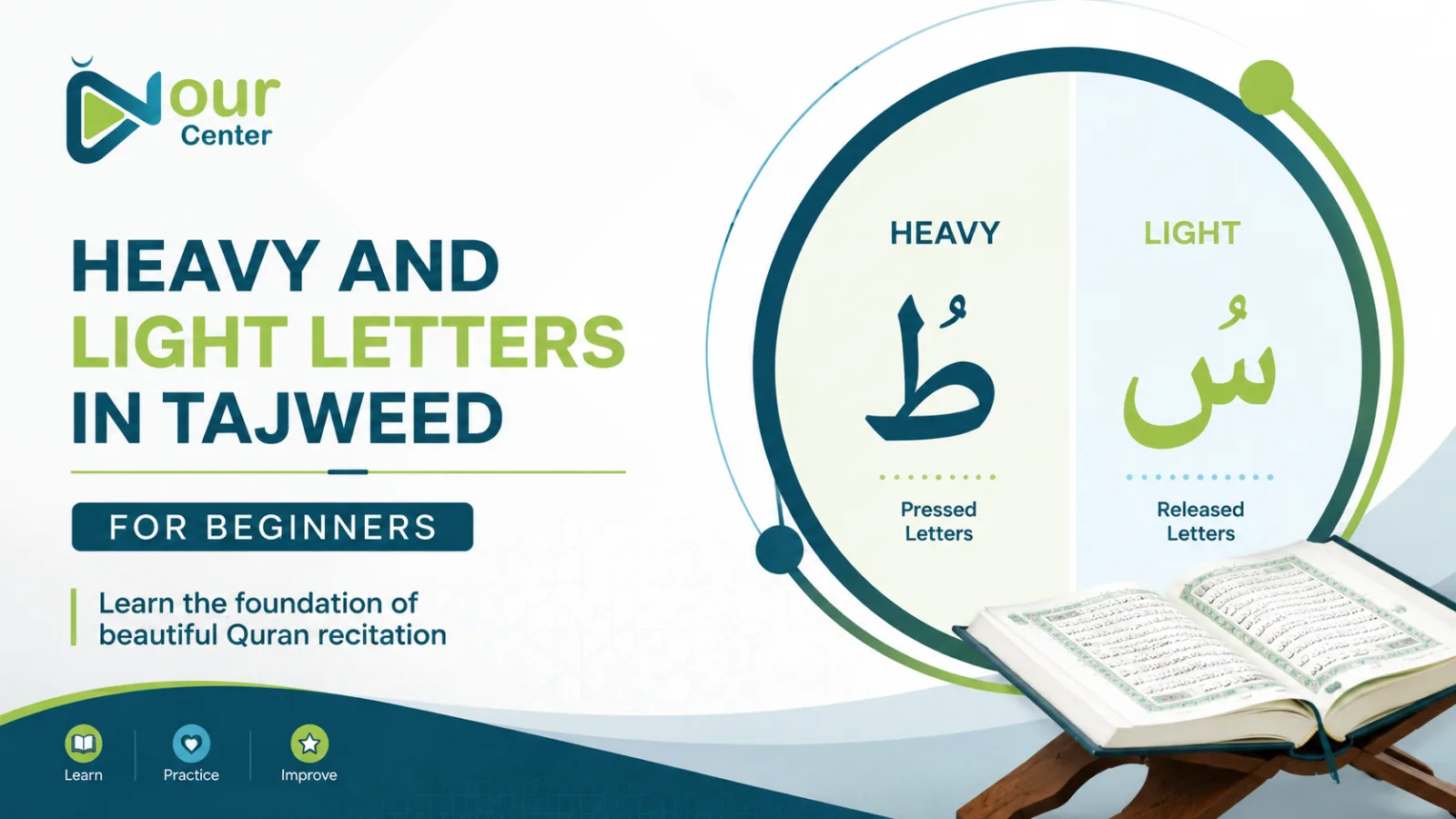
Even if two letters come from the same point, their "Sifat" distinguish them. Some letters are pronounced with a whisper (Hams), some with a heavy echo (Qalqalah), and others are heavy and full-mouthed (Tafkheem).
3. Ahkam An-Noon and Al-Meem (Rules of Noon and Meem)
These are the most frequently applied rules in the Quran. Depending on what letter follows a silent Noon or Meem, the sound will either be:
Izhaar: Pronounced clearly.
Idgham: Merged into the next letter.
Ikhfaa: Hidden with a nasal hum (Ghunnah).
Iqlab: Flipped into a different sound.
4. Ahkam Al-Madd (Rules of Elongation)
Tajweed dictates exactly how long a vowel should be stretched. While a natural vowel is held for 2 beats, certain grammatical structures in the Quran require holding the sound for 4, 5, or even 6 full beats (counts).
The Oral Tradition: Why Books Aren't Enough
Unlike history or math, Tajweed is an auditory and oral science. It relies entirely on Mushafah (lip-to-lip transmission) and Talaqqi (direct reception).
Historically, the Prophet (ﷺ) learned it directly from Angel Gabriel, the companions learned it directly from the Prophet, and this unbroken chain of teachers (Sanad) continues to this day. You cannot perfect the heavy Dhaad letter or the subtle nasal Ikhfaa merely by reading a textbook. A qualified, certified teacher is absolutely essential to listen to your recitation and correct the microscopic errors of your tongue and jaw.
Frequently Asked Questions
Is learning Tajweed obligatory (Fard) for every Muslim?
Scholars divide the application of Tajweed into two categories based on the type of mistake (Lahn):
Lahn Jali (Obvious/Major Mistake): Changing a letter or a vowel that alters the core meaning of the Quranic word. Avoiding this is obligatory (Fard 'Ayn) on every Muslim.
Lahn Khafi (Hidden/Minor Mistake): Missing a technical Tajweed rule, like not holding a Madd for exactly 4 beats, or missing a Ghunnah. While applying these rules is highly recommended to beautify the recitation, making a mistake here is generally not considered a sin for the average Muslim, though it is obligatory for scholars and professional reciters to avoid.
What is the difference between Tajweed and Tarteel?
Tarteel is the broader concept commanded by the Quran: reading at a slow, measured, and reflective pace. Tajweed is the set of technical, phonetic rules applied to the letters to achieve that perfect Tarteel. In short, Tajweed is the tool, and Tarteel is the goal.
I am an adult and struggle to pronounce Arabic letters. Is it too late to learn?
It is never too late. The Prophet Muhammad (ﷺ) gave a beautiful glad tiding to those who struggle, saying: "The one who is proficient in the recitation of the Qur'an will be with the honourable and obedient scribes (angels), and he who recites the Qur'an and finds it difficult to recite, doing his best to recite it in the best way possible, will have two rewards." (One reward for the recitation, and one for the struggle and effort).
Can I learn Tajweed by myself using YouTube videos or apps?
While videos and apps are excellent supplementary tools to familiarize your ear with the rules, they are not sufficient on their own. A video cannot hear your mistakes or tell you that your tongue is positioned slightly too high. To truly learn Tajweed, you must recite to a qualified teacher who can provide real-time, personalized feedback
What is the best method for kids (or non-Arab beginners) to start learning Tajweed?
The most proven and effective global methods for establishing a flawless Tajweed foundation are the "Noorani Qaida" (القاعدة النورانية) and "Noor Al Bayan" (نور البيان). Rather than jumping straight into complex verses, these curriculums teach students to break down Arabic words phonetically, starting from individual alphabet sounds and gradually building up to applying Tajweed rules on full Quranic words.
How long does it take to master Tajweed?
Learning the theoretical rules of Tajweed can take just a few months. However, mastering the practical application—training your vocal cords and tongue muscles to apply the rules effortlessly while reading—is a lifelong journey. Consistent daily practice with a teacher yields the fastest results.
Do I need to understand Arabic grammar to learn Tajweed?
No, you do not need to understand Arabic vocabulary or grammar to learn Tajweed. Millions of non-Arab Muslims around the world recite the Quran with flawless Tajweed without speaking conversational Arabic. Tajweed is a science of sound and phonetics, not syntax or translation.
Comments
No comments yet. Be the first to comment.
Note: Comments may require approval
before appearing publicly.