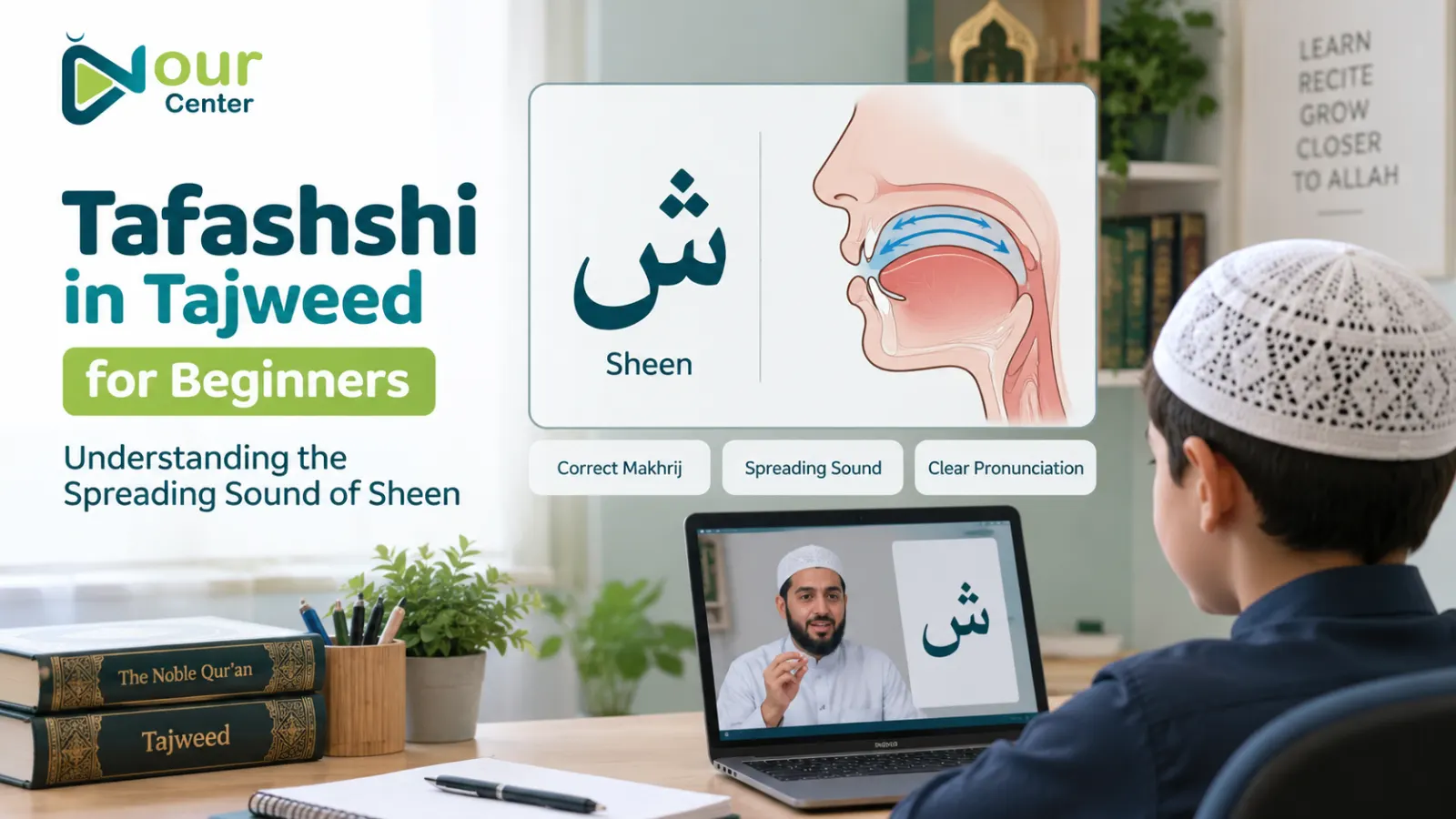
Tafashshi in Tajweed for Beginners: Understanding the Spreading Sound of Sheen
Learn Tafashshi in Tajweed for beginners, why it belongs to Sheen, how its spreading sound is produced, common pronuncia...
Read Article →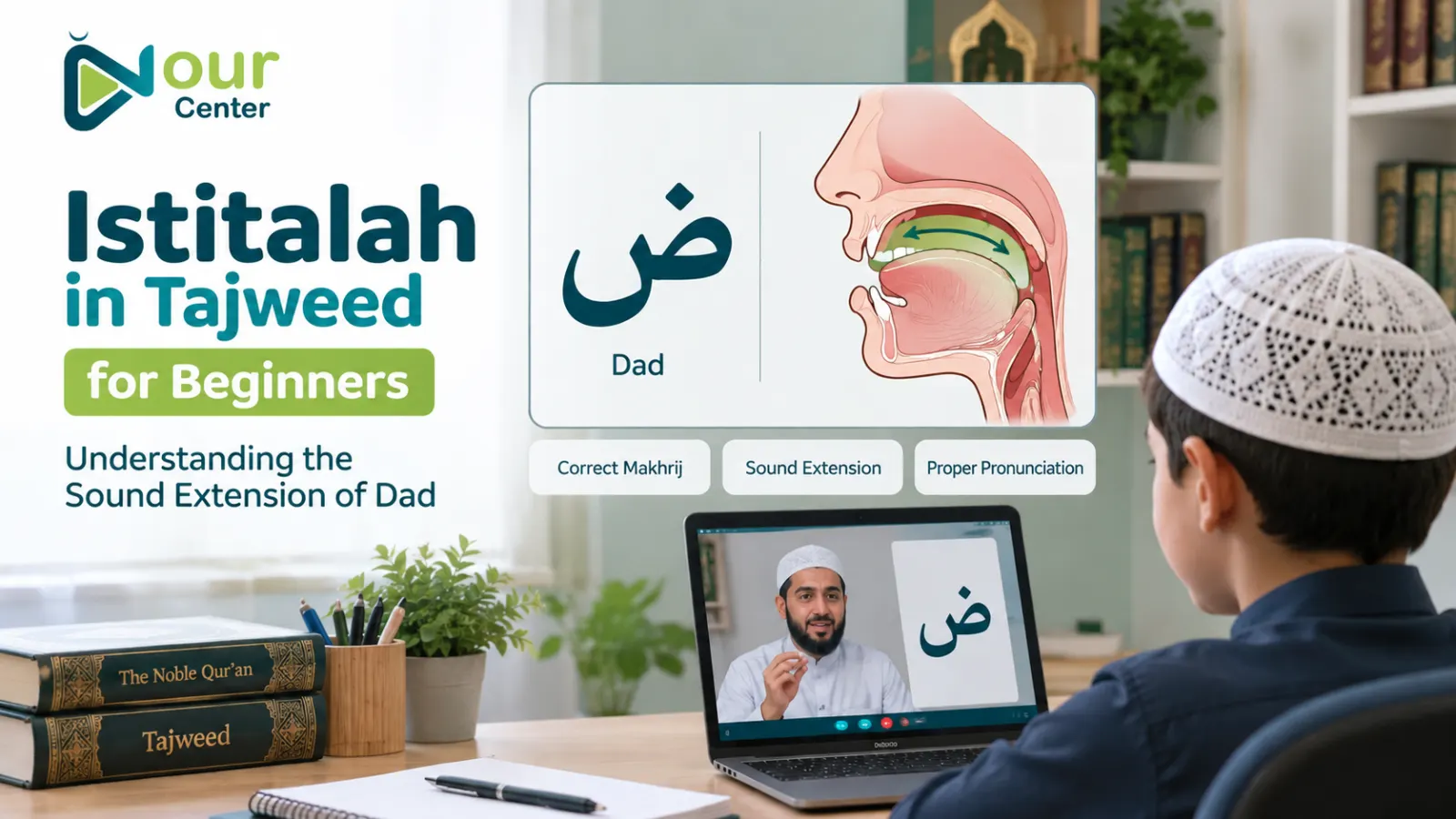
Understanding the Sound Extension of Dad
Istitalah in Tajweed for Beginners is an important lesson within Sifat al-Huruf because it explains a unique permanent characteristic associated with only one Arabic letter: Dad.
ض Istitalah is commonly described as the extension of the sound of Dad along its articulation area. This definition needs to be understood carefully. Istitalah does not mean that Dad should be stretched like a Madd letter. It does not mean adding extra counts. It does not mean holding the letter for an arbitrary amount of time.
Instead, Istitalah describes how the sound of Dad extends naturally along the side of the tongue during its correct articulation.
Istitalah belongs specifically to Dad. Students who understand Sifat al-Huruf for Beginners will find Istitalah easier because it is an individual permanent characteristic that belongs specifically to Dad. This guide explains Istitalah in Tajweed for beginners, the Makhrij of Dad, how its sound extension works, its relationship with other Sifat, common pronunciation mistakes, and practical exercises for clearer Quran recitation. What Is Istitalah in Tajweed?
Istitalah is one of the individual permanent characteristics of Arabic letters.
It applies specifically to Dad. The characteristic describes the natural extension of the sound along the articulation area of the letter. Dad is articulated using the side of the tongue with the corresponding upper molar area. During correct pronunciation, the sound travels or extends along this contact area. This is the characteristic known as Istitalah.
Istitalah = a special sound extension within the articulation of Dad.
Madd. An extra vowel. A long pause. Qalqalah. Ghunnah. Artificial stretching. Which Letter Has Istitalah?
ض — Dad. This makes the characteristic easy to memorize. However, Dad itself is one of the more challenging Arabic letters for many non-native speakers.
A distinctive Makhrij. A strong heavy sound. Several permanent characteristics. Controlled sound flow. The unique Istitalah characteristic. Therefore, memorizing that Dad has Istitalah is easy. Producing Dad correctly requires more practice. What Does Istitalah Mean? The word Istitalah carries the meaning of extension or lengthening. In Tajweed terminology, it refers to the extension of the sound along the articulation area of Dad. Beginners sometimes misunderstand the English word “extension.”
I should hold Dad longer. That is not the correct idea. The extension is primarily related to the path of the sound through the Makhrij. It is not a measured vowel length such as Madd. Understanding this difference prevents one of the most common mistakes in studying Istitalah.
Dad is articulated from the side of the tongue with the corresponding upper molar area. Traditionally, the articulation can involve one side of the tongue, and learners often find one side easier than the other. The important point is that Dad should not simply be produced from the tip of the tongue like several other Arabic consonants.
Correct Makharij for Beginners provides the foundation for Istitalah because Dad must be articulated from the side of the tongue against the upper molar area before its characteristic extension can appear correctly.
Without the correct Makhrij, a learner may produce a sound that seems heavy but is not an accurate Dad.
Many languages do not contain a sound equivalent to Arabic Dad.
Dal. A heavy Dal. Emphatic Za. Another heavy consonant. A sound created mostly from the tip of the tongue. A sound produced with excessive jaw pressure. These substitutions may sound somewhat similar to an inexperienced learner. But correct Dad has a distinctive articulation and combination of Sifat. Teacher correction is especially valuable for this letter. The Side of the Tongue in Dad The side of the tongue is central to correct Dad pronunciation.
The learner should establish contact with the appropriate upper molar region. The sound then develops along that articulation area. This helps create the characteristic extension associated with Istitalah. A beginner should not deliberately drag the tongue backward. Nor should the tongue slide dramatically. The movement and sound extension should happen naturally as a result of correct articulation.
Istitalah belongs permanently to Dad.
Fathah. Kasrah. Dammah. Sukoon. Shaddah. The exact sound environment may change, but Dad retains its permanent characteristics. This is different from conditional Tajweed rules that appear only in specific contexts. Permanent Sifat are part of the identity of the letter itself.
This is one of the most important distinctions. Madd concerns the lengthening of vowel sounds. Istitalah concerns the articulation of Dad. Madd may be measured in counts depending on its type.
Two counts. Four counts. Six counts. Do not treat Dad as though it contains a hidden Madd. A learner should preserve the natural characteristic without adding unnecessary time.
“The sound extends,” they may focus only on duration. But Istitalah is better understood in relation to the articulation area. The sound extends along the side of the tongue during the production of Dad.
Articulatory extension.
Extra recitation length. This distinction keeps the letter natural. Istitalah and Isti'la Dad is one of the seven Isti'la letters. Isti'la involves elevation of the tongue and contributes to heavy pronunciation. Dad therefore has a naturally heavy quality. But Isti'la and Istitalah are different characteristics.
Tongue elevation.
Sound extension along the articulation area of Dad. Both exist in the same letter.
Dad is also one of the four Itbaq letters. Itbaq involves a stronger enclosed relationship between the tongue and the upper palate. Students who understand Itbaq and Infitah in Tajweed for Beginners will recognize that Dad combines Itbaq with Isti'la, contributing to its strong heavy quality while Istitalah describes a different aspect of the letter. This combination helps explain why Dad has such a distinctive full sound.
Itbaq is not Istitalah. Each Sifah describes something different.
Because Dad has Isti'la and Itbaq, it is pronounced with Tafkhim. The sound should be full and heavy. However, Tafkhim alone does not create a correct Dad. A learner may produce a very heavy sound but use the wrong Makhrij.
Correct Makhrij. Correct heaviness. Correct sound flow. Correct Istitalah. The characteristics must work together. Does Dad Become Light With Kasrah? Dad remains one of the heavy Isti'la letters. Kasrah may affect how the heaviness is perceived, but the letter does not become an ordinary light consonant. Beginners should preserve Dad's identity while keeping the Kasrah accurate. Do not distort the vowel to make the consonant heavier.
Accurate Dad. Accurate Kasrah. Natural Tafkhim. Natural Istitalah.
Dad has Rikhwah. Rikhwah describes the continuation of sound rather than complete blockage. This interacts naturally with the articulation of Dad.
Rikhwah and Istitalah are not the same characteristic. Rikhwah tells us that sound can flow. Istitalah describes the special extension along the articulation area of Dad. The distinction becomes easier when the learner compares Dad with other Rikhwah letters that do not have Istitalah.
Dad also has Jahr. Jahr concerns breath behavior. Istitalah concerns another aspect of the sound and articulation.
Jahr. Rikhwah. Isti'la. Itbaq. Ismat. Istitalah. This combination helps create the unique identity of Dad.
Jahr. Rikhwah. Isti'la. Itbaq. Ismat. Istitalah. Each characteristic describes a different part of the pronunciation.
Breath is restrained according to its characteristic.
Sound can continue.
The tongue has elevation.
There is strong tongue-palate enclosure.
Dad belongs to the Ismat classification.
The sound extends along its articulation area. Understanding the complete profile makes it easier to see why Dad cannot be learned by simply saying: “Make a heavy D.”
This is one of the most important beginner corrections.
د
ض are separate Arabic letters. Making Dal heavier does not automatically produce Dad. Their Makharij differ. Their Sifat differ. Dad has Istitalah. Dal does not. A learner who substitutes a heavy Dal for Dad loses an important distinction in Arabic pronunciation.
ظ especially by learners whose native language does not contain either sound. Both are heavy letters. Both have Isti'la and Itbaq. But their articulation points are different. Dad uses the side of the tongue with the upper molar region. Emphatic Za involves a different tongue position closer to the front teeth. Istitalah belongs to Dad. It does not belong to emphatic Za. This makes Makhrij one of the best ways to distinguish the two.
د ض Dal should remain distinct. Dad should have its characteristic side-of-tongue articulation and heavy sound. Do not attempt to create the difference only through volume. Heavy pronunciation is not louder pronunciation. It is a different resonance and tongue configuration.
Dad and emphatic Ta share important heavy characteristics.
Isti'la. Itbaq. But emphatic Ta has different sound-flow characteristics and a different Makhrij. Dad uniquely has Istitalah. Comparing heavy letters helps beginners understand that Tafkhim does not make all heavy consonants identical.
Several Arabic letters are heavy. Several have Rikhwah. Several have Jahr. Four have Itbaq. But only Dad has Istitalah. This characteristic helps preserve the unique pronunciation identity of the letter. It is therefore especially important for learners who tend to replace Dad with another heavy consonant.
Students who have studied Tafashshi in Tajweed for Beginners can compare the two individual Sifat: Tafashshi belongs to Sheen, while Istitalah belongs only to Dad. Tafashshi describes spreading. Istitalah describes extension along the articulation area. Both are individual Sifat. But they apply to different letters and different sound behaviors. This comparison helps organize the final individual characteristics studied in Tajweed.
Sad. Seen. Zay.
Dad. Safeer creates a distinctive sharp quality. Istitalah describes extension within the articulation area. Do not create a whistling sound in Dad. Dad should remain full and controlled.
Ra. It concerns the natural tendency toward repeated tongue movement.
Dad. It concerns sound extension along the side-tongue articulation. Do not repeat or trill Dad. The two Sifat are completely different.
Lam. Ra. It describes natural inclination or deviation. Istitalah belongs only to Dad. Although both English descriptions may involve ideas of movement, their Arabic articulation and letter groups are completely different.
Waw Sakinah. Ya Sakinah. When preceded by Fathah. Istitalah is permanently associated with Dad. Leen concerns softness. Istitalah concerns articulation extension. There is no timing connection between the two.
Dad is not one of the Qalqalah letters. If Dad carries Sukoon, the learner should not create an artificial bounce.
Its heavy quality. Its Makhrij. Its Rikhwah. Its Istitalah. But no false Qalqalah. This distinction is particularly important because heavy consonants with Sukoon can sometimes tempt beginners to create an extra release.
Practice Dad with Fathah.
Heavy. Clear. Produced from the side of the tongue. Followed by a correct Fathah. Avoid making the vowel excessively broad. The consonant is heavy. The Fathah should remain accurate.
Practice Dad with Dammah.
Correct tongue articulation. Natural heaviness. Controlled lip rounding for Dammah. Do not use lip movement to create the consonant itself. The tongue produces Dad. The lips shape Dammah.
Dad with Kasrah can challenge beginners.
Make Dad too light. Or distort Kasrah to maintain heaviness. Neither is correct. Preserve Dad as a heavy letter while pronouncing a clear Kasrah. Slow repetition helps.
Dad Sakinah is especially useful for studying its permanent characteristics. Without a following short vowel, the consonant itself becomes more exposed.
Side-tongue contact. Rikhwah. Tafkhim. Istitalah.
Adding a vowel. Adding Qalqalah. Holding Dad for an arbitrary duration.
Dad Mushaddadah requires a strong and complete consonant pronunciation. The learner should preserve Shaddah while maintaining correct Dad articulation.
Extend Istitalah indefinitely. The consonant structure must remain correct without unnecessary stretching. Practice with a teacher because Shaddah can make an already difficult Dad more challenging. Does Istitalah Have a Specific Number of Counts? No. This question deserves a clear answer. Istitalah should not be measured like Madd.
Istitalah = two counts. Istitalah = four counts. Istitalah = six counts. Those measurements belong to different Tajweed discussions. Istitalah is a permanent characteristic of Dad's articulation. Its correct duration follows natural pronunciation and the structure of the word. Can You Hear Istitalah? With good pronunciation and careful listening, a teacher can help the student recognize the characteristic. However, beginners should not become obsessed with trying to hear a dramatic extra sound.
Istitalah is part of correct Dad.
Correct the Makhrij. Listen to accurate pronunciation. Repeat slowly. Receive feedback. Then apply Dad naturally in Quran words.
Dragging the tongue. Holding Dad too long. Adding a vowel. Making the sound extremely deep. Moving the jaw excessively. These actions can distort the letter. Istitalah should not be manufactured. It should arise from correct Dad articulation.
Pronouncing Dad Like Dal
This removes the distinctive side-tongue articulation. Return to the Makhrij. Do not attempt to fix the problem only by making Dal heavier.
Pronouncing Dad Like Emphatic Za
These are separate letters with different articulation points. Practice them side by side under teacher guidance.
Stretching Dad Like Madd
Istitalah is not Madd. Do not assign extra counts to Dad. Preserve natural timing.
Using Only the Tip of the Tongue
Dad relies significantly on the side of the tongue. Tip-only articulation can change the letter. Focus on the correct side contact with the upper molar area.
Excessive Tongue Pressure
Pressing too hard can make the letter tense and difficult. Correct articulation should be firm enough to establish the letter but not forced.
Making Dad Too Light
Dad is an Isti'la and Itbaq letter. It should retain its heavy quality. Do not allow it to collapse into a light consonant.
Making the Vowel Too Heavy
A heavy consonant does not give permission to distort its vowel.
Fathah. Kasrah. Dammah.
Adding Qalqalah to Dad Sakinah
Dad is not a Qalqalah letter. Do not bounce it. Allow its own characteristics to remain clear.
Holding Dad Too Long
Rikhwah and Istitalah may tempt beginners to prolong the consonant. Do not add unnecessary duration. Practice naturally.
Making Dad Too Short
The opposite error also exists. A learner may cut off Dad so quickly that its articulation and characteristics cannot develop correctly. Do not rush through the letter. The goal is natural balanced pronunciation.
Moving the Tongue Deliberately Along the Teeth
Istitalah does not require manually sliding the tongue across a long path. Establish correct articulation and allow the sound behavior to appear naturally.
Using the Throat to Create Heaviness
Dad's heaviness should not be created by unnecessary throat tension. The tongue and oral configuration play the central role. Relax the throat.
Copying a Native-Language D Sound
Many languages have a D-like consonant. Arabic Dad is not simply a variation of that sound. Learn its Makhrij independently.
Ignoring Rikhwah
Dad has sound flow characteristics. Do not turn it into a completely blocked consonant. The sound should retain the appropriate Rikhwah while preserving the other Sifat.
Studying Istitalah Without Learning Dad
“Istitalah belongs to Dad.” But if Dad itself is still incorrect, the theoretical knowledge has limited practical value. Always connect terminology to pronunciation.
Fathah. Kasrah. Dammah. Sukoon.
Makhrij.
Heavy quality.
Sound flow.
Natural Istitalah. Do not attempt to perfect everything at once.
Dad. Dal. Dad. Dal.
Is Dad coming from the correct side-tongue area? Does Dal remain distinct? Am I creating the difference only through heaviness? The two consonants should remain clearly separate.
Practice the two letters under teacher guidance. Focus particularly on the articulation point. Do not rely only on the fact that both letters are heavy. This exercise is extremely useful for students who confuse them in Quran reading.
Practice Dad with Sukoon.
Did I preserve the Makhrij? Did I allow natural sound continuation? Did I accidentally add Qalqalah? Did I hold the letter too long? Did I add a vowel? Repeat slowly.
Practice Quran examples containing Dad Mushaddadah.
Correct side-tongue articulation. Shaddah. Tafkhim. Istitalah. Correct following vowel. Avoid turning the sound into an unnecessarily long heavy consonant.
Dad. Dal. Emphatic Za. Dad with Fathah. Dad with Kasrah. Dad with Dammah. Dad with Sukoon. Listen afterward.
Are these three consonants clearly different? Does Dad sound like a heavy Dal? Am I stretching Dad? Is the vowel accurate? Then compare with a qualified teacher's pronunciation.
Review the Makhrij of Dad.
Practice Dad with short vowels.
Practice Dad Sakinah.
Compare Dad with Dal and emphatic Za.
Read Quran words containing Dad.
Focus on side-of-tongue articulation.
Practice Fathah, Kasrah, and Dammah.
Practice Sukoon and Shaddah.
Compare Dad with nearby or commonly confused letters.
Record yourself.
Repeat teacher corrections.
Learn the Makhrij
Focus on the side of the tongue and upper molar area.
Understand Istitalah
Learn that the sound extends along the articulation area rather than being stretched like Madd.
Practice Short Vowels
Use Fathah, Dammah, and Kasrah.
Practice Sukoon
Preserve the characteristic without Qalqalah or an added vowel.
Compare Dad With Other Letters
Focus on Dad vs Dal and Dad vs emphatic Za.
Practice Shaddah and Quran Words
Move beyond isolated sounds.
Connected Quran Reading
Read a passage while a teacher checks every Dad.
Children do not need a complicated theoretical definition at first.
This special characteristic belongs to Dad. Then focus on correct Dad pronunciation. Once the child produces the letter accurately, explain that its sound naturally extends along its articulation area. The practical sound should come before detailed terminology.
Listen to Dad. Observe the teacher. Practice the tongue position. Repeat simple syllables. Compare Dad and Dal. Read simple Quran examples. Keep sessions short. Dad can require patience because the tongue position may initially feel unfamiliar.
Adults often have established pronunciation habits. Some may have read Dad as a heavy D for years. Correcting the sound may therefore require focused retraining.
Makhrij explanation. Slow repetition. Side-tongue awareness. Audio recording. Teacher feedback. Contrast exercises. Daily short practice. Can Istitalah Be Learned Without a Teacher?
Istitalah belongs to Dad. But accurate Dad pronunciation is difficult to self-assess.
Incorrect side-tongue placement. Dad becoming Dal. Dad becoming emphatic Za. Excessive heaviness. Incorrect vowel quality. Artificial stretching. A qualified teacher can usually identify these errors quickly.
Written descriptions of the side of the tongue and upper molars are useful. But Quran pronunciation is primarily learned through sound. Listen to reliable recitation. Then listen to your teacher isolate Dad. Repeat it. Receive correction. Return to Quran words. The cycle of listening and correction is more effective than trying to build the sound from anatomical descriptions alone.
Choose a short passage.
ض Read the word slowly.
The Makhrij. The heaviness. The vowel. The sound flow. Then read the entire passage naturally. The final objective is not isolated Dad practice. It is stable Dad pronunciation during fluent Quran recitation.
Correct Istitalah should not make Quran reading slow. At the beginning, the learner may pause to establish Dad. That is normal. But as muscle memory develops, the articulation should become automatic.
Side of tongue. Isti'la. Itbaq. Rikhwah. Istitalah. Training builds the system. Fluent recitation uses it automatically.
At this stage, the learner has studied important individual characteristics including: Safeer. Leen. Inhiraf. Takrir. Tafashshi. Istitalah. Qalqalah may also have been studied earlier as a major practical Tajweed rule. Together with the opposite Sifat, these characteristics create a detailed framework for understanding Arabic letters.
Makhrij. Permanent characteristics. And sometimes contextual Tajweed rules. This is one of the most important outcomes of studying Sifat al-Huruf.
At Nour Center, live one-to-one Tajweed lessons can teach Istitalah through direct Dad correction.
Dad Makhrij. Side-of-tongue placement. Tafkhim. Isti'la. Itbaq. Rikhwah. Istitalah. Sukoon. Shaddah. Dad vs Dal. Dad vs emphatic Za. Connected Quran reading. Instead of only memorizing that Istitalah belongs to Dad, the learner develops the actual pronunciation through guided practice. This turns Tajweed theory into practical Quran recitation.
You know Istitalah belongs specifically to Dad. You understand that it is not Madd. Your Dad comes from the side of the tongue rather than simply the tip. Dad remains clearly different from Dal. Dad remains clearly different from emphatic Za. The letter retains its heavy quality. You preserve the vowel accurately. Dad Sakinah has no false Qalqalah. You do not add extra vowels. You do not stretch Dad arbitrarily.
You understand how Istitalah differs from Isti'la and Itbaq. Your Dad remains stable during connected Quran reading. Your teacher corrects the letter less frequently. The final goal is natural pronunciation. You should no longer need to consciously create Istitalah. Correct Dad articulation naturally contains it. What Should You Study After Istitalah? Istitalah completes the current sequence of individual Sifat in this beginner Tajweed series.
At this stage, learners should review the whole Sifat system rather than immediately adding more terminology.
Hams and Jahr. Shiddah, Tawassut, and Rikhwah. Isti'la and Istifal. Itbaq and Infitah. Idhlaq and Ismat. Safeer. Qalqalah. Leen. Inhiraf. Takrir. Tafashshi. Istitalah. Then return to Quran reading and identify how these characteristics combine within actual letters. The purpose of Sifat is not simply to memorize terminology. The purpose is to improve pronunciation.
Istitalah in Tajweed for Beginners is the unique permanent characteristic of: Dad. ض It describes the natural extension of the sound along the articulation area of Dad.
Istitalah belongs only to Dad. Dad is articulated using the side of the tongue with the upper molar area. Istitalah is not Madd. It does not have a fixed number of counts. Do not stretch Dad artificially. Do not pronounce Dad as a heavy Dal. Do not confuse Dad with emphatic Za. Do not add Qalqalah when Dad has Sukoon.
Jahr. Rikhwah. Isti'la. Itbaq. Ismat. Istitalah. Correct Makhrij is the foundation of all of them.
Careful listening. Correct side-of-tongue placement. Slow practice. Letter comparison. Sukoon practice. Shaddah practice. Recording. Connected Quran reading. Qualified teacher correction. With consistent practice, Dad becomes clearer, more stable, and more natural, and Istitalah becomes an automatic part of accurate Quran recitation.
Note: Comments may require approval before appearing publicly.
Learn Tafashshi in Tajweed for beginners, why it belongs to Sheen, how its spreading sound is produced, common pronuncia...
Read Article →
Learn Inhiraf in Tajweed for beginners, why it applies to Lam and Ra, how their sounds deviate naturally, common pronunc...
Read Article →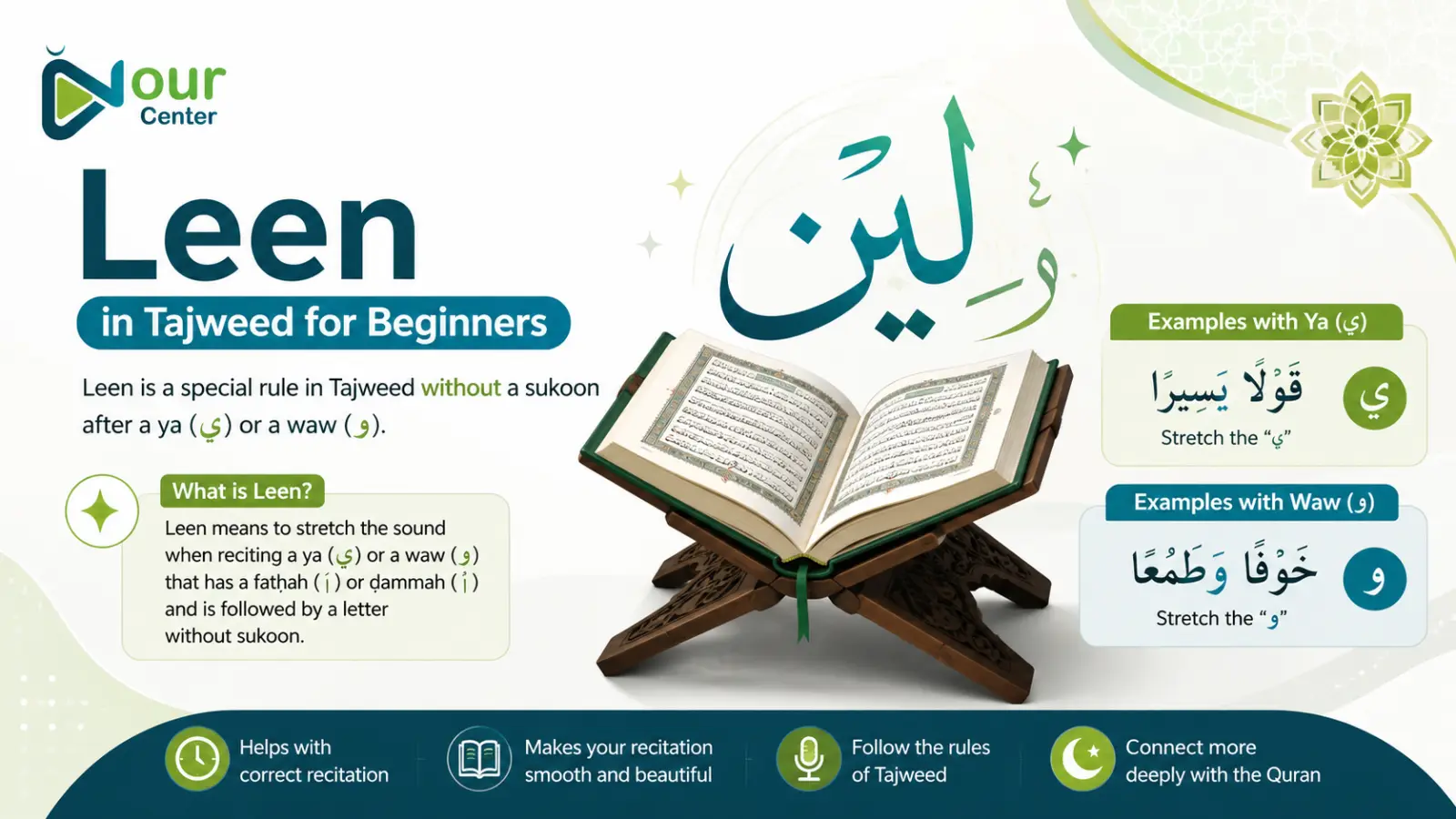
Learn Leen in Tajweed for beginners, the conditions of Waw and Ya Leen, the difference between Leen and Madd, stopping r...
Read Article →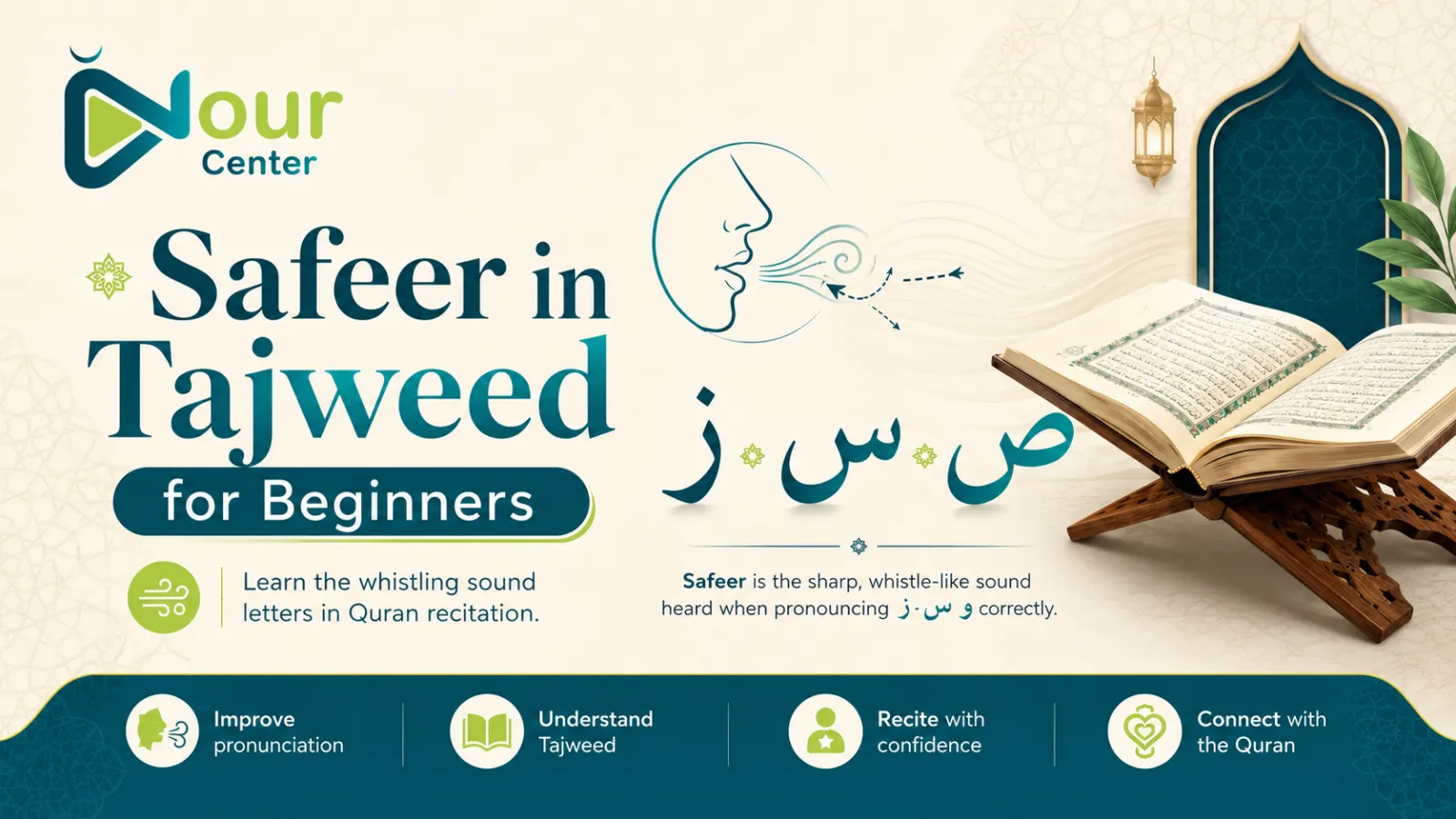
Learn Safeer in Tajweed for beginners, the three Safeer letters, how the whistling sound is produced, common pronunciati...
Read Article →