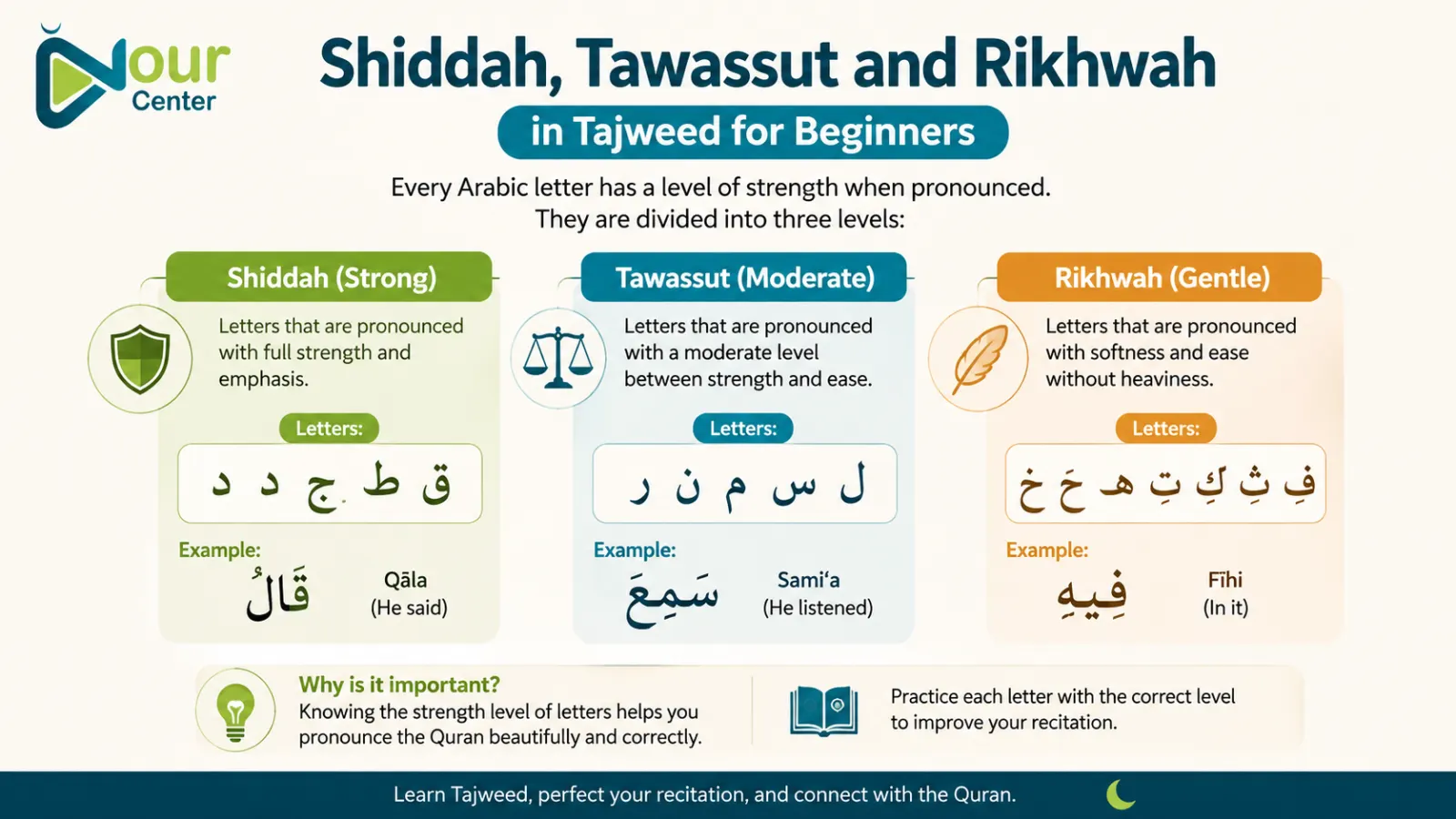
Shiddah, Tawassut, and Rikhwah in Tajweed for Beginners: Understanding Sound Flow
Learn Shiddah, Tawassut, and Rikhwah in Tajweed for beginners, how sound stops or flows through Arabic letters, common m...
Read Article →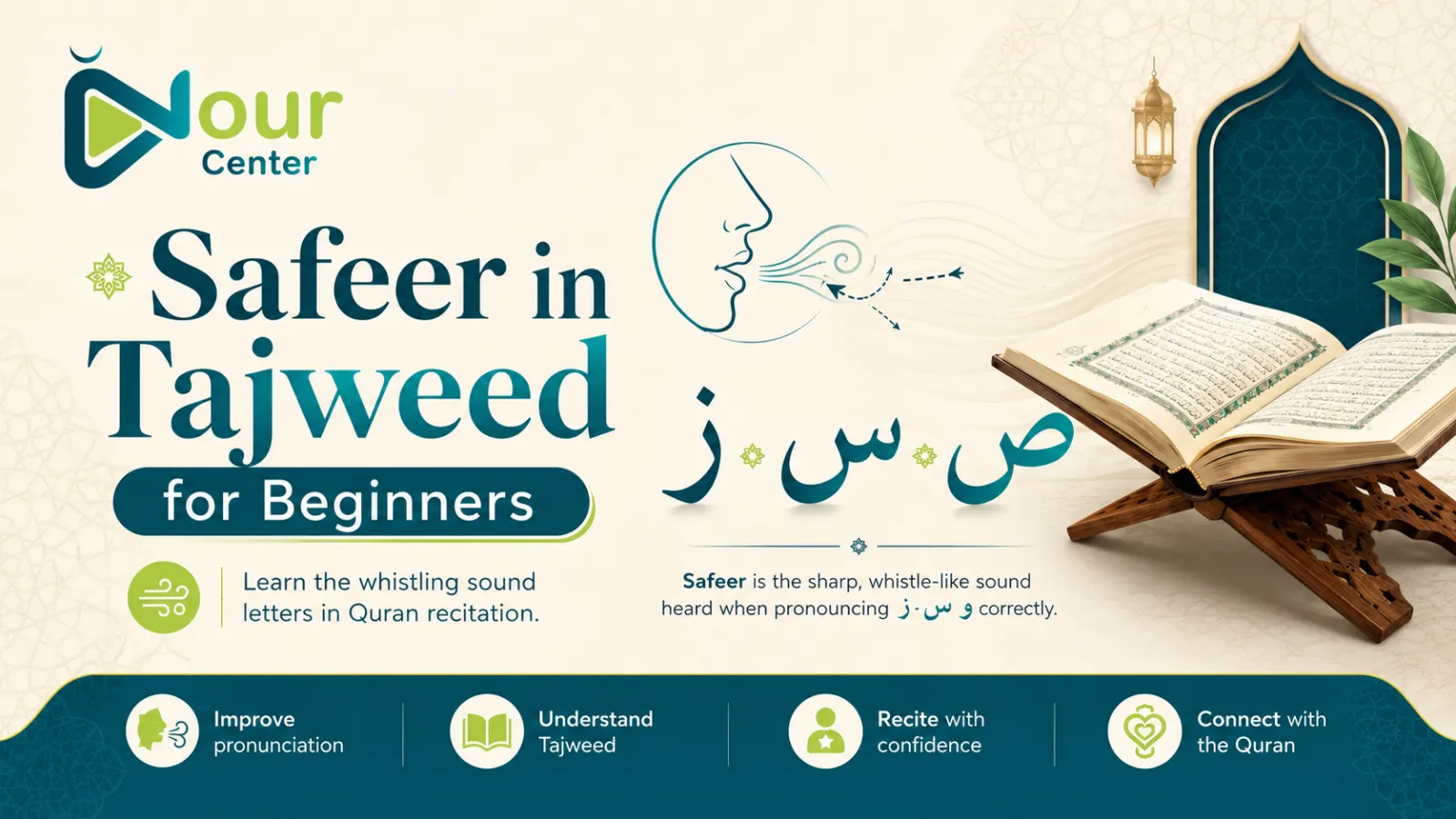
Understanding the Whistling Sound of Arabic Letters
Safeer in Tajweed is one of the individual characteristics of Arabic letters studied within Sifat al-Huruf. Unlike paired characteristics such as Hams and Jahr or Isti'la and Istifal, Safeer does not have a direct opposite characteristic. It belongs to a group of special qualities that apply only to particular Arabic letters.
Sad. Seen. Zay.
ص س ز These letters share a distinctive sharp or high-pitched sound quality that Tajweed scholars traditionally describe as Safeer. The word is often translated as whistling. However, beginners should understand this carefully. Correct Safeer does not mean creating an artificial whistle with the lips. The sound naturally appears because of the articulation and airflow of the three letters.
Pronounce Sad, Seen, and Zay from their correct Makharij and allow their natural Safeer quality to appear without exaggeration. This guide explains Safeer in Tajweed for beginners, the three Safeer letters, how the characteristic is produced, the differences between Sad, Seen, and Zay, common mistakes, and practical exercises for Quran pronunciation. What Is Safeer in Tajweed? Safeer is a permanent characteristic of three Arabic letters. It produces a noticeable sharp, high-frequency sound during pronunciation.
Sad. Seen. Zay. The sound can resemble a controlled whistle or sharp airflow. But the learner should not deliberately whistle.
The tongue is positioned correctly. The letter comes from its proper articulation point. The airflow is controlled. The other characteristics of the letter are maintained. Students who understand Sifat al-Huruf for Beginners will find Safeer easier because Safeer is one of the individual permanent characteristics that helps distinguish specific Arabic letters. What Does the Word Safeer Mean? Safeer can carry the meaning of whistling or a sharp sound.
In Tajweed, it refers to the distinctive sound quality present in Sad, Seen, and Zay.
The term gives beginners a useful listening clue. When the three letters are pronounced correctly, they have a sharpness that distinguishes them from many other consonants.
Safeer is not an added musical effect. It is part of the natural pronunciation of the letters themselves. How Many Safeer Letters Are There?
ص — Sad س — Seen ز — Zay This makes Safeer one of the easier Sifat groups to memorize. The main challenge is not remembering the letters. The challenge is producing each one correctly while preserving its individual characteristics. Why Do Sad, Seen, and Zay Share Safeer? These three letters are articulated in closely related areas involving the tongue and the front teeth.
The narrow passage created during pronunciation allows a distinctive stream of sound and air.
This produces the sharp quality associated with Safeer. However, the three letters are not identical. Sad is heavy. Seen is light. Zay has a different relationship with breath and voicing characteristics. Safeer is only one feature they share.
Safeer helps maintain clear differences among Arabic consonants. If it is too weak, a letter may lose some of its natural identity. If it is exaggerated, the recitation may sound artificial.
Clear Arabic pronunciation. Stronger letter distinction. Accurate Quran reading. Better listening awareness. More precise Sukoon pronunciation. Improved understanding of Sifat al-Huruf.
Safeer cannot be produced correctly if the Makhrij of the letter is wrong. Correct Makharij for Beginners remains essential because the characteristic whistling quality of Safeer depends on accurate tongue placement and airflow near the front of the mouth. If the tongue moves to the wrong place, the learner may produce: A weak Safeer. An exaggerated whistle. A different Arabic letter. A foreign-language approximation. The articulation point must come first.
Then the Sifah appears naturally. What Is the Makhrij of the Safeer Letters? Sad, Seen, and Zay are articulated from a closely related region involving the tip or front part of the tongue and the lower front teeth. A narrow passage allows the characteristic sound to form. Beginners should not attempt to learn this only from written anatomical descriptions. A teacher can demonstrate the exact tongue relationship and help correct subtle mistakes.
Seen is often the easiest Safeer letter for beginners to hear. It has a clear hissing or sharp airflow quality. Seen is a light letter.
Clear. Light. Sharp. Controlled. Do not turn Seen into an exaggerated hiss. Do not extend it longer than the word requires. Its Safeer should be present naturally.
Safeer can become especially noticeable when Seen carries Sukoon. Because there is no short vowel immediately masking the consonant, the learner can hear the character of the letter more clearly. Practice a silent Seen carefully. Allow the natural sound. But do not extend it indefinitely. Safeer is a characteristic, not a Madd rule.
Too Much Hissing
A learner may discover the Safeer quality and begin holding Seen for too long. This makes the consonant sound exaggerated.
Maintain the proper articulation. Allow the sharp sound. Then move naturally into the next letter or stop according to the word.
The opposite mistake occurs when the tongue blocks too much airflow. The Seen may sound dull. Correct the Makhrij first. Then allow the natural narrow airflow to produce the Safeer.
Sad is also a Safeer letter. However, Sad is very different from Seen because Sad has heavy pronunciation characteristics.
Safeer. Isti'la. Itbaq. Hams. Rikhwah. Other permanent characteristics. Understanding Heavy and Light Letters in Tajweed for Beginners helps learners distinguish Sad from Seen because both have Safeer while only Sad carries the strong heavy quality of Tafkhim. This is an extremely useful comparison.
Sad and Seen share Safeer. But they should never sound identical.
Heavy. Fuller. Has Isti'la. Has Itbaq.
Light. Does not have Isti'la. Does not have Itbaq.
Have Safeer. This shows why learning only one characteristic is never enough. A complete Arabic letter is produced by combining all of its characteristics.
Safeer in Sad remains audible, but the overall sound is heavier and fuller than Seen. Beginners sometimes make one of two errors. They may make Sad too light and turn it toward Seen. Or they may focus so much on heaviness that the sharp Safeer quality disappears.
Tafkhim. Safeer. Neither characteristic should destroy the other.
Zay is the third Safeer letter. It shares the sharp quality of Sad and Seen but differs in other characteristics. Zay has Jahr rather than Hams. This changes the overall sound. The learner should not pronounce Zay exactly like Seen with an added vowel. It is a distinct consonant. Safeer helps create its sharp quality, while its other Sifat preserve its unique identity.
Zay and Seen are particularly useful for comparing Hams and Jahr. Seen belongs to Hams. Zay belongs to Jahr. Both share Safeer. Students who understand Hams and Jahr in Tajweed for Beginners can use Seen and Zay to hear how the same Safeer quality can exist alongside different breath characteristics. This is one of the clearest examples of Sifat combining independently. Does Zay Have the Same Breath Flow as Seen?
No. Both have Safeer. But their breath characteristics differ.
Hams.
Jahr. Therefore, Safeer should not be interpreted simply as "air flowing." It describes a specific sharp sound characteristic. Hams answers a different question about breath behavior.
This is important because two of the three Safeer letters may feel strongly connected with airflow. But Safeer and Hams are different characteristics. Safeer describes the distinctive sharp or whistling quality. Hams describes breath flow. Zay demonstrates the difference clearly because it has Safeer while belonging to Jahr rather than Hams.
Sad, Seen, and Zay also have flowing sound characteristics associated with Rikhwah. However, Rikhwah and Safeer are not the same. Rikhwah describes the continuation of sound. Safeer describes the specific sharp sound quality of the three letters. A learner should not assume every Rikhwah letter has Safeer. Most do not.
Students who understand Shiddah, Tawassut, and Rikhwah in Tajweed for Beginners should remember that Safeer describes the special sound quality of three letters, while Rikhwah describes how sound is allowed to continue through the articulation. This distinction prevents learners from mixing Sifat categories. Different characteristics can exist simultaneously in the same consonant. Safeer and Isti'la Only Sad among the three Safeer letters belongs to the seven Isti'la letters.
Sad = heavy Safeer letter. Seen = light Safeer letter. Zay = light Safeer letter. This makes Safeer a valuable topic for practicing heavy and light pronunciation without losing a shared characteristic.
Sad is also one of the four Itbaq letters. Seen and Zay have Infitah.
The letters share Safeer. But their tongue-palate characteristics differ. This produces noticeably different sound qualities.
Safeer itself does not make a letter heavy. Sad is heavy because of its other characteristics. Seen and Zay remain light.
Safeer does not determine Tafkhim or Tarqiq. The full Sifat profile of the letter determines its overall pronunciation.
Safeer is often easiest to hear when one of the three letters carries Sukoon. The absence of a short vowel makes the consonant quality more exposed.
Adding an extra vowel. Extending the Safeer excessively. Adding Qalqalah. A silent Safeer letter should retain its own natural characteristics.
Safeer letters are not Qalqalah letters simply because they may carry Sukoon. A learner who has studied What Is Qalqalah should remember that Safeer is a permanent quality of Sad, Seen, and Zay, while Qalqalah is a controlled release that applies only to its designated letters under specific Sukoon conditions. Do not bounce Seen. Do not bounce Zay. Do not bounce Sad. Instead, preserve their natural Safeer.
Madd controls vowel length. Safeer belongs to consonant pronunciation. Because Seen and similar letters can produce a continuous sound, beginners may accidentally hold them for too long. That does not create correct Tajweed. Allow the characteristic to appear without turning the consonant into a long sound.
Ghunnah is nasal resonance associated mainly with Noon and Meem. Safeer is produced through the oral articulation of Sad, Seen, and Zay. Do not nasalize Safeer. The sound should remain focused at the correct oral articulation.
Learn the correct Makhrij.
Pronounce the letter slowly.
Allow the natural sharp quality to appear.
Avoid exaggerating the airflow.
Practice the letter with vowels and Sukoon.
Use Quran words.
Ask a teacher to correct the sound.
Do not manufacture Safeer separately from the letter. It should emerge from correct articulation.
Seen with Fathah. Seen with Kasrah. Seen with Dammah. Seen with Sukoon. Listen for the same basic Safeer quality. Do not change the characteristic because the vowel changes. Then practice short Quran words containing Seen.
Repeat the same vowel pattern with Sad.
Correct Makhrij. Safeer. Tafkhim. Itbaq. Compare the result directly with Seen. This teaches the learner how one shared Sifah can exist inside two very different overall sounds.
Practice Zay with the three short vowels and Sukoon. Compare it with Seen.
Shared Safeer. Different breath behavior. Different consonant identity. Do not allow Zay to become Seen.
Sad. Seen. Zay. Then repeat them in a random order.
Can I hear Safeer in all three? Can I still distinguish each letter?
Shared sharp quality. Three clearly different consonants.
Safeer is easier to understand through sound than through definitions. A learner may read the phrase "whistling characteristic" and imagine something much stronger than correct Quran pronunciation. Listening to a qualified teacher provides the correct reference.
How much sharpness is natural. How long the consonant should last. How Sad differs from Seen. How Zay differs from Seen. Theoretical knowledge then supports the sound rather than replacing it.
Artificial Whistling
This is perhaps the most obvious error. A beginner hears that Safeer means whistling and deliberately creates a whistle. That is not correct. The lips should not form an artificial whistle shape. Pronounce the letter from its Makhrij. Let the natural characteristic appear.
Excessive Safeer
Some learners exaggerate the sharpness until the recitation sounds unnatural. The objective is not to make the Sifah as noticeable as possible. The objective is balanced correct pronunciation.
If the tongue position is wrong or airflow is obstructed, the characteristic may disappear. Return to Makharij practice. Do not fix weak Safeer merely by blowing more air. Correct articulation produces the correct quality.
Turning Sad Into Seen
Both letters have Safeer. But Sad must retain its heavy characteristics. If Sad becomes too light, it can resemble Seen. Practice both letters side by side.
Making Seen Heavy
The reverse mistake also occurs. A learner may allow the heaviness of nearby letters to influence Seen. Seen should remain light. Safeer does not require Tafkhim.
Confusing Zay and Seen
The two letters share Safeer but differ in other characteristics. If the learner does not preserve those differences, Zay may become too close to Seen. Compare their breath and sound behavior with teacher guidance.
Holding the Letter Too Long
A flowing Safeer sound can tempt beginners to extend the consonant. Do not convert Safeer into a timing rule. Keep the consonant proportionate to normal recitation.
Adding an Extra Vowel
When a Safeer letter has Sukoon, beginners may release it with an extra vowel. For example, a silent Seen may accidentally become "sa." This changes the word. Practice stopping the consonant cleanly.
Adding Qalqalah
Sukoon does not automatically mean Qalqalah. Sad, Seen, and Zay are not Qalqalah letters. Maintain Safeer without creating an artificial bouncing release.
Forgetting the Other Sifat
Safeer is only one characteristic.
Tafkhim. Isti'la. Itbaq. Hams. Rikhwah. Seen and Zay also have their own complete Sifat profiles. Never let one Sifah erase the rest.
The group is small.
ص س ز Sad. Seen. Zay. You can write them together and repeat them several times. Then test yourself with random Arabic letters.
Does this letter have Safeer? Only three should receive the answer yes.
Seen. A non-Safeer letter. Zay. Another non-Safeer letter. Sad. Try to identify which letters have the sharp Safeer quality. This strengthens auditory recognition.
Sad. Seen. Both have Safeer.
What is shared? The sharp Safeer quality. What is different? Sad is heavy. Seen is light. This is one of the best exercises for separating Sifat characteristics.
Compare Seen and Zay. Both have Safeer. Now listen for the difference in Hams and Jahr. The exercise helps learners understand that two letters can share one Sifah while differing in another.
Review the three Safeer letters.
Practice Seen.
Practice Sad.
Practice Zay and compare it with Seen.
Read a short Quran phrase containing Safeer letters.
Review the definition of Safeer.
Practice Sad, Seen, and Zay with short vowels.
Practice the letters with Sukoon.
Compare Sad vs Seen and Seen vs Zay.
Record yourself.
Repeat teacher corrections.
Understand Safeer
Listen to the three letters and identify the shared sound quality.
Practice clear light Safeer.
Practice Safeer while maintaining Tafkhim and Itbaq.
Practice Safeer while preserving its distinct sound from Seen.
Practice the three letters without adding vowels or Qalqalah.
Compare Safeer with Hams, Jahr, Tafkhim, and Rikhwah.
Quran Application
Read a passage while the teacher checks all three Safeer letters.
Children can learn Safeer through listening games.
Which one has the sharp sound?
Sad. Seen. Zay. Avoid telling young learners simply to "whistle." Instead, demonstrate the correct sound and let them imitate it. Do Children Need to Memorize the Term Safeer? The term is useful once the child can hear the characteristic.
Hear the sound. Repeat the letters. Recognize the three-letter group. Learn the name Safeer. Use Quran examples. This keeps the lesson practical.
Adults may understand the theory quickly but exaggerate the characteristic because of the English translation "whistling." The teacher should demonstrate a natural Safeer sound.
Sad and Seen. Seen and Zay. Safeer and non-Safeer letters. Recording can also reveal excessive hissing or weak articulation. Can Safeer Be Learned Without a Teacher? You can memorize the three letters independently. Reliable recitation audio can also help. However, self-correction can be difficult.
Artificial whistling. Excessive hissing. Weak Safeer. Incorrect Sad heaviness. Zay becoming too close to Seen. Added vowels. Teacher feedback makes these problems much easier to identify.
Sad. Seen. Zay. Then listen.
Can I hear the shared sharp quality? Is Sad still heavy? Is Seen still light? Is Zay clearly different from Seen? Did I extend the consonant too long? Did I add a vowel after Sukoon? Compare with a reliable teacher model.
Choose a short Quran passage.
ص س ز Mark them temporarily for study. Read each word slowly. Then read the complete passage naturally. The goal is not to pause at every Safeer letter. The goal is to train the characteristic until it appears automatically during normal Quran recitation.
Safeer becomes easier to understand when placed inside the complete characteristics system.
Hams and Jahr. Shiddah, Tawassut, and Rikhwah. Isti'la and Istifal. Itbaq and Infitah. Idhlaq and Ismat. Students who have studied Idhlaq and Ismat in Tajweed for Beginners can now move from paired permanent characteristics to an individual Sifah with a clearly audible effect. Safeer is one of the first individual characteristics where the learner can easily hear a distinctive sound shared by a very small group of letters.
Seen can be studied as a combination of several permanent characteristics.
Hams. Rikhwah. Istifal. Infitah. Ismat. Safeer. These characteristics combine with its Makhrij to create Seen. Safeer alone does not define the letter.
Hams. Rikhwah. Isti'la. Itbaq. Ismat. Safeer. This explains why Sad shares some characteristics with Seen but still sounds significantly heavier.
Jahr. Rikhwah. Istifal. Infitah. Ismat. Safeer. Comparing all three profiles demonstrates the value of Sifat al-Huruf.
At Nour Center, live one-to-one Tajweed lessons can teach Safeer through direct pronunciation and comparison.
Makharij. Seen. Sad. Zay. Safeer strength. Tafkhim in Sad. Hams and Jahr differences. Sukoon pronunciation. General Quran reading. The teacher can identify whether a learner needs more work on articulation, airflow, heaviness, or sound distinction. The student then practices Quran words and verses until the characteristic becomes natural.
You can name all three Safeer letters immediately. The sharp quality appears naturally. You do not deliberately whistle. Seen remains light. Sad remains heavy. Zay remains distinct from Seen. You avoid extra vowels after Sukoon. You do not add false Qalqalah. You do not overextend the letters. You can hear Safeer during Quran recitation. Your teacher corrects fewer Safeer mistakes. The final goal is automatic pronunciation. What Should You Study After Safeer?
After Safeer, a useful next individual Sifah is Leen. Leen describes softness and ease of pronunciation associated with Waw and Ya in specific conditions. The learner can then continue through other individual characteristics such as: Inhiraf. Takrir. Tafashshi. Istitalah. Qalqalah may also be reviewed as an individual Sifah within the wider Sifat system. Studying these characteristics completes a more detailed map of Arabic letter pronunciation.
Safeer in Tajweed for Beginners is one of the easiest individual Sifat to memorize because it has only three letters: Sad. Seen. Zay. The characteristic produces a natural sharp or whistling quality. But correct Safeer does not mean deliberately whistling.
Correct Makharij. Accurate tongue position. Controlled airflow. The other characteristics of each letter.
Sad has Safeer and is heavy. Seen has Safeer and is light. Zay has Safeer and remains distinct from Seen. Safeer is not Hams. Safeer is not Rikhwah. Safeer is not Madd. Safeer is not Ghunnah. Safeer is not Qalqalah. Each Tajweed characteristic answers a different pronunciation question. The best way to improve Safeer is through listening, letter comparison, Sukoon practice, Quran examples, recording, and qualified teacher correction.
With consistent practice, the characteristic becomes a natural part of clear and accurate Quran pronunciation.
Note: Comments may require approval before appearing publicly.
Learn Shiddah, Tawassut, and Rikhwah in Tajweed for beginners, how sound stops or flows through Arabic letters, common m...
Read Article →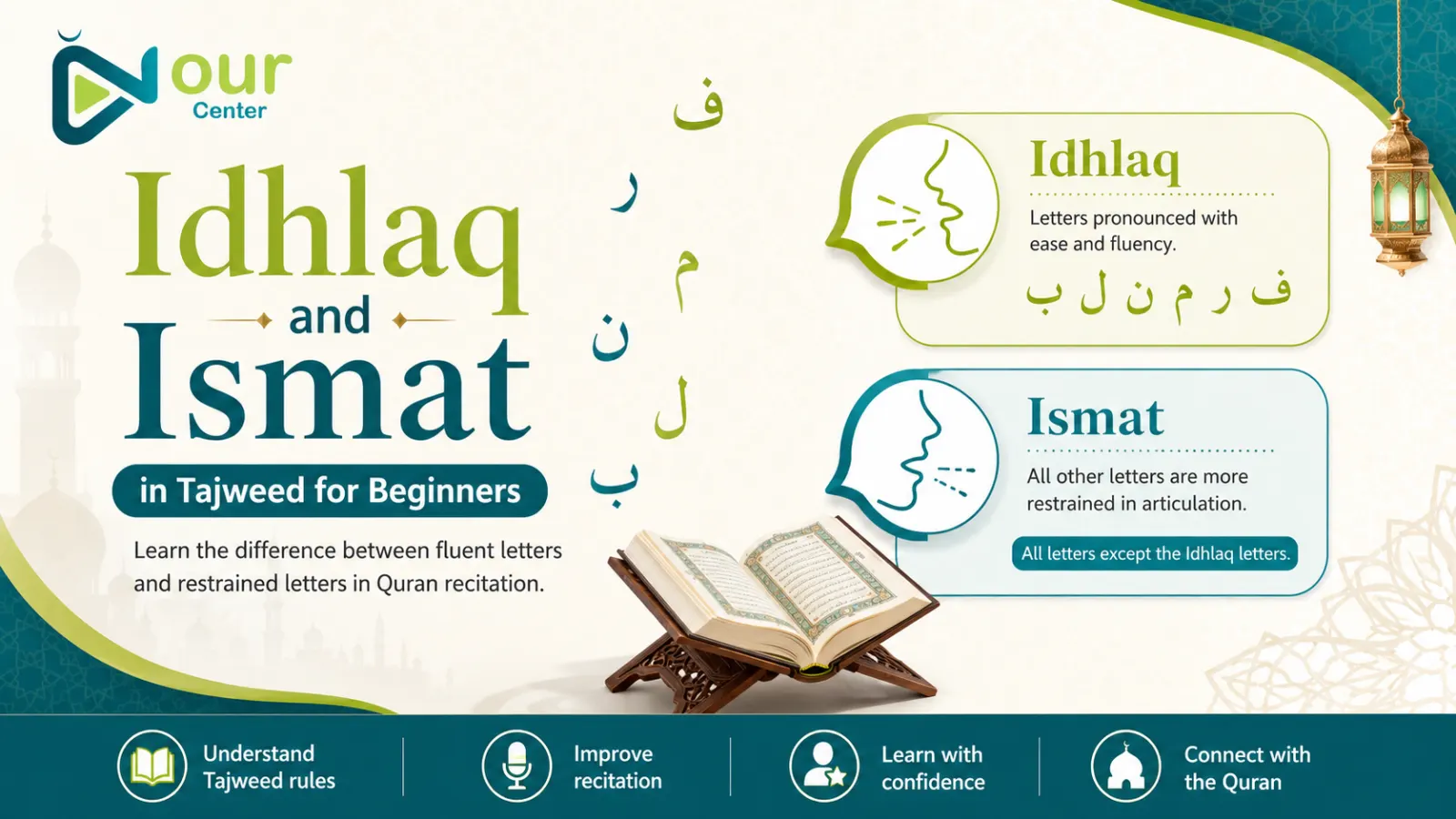
Learn Idhlaq and Ismat in Tajweed for beginners, the six Idhlaq letters, their pronunciation characteristics, the differ...
Read Article →
Learn Arabic letter sounds for beginners, discover how to pronounce all 28 Arabic letters, distinguish difficult sounds,...
Read Article →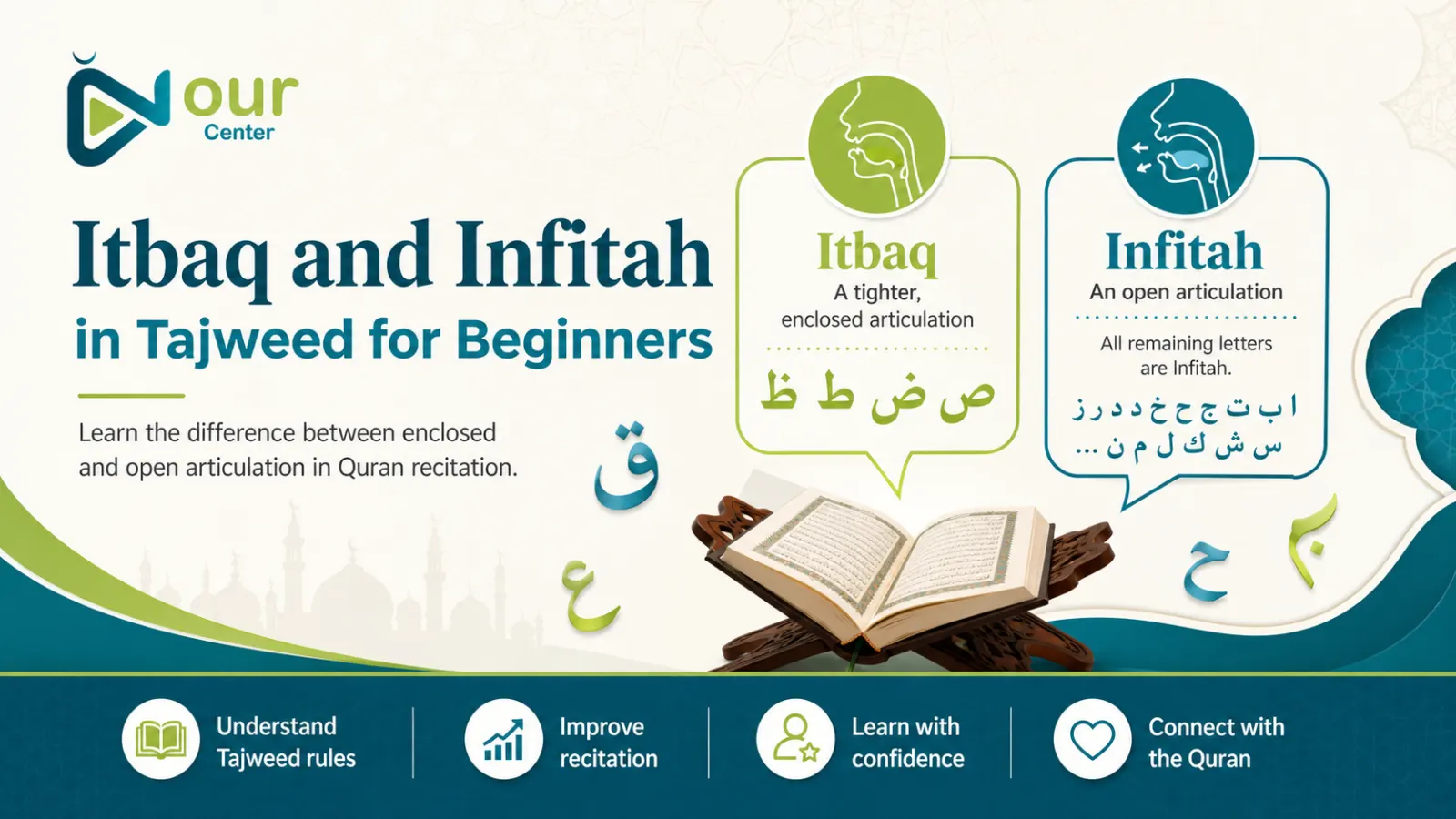
Learn Itbaq and Infitah in Tajweed for beginners, the four Itbaq letters, tongue position, heavy pronunciation, common m...
Read Article →