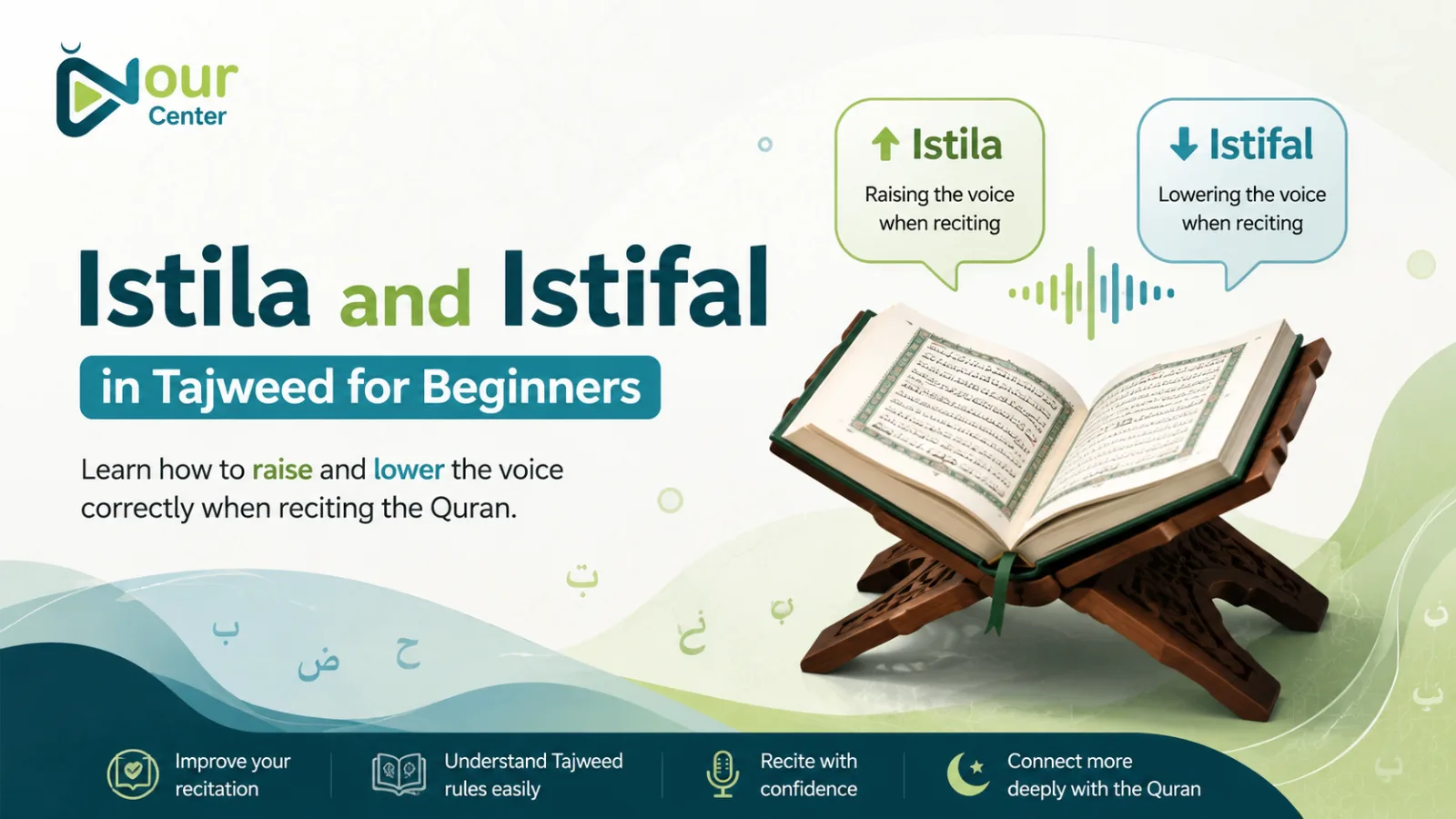
Isti'la and Istifal in Tajweed for Beginners: Understanding Heavy and Light Tongue Position
Learn Isti'la and Istifal in Tajweed for beginners, the seven elevated letters, tongue position, heavy and light pronunc...
Read Article →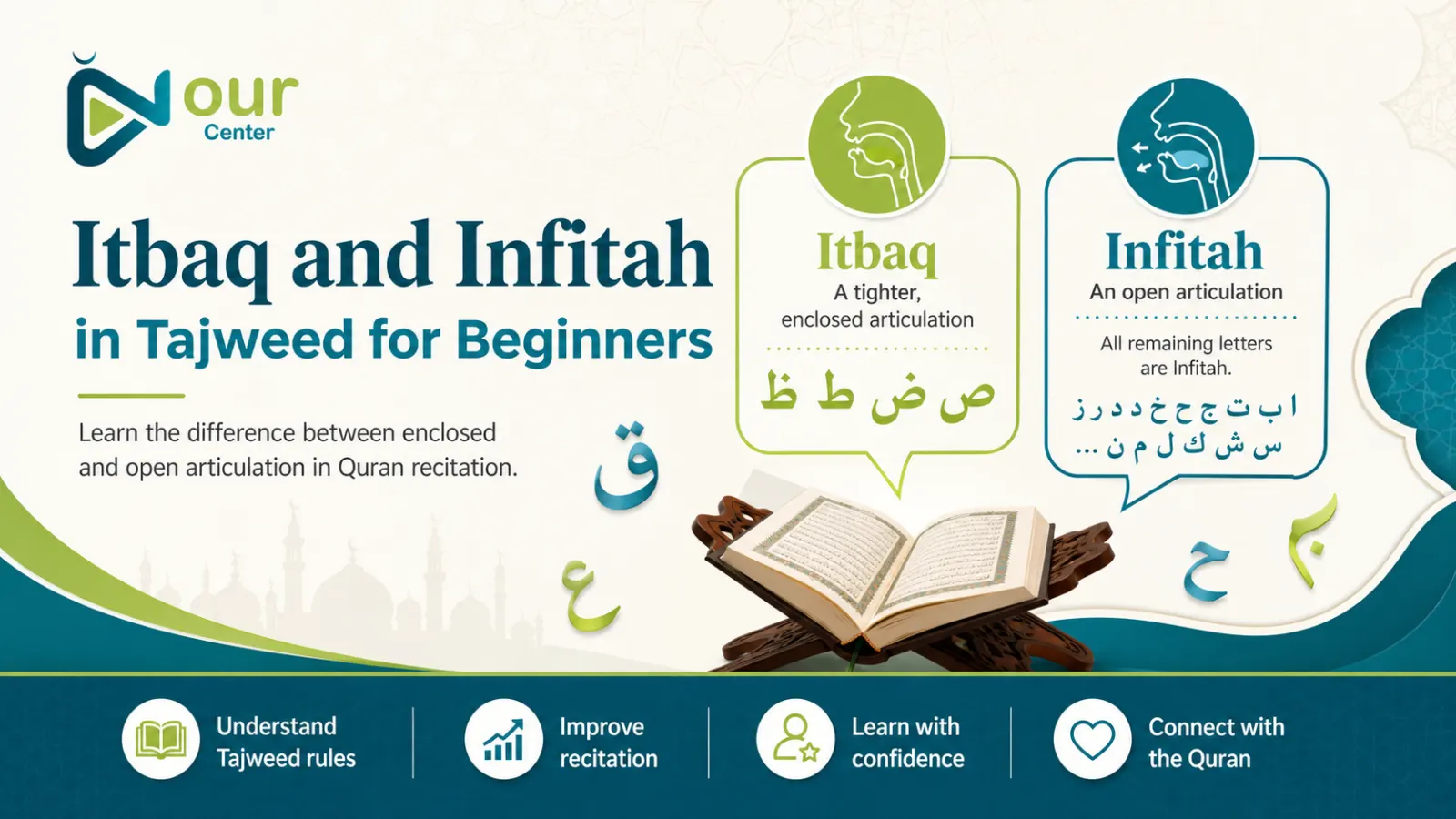
Itbaq and Infitah in Tajweed for Beginners: Understanding Tongue Contact and Openness
Itbaq and Infitah are two important characteristics of Arabic letters in Tajweed.
They help explain how the tongue relates to the upper palate while certain letters are being pronounced.
For beginners, the basic distinction is:
Itbaq = the tongue creates a stronger enclosed relationship with the upper palate.
Infitah = the tongue remains more open and separated from the upper palate.
There are only four Itbaq letters.
They are:
Sad.
Dad.
Emphatic Ta.
Emphatic Za.
The remaining Arabic letters belong to Infitah in this paired classification.
Itbaq is closely connected with heavy pronunciation because all four Itbaq letters are also Isti'la letters.
However, Itbaq and Isti'la are not exactly the same characteristic.
Understanding this difference helps beginners develop more precise pronunciation instead of simply trying to make every heavy letter sound deeper.
Students who understand Sifat al-Huruf for Beginners will find Itbaq and Infitah easier because these two qualities form another important pair of permanent Arabic letter characteristics.
This guide explains Itbaq and Infitah in Tajweed for beginners, the four Itbaq letters, tongue position, the relationship with Isti'la and Tafkhim, common pronunciation mistakes, and practical Quran exercises.
What Is Itbaq in Tajweed?
Itbaq is a permanent characteristic of four Arabic letters.
The term refers to a strong relationship between the tongue and the upper palate during pronunciation.
The tongue rises and creates a more enclosed oral space.
This contributes to the powerful, full sound of the four Itbaq letters.
For beginners, a useful memory idea is:
Itbaq = greater enclosure.
The learner should not interpret this as completely sealing the mouth.
Air and sound still move according to the Makhrij and the other characteristics of the individual letter.
What Does Itbaq Do to the Sound?
Itbaq contributes to a fuller and more compressed sound quality.
Because of the tongue position, the resonance of the mouth changes.
This helps distinguish letters such as Sad from their lighter counterparts.
The learner may hear the Itbaq letters as particularly strong heavy sounds.
However, correct Itbaq does not mean:
Speaking loudly.
Forcing the jaw.
Pulling the tongue as far back as possible.
Changing the vowel.
Extending the consonant.
The characteristic should arise naturally from correct articulation.
How Many Itbaq Letters Are There?
There are four Itbaq letters:
Sad.
Dad.
Emphatic Ta.
Emphatic Za.
In Arabic, they are:
ص
ض
ط
ظ
These four letters should be memorized as a group.
They are also all members of the seven Isti'la letters.
This relationship is important for understanding why they have especially strong heavy qualities.
Why Are the Itbaq Letters Important?
These four letters are distinctive sounds in Arabic.
Many non-Arabic speakers initially replace them with lighter sounds from their own language.
Examples include:
Sad becoming too similar to Seen.
Emphatic Ta becoming too similar to ordinary Ta.
Dad losing its distinctive articulation.
Emphatic Za becoming too light.
Correct Itbaq helps preserve the unique identity of these consonants.
Itbaq and Makharij
Itbaq cannot correct an incorrect articulation point.
A learner may make a sound very heavy but still pronounce the wrong letter.
Correct Makharij for Beginners remains essential because Itbaq only produces the intended Arabic sound when the tongue begins from the correct articulation position.
This is particularly important for Dad, which requires careful Makhrij training.
Makharij and Sifat should therefore be studied together.
Makhrij answers:
Where is the letter produced?
Sifat answers:
How does the letter behave while it is being produced?
What Is Infitah in Tajweed?
Infitah is the opposite characteristic to Itbaq.
The tongue does not create the same enclosed relationship with the upper palate.
The oral space remains comparatively more open.
For beginners:
Infitah = greater openness.
All Arabic letters other than the four Itbaq letters belong to Infitah in this classification.
This includes both light letters and some heavy letters.
That final point is extremely important.
Are All Infitah Letters Light?
No.
This is one of the most important distinctions in the topic.
Three Isti'la letters are also Infitah letters:
Kha.
Ghayn.
Qaf.
They are heavy because they have Isti'la.
But they do not have Itbaq.
Therefore:
Heavy does not automatically mean Itbaq.
All Itbaq letters are heavy.
But not all heavy letters have Itbaq.
Students who understand Isti'la and Istifal in Tajweed for Beginners will recognize this distinction because the seven Isti'la letters include four Itbaq letters and three Infitah letters.
This relationship explains why some heavy Arabic letters can sound stronger or more enclosed than others.
Itbaq vs Isti'la
Beginners often confuse these two terms because all four Itbaq letters also belong to Isti'la.
A simple distinction is:
Isti'la = elevation of the tongue.
Itbaq = stronger enclosure between the tongue and upper palate.
All four Itbaq letters have Isti'la.
But Kha, Ghayn, and Qaf have Isti'la without Itbaq.
This creates two groups within the seven heavy letters.
Group 1:
Sad.
Dad.
Emphatic Ta.
Emphatic Za.
These have:
Isti'la + Itbaq.
Group 2:
Kha.
Ghayn.
Qaf.
These have:
Isti'la + Infitah.
This comparison gives learners a more precise understanding of Tafkhim.
Itbaq and Tafkhim
Itbaq contributes strongly to Tafkhim.
The four Itbaq letters naturally have a strong heavy sound.
Understanding Heavy and Light Letters in Tajweed for Beginners helps learners hear the practical effect of Itbaq because the four Itbaq letters belong to the strongest group of heavy Arabic consonants.
However, Tafkhim is the resulting heavy pronunciation quality.
Itbaq is one of the permanent characteristics contributing to that sound.
The terms should therefore not be treated as exact synonyms.
Itbaq in Sad
Sad is an excellent letter for hearing Itbaq.
The tongue position creates a fuller sound than Seen.
Compare:
Sad.
Seen.
The contrast should be clear.
If Sad becomes too light, it may resemble Seen.
If the learner exaggerates Itbaq, the vowel may also become distorted.
The goal is a full consonant with an accurate vowel.
Sad vs Seen
This comparison is especially useful for beginners.
Seen is an Infitah letter and is generally light.
Sad has both Isti'la and Itbaq.
The difference should not be created by shouting Sad.
Instead, notice:
Tongue position.
Oral resonance.
Heavy sound quality.
Correct Makhrij.
Practice both letters at the same volume.
This reveals the true pronunciation difference.
Itbaq in Dad
Dad is one of the most distinctive Arabic consonants.
It combines a special articulation point with strong heavy characteristics.
Itbaq contributes to its full sound.
However, students should never try to learn Dad through heaviness alone.
An incorrect Makhrij cannot be fixed by making the sound deeper.
The side of the tongue and the appropriate upper molar area play an important role in correct Dad articulation.
Once the Makhrij is established, Itbaq and the other characteristics refine the sound.
Why Dad Is Difficult for Beginners
Many languages do not have an equivalent sound.
Learners may replace Dad with:
A heavy Dal.
An ordinary Dal.
An English-style D.
Another emphatic consonant.
This is why teacher correction is particularly useful.
The student needs to coordinate:
Makhrij.
Isti'la.
Itbaq.
Jahr.
Rikhwah.
Istitalah.
Other relevant characteristics.
Dad is a good example of how multiple Sifat combine in one consonant.
Itbaq in Emphatic Ta
Emphatic Ta should sound clearly different from ordinary Ta.
The emphatic letter has both Isti'la and Itbaq.
Ordinary Ta does not.
Compare:
Heavy emphatic Ta.
Light Ta.
The learner should notice a clear difference in tongue position and resonance.
Do not simply increase volume.
Do not lengthen the heavy letter.
Correct pronunciation should remain concise and controlled.
Emphatic Ta and Qalqalah
Emphatic Ta is also one of the Qalqalah letters.
When Sukoon applies, the learner must preserve:
Its heavy quality.
Its Itbaq.
Its correct Makhrij.
Its Qalqalah release.
This shows that several Tajweed characteristics can operate simultaneously.
One rule does not cancel another.
Itbaq in Emphatic Za
Emphatic Za also has a full and enclosed sound quality.
Learners may accidentally replace it with a lighter consonant because its articulation is unfamiliar.
The correct sound needs:
Proper tongue placement.
Isti'la.
Itbaq.
Accurate vowel pronunciation.
The learner should practice slowly and compare with a qualified teacher.
Why Itbaq Letters Sound Particularly Heavy
All four Itbaq letters combine two important characteristics:
Isti'la.
Itbaq.
The tongue rises and the oral space becomes more enclosed.
This combination increases the sense of fullness in the sound.
That is why these four letters are particularly important when learning Tafkhim.
The learner should still avoid exaggeration.
Strong does not mean artificial.
The Role of the Tongue
The tongue is central to Itbaq.
Beginners sometimes try to create heavy pronunciation by tightening the throat instead.
That is not the correct approach.
The learner should focus on:
Correct Makhrij.
Natural tongue elevation.
Appropriate enclosure.
Relaxed jaw.
Accurate vowel.
The mouth should not become tense.
Itbaq and Vowels
The Itbaq characteristic remains part of the letter regardless of whether it carries:
Fathah.
Dammah.
Kasrah.
Sukoon.
However, the perceived degree of heaviness can differ according to the vowel.
Beginners should first focus on preserving the basic identity of the consonant.
Advanced study can refine the levels of Tafkhim later.
Itbaq With Fathah
Fathah can make the heavy quality easy to hear.
However, beginners often exaggerate the vowel.
The Fathah should not become an overly broad sound.
Maintain:
Correct Fathah.
Correct heavy consonant.
Correct Itbaq.
Itbaq With Dammah
Dammah requires lip rounding.
Do not let the combination of lip rounding and heavy consonant create unnecessary tension.
The lips handle the vowel.
The tongue maintains the consonant characteristics.
Both should remain controlled.
Itbaq With Kasrah
Kasrah is often the most challenging vowel for heavy letters.
The learner may lighten the consonant too much because Kasrah naturally has a fronted quality.
But the Itbaq letter still retains its permanent characteristics.
Do not lose:
Isti'la.
Itbaq.
Correct Makhrij.
At the same time, do not distort the Kasrah in order to maintain heaviness.
Itbaq With Sukoon
Sukoon can make the permanent characteristics easier to study because there is no following short vowel.
The learner can focus directly on the consonant.
However, avoid:
Adding a vowel.
Holding the consonant too long.
Creating false Qalqalah on Sad, Dad, or emphatic Za.
Only the designated Qalqalah letters receive Qalqalah.
Emphatic Ta has Qalqalah when its conditions apply.
What Is Infitah in Practice?
In an Infitah letter, the tongue does not create the same enclosed oral relationship found in Itbaq.
This allows a more open configuration.
Most Arabic letters belong to this category.
The student does not need to memorize twenty-five letters individually at first.
Memorize the four Itbaq letters.
Then remember:
Everything else = Infitah.
This is much easier.
Infitah Does Not Mean Lightness
This point deserves repetition.
Kha, Ghayn, and Qaf have Infitah but remain heavy because they have Isti'la.
Therefore, a learner should never use this formula:
Infitah = light.
That would be incorrect.
Instead:
Infitah = the opposite of Itbaq in tongue-palate relationship.
Istifal is the characteristic more directly associated with the lower tongue position found in most light letters.
Different Sifat answer different pronunciation questions.
Why Qaf Is an Important Example
Qaf is heavy.
It has Isti'la.
But it does not have Itbaq.
It belongs to Infitah.
This makes Qaf a valuable comparison with emphatic Ta.
Both are heavy.
But their combinations of characteristics differ.
Qaf:
Isti'la + Infitah.
Emphatic Ta:
Isti'la + Itbaq.
The learner can hear that not every heavy consonant has exactly the same sound quality.
Why Kha and Ghayn Matter
Kha and Ghayn provide the same lesson.
They are heavy Isti'la letters.
But they belong to Infitah.
The mouth does not use the same enclosed tongue-palate relationship as the four Itbaq letters.
This explains part of the difference in resonance among heavy letters.
Itbaq and Hams
Some Itbaq letters also have Hams.
Sad and emphatic Ta are examples.
This teaches an important principle:
Breath characteristics and tongue characteristics can combine independently.
Sad has:
Hams.
Isti'la.
Itbaq.
Rikhwah.
Other qualities.
Emphatic Ta has:
Hams.
Isti'la.
Itbaq.
Shiddah.
Qalqalah under Sukoon conditions.
Every consonant is a combination.
Itbaq and Jahr
Dad and emphatic Za belong to Jahr.
Again, they still share Itbaq with Sad and emphatic Ta.
This means that all four Itbaq letters share one characteristic while differing in others.
The learner should never assume they should all sound identical.
Itbaq and Shiddah, Tawassut, and Rikhwah
Sound flow also varies among these letters.
Students who understand Shiddah, Tawassut, and Rikhwah in Tajweed for Beginners should remember that Itbaq describes tongue-palate enclosure, while Shiddah and Rikhwah describe how sound is restrained or allowed to flow.
For example:
Emphatic Ta has Shiddah.
Sad has Rikhwah.
Both still have Itbaq.
Different Sifat can therefore coexist.
Common Mistake 1: Making Every Heavy Letter an Itbaq Letter
This is incorrect.
There are seven Isti'la letters but only four Itbaq letters.
Kha, Ghayn, and Qaf are heavy but have Infitah.
Memorize the four Itbaq letters separately.
Common Mistake 2: Making Itbaq Letters Too Light
This is particularly common with learners whose native language lacks emphatic consonants.
Sad may resemble Seen.
Emphatic Ta may resemble Ta.
The solution is not merely speaking louder.
Correct the tongue position.
Common Mistake 3: Exaggerating the Enclosure
Some learners press the tongue too strongly toward the palate.
This can:
Distort the vowel.
Create tension.
Slow the recitation.
Make the sound artificial.
Correct Itbaq should remain natural.
Common Mistake 4: Pulling the Entire Tongue Back
Itbaq does not mean dragging the whole tongue backward.
The movement follows the Makhrij and natural characteristics of the specific consonant.
Teacher feedback helps identify unnecessary tongue tension.
Common Mistake 5: Using the Throat to Create Heaviness
A learner may tighten the throat because they associate deep sound with heavy pronunciation.
This is not a substitute for Itbaq.
Use the correct tongue position.
Do not force the throat.
Common Mistake 6: Distorting Fathah
A learner may pronounce a heavy Fathah too broadly.
The vowel should remain accurate.
The consonant carries the heavy characteristics.
Do not change one vowel into another sound.
Common Mistake 7: Losing Heaviness With Kasrah
Kasrah can tempt learners to lighten an Itbaq letter too much.
The consonant still needs its permanent characteristics.
Keep the Kasrah accurate while preserving the letter.
Common Mistake 8: Making Infitah Letters Weak
Infitah means openness.
It does not mean weak pronunciation.
Qaf, for example, has Infitah but remains a strong heavy letter.
Every consonant should retain its correct identity.
Common Mistake 9: Confusing Infitah With Istifal
The words may both seem connected with openness or lowering.
But they describe different characteristics.
Istifal concerns tongue elevation versus lowering.
Infitah concerns enclosure versus openness between the tongue and palate.
Learning the definitions separately prevents confusion.
Common Mistake 10: Memorizing Without Listening
Knowing that ص ض ط ظ are the four Itbaq letters is useful.
But Tajweed is an oral science.
The learner must hear and produce the difference.
Use Quran words and teacher demonstration.
How to Memorize the Four Itbaq Letters
The group is small:
Sad.
Dad.
Emphatic Ta.
Emphatic Za.
Review them together every day.
You can also remember that they are four of the seven Isti'la letters.
Then separate the other three Isti'la letters:
Kha.
Ghayn.
Qaf.
This creates a useful chart:
Isti'la + Itbaq:
Sad, Dad, emphatic Ta, emphatic Za.
Isti'la + Infitah:
Kha, Ghayn, Qaf.
That single comparison teaches two topics at once.
A Simple Itbaq Exercise
Practice:
Sad.
Dad.
Emphatic Ta.
Emphatic Za.
Use each with:
Fathah.
Dammah.
Kasrah.
Sukoon.
Listen for the full enclosed quality.
Do not exaggerate.
A Heavy Letter Comparison Exercise
Compare:
Sad and Kha.
Emphatic Ta and Qaf.
All four are heavy examples across the exercise.
But one letter has Itbaq while the other has Infitah.
This helps the learner hear that heavy sounds can have different internal qualities.
A Light vs Itbaq Exercise
Compare:
Sad and Seen.
Emphatic Ta and Ta.
Listen carefully.
Then repeat.
Do not simply increase volume for the heavy letter.
Try to reproduce the correct tongue position.
A 5-Minute Practice Routine
Minute 1:
Review the four Itbaq letters.
Minute 2:
Practice them with Fathah.
Minute 3:
Practice them with Dammah and Kasrah.
Minute 4:
Compare Itbaq and Infitah heavy letters.
Minute 5:
Read a short Quran phrase containing the four letters.
A 10-Minute Practice Routine
Minutes 1–2:
Review Itbaq and Infitah definitions.
Minutes 3–4:
Practice Sad and Dad.
Minutes 5–6:
Practice emphatic Ta and emphatic Za.
Minutes 7–8:
Compare the four Itbaq letters with Kha, Ghayn, and Qaf.
Minute 9:
Record yourself.
Minute 10:
Repeat corrected Quran examples.
A 7-Day Learning Plan
Day 1: Understand Itbaq
Learn the idea of tongue-palate enclosure.
Day 2: Memorize the Four Letters
Practice Sad, Dad, emphatic Ta, and emphatic Za.
Day 3: Compare With Infitah Heavy Letters
Practice Kha, Ghayn, and Qaf.
Day 4: Practice With Vowels
Use Fathah, Dammah, Kasrah, and Sukoon.
Day 5: Heavy and Light Comparisons
Practice Sad vs Seen and emphatic Ta vs Ta.
Day 6: Combine With Other Sifat
Notice Hams, Jahr, Shiddah, Rikhwah, and Qalqalah where relevant.
Day 7: Quran Reading Assessment
Read a short passage while the teacher checks tongue position, Makharij, Tafkhim, and vowel quality.
Itbaq and Infitah for Kids
Children can learn the topic with simple language.
For example:
Four letters have a more closed heavy mouth shape.
Most other letters are more open.
The teacher can show:
Sad.
Seen.
Then let the child hear the difference.
Technical terms can be introduced after the sound becomes familiar.
Should Children Memorize the Four Letters?
Yes.
Because there are only four, the group is manageable.
However, pronunciation should accompany memorization.
The child should learn:
The name.
The sound.
The tongue position.
A Quran example.
This produces better long-term understanding.
Itbaq and Infitah for Adult Beginners
Adults often understand the classification quickly.
Their challenge is usually pronunciation.
Common issues include:
Replacing emphatic consonants.
Overusing throat tension.
Distorting vowels.
Making every heavy letter sound identical.
Comparison exercises are especially useful.
Can Itbaq Be Learned Without a Teacher?
The four-letter list can easily be memorized independently.
Reliable audio also helps.
However, it can be difficult to judge:
How much enclosure is correct.
Whether the tongue is too tense.
Whether the vowel has changed.
Whether the Makhrij is correct.
Whether Sad sounds too close to Seen.
Teacher correction can greatly accelerate improvement.
Why Recording Yourself Helps
Record:
Sad.
Seen.
Emphatic Ta.
Ta.
Qaf.
Then listen.
Ask:
Is Sad clearly different from Seen?
Is emphatic Ta clearly different from Ta?
Does Qaf remain heavy without sounding like an Itbaq letter?
Did I distort the vowels?
Did I exaggerate the mouth movement?
Compare with a reliable teacher model.
Using a Mushaf for Itbaq Practice
Choose a short passage.
Find:
Sad.
Dad.
Emphatic Ta.
Emphatic Za.
Read the words slowly.
Then identify heavy letters such as Qaf, Kha, or Ghayn.
Ask:
Is this Itbaq?
Or is it Isti'la with Infitah?
This turns theoretical classification into real Quran reading.
How Nour Center Teaches Itbaq and Infitah
At Nour Center, live one-to-one Tajweed lessons can teach Itbaq and Infitah through direct comparison and Quran application.
A teacher can assess:
Makharij.
Tongue position.
Isti'la.
Istifal.
Itbaq.
Infitah.
Tafkhim.
Vowel accuracy.
Other Sifat.
The student can then compare letters that sound close and receive immediate correction.
This is especially useful for learners who cannot easily hear whether their emphatic consonants are heavy enough or are being exaggerated.
How to Know Your Itbaq Is Improving
You are improving when:
You instantly recognize the four Itbaq letters.
Sad remains clearly different from Seen.
Emphatic Ta remains clearly different from Ta.
Dad becomes more stable.
Emphatic Za retains its heavy quality.
The tongue position feels controlled rather than forced.
Vowels remain accurate.
You understand that Qaf, Kha, and Ghayn are heavy but have Infitah.
You stop treating all heavy letters as identical.
Your teacher corrects fewer emphatic-letter errors.
How to Know Your Infitah Understanding Is Improving
You understand Infitah better when:
You know it includes most Arabic letters.
You know Infitah does not automatically mean light.
You recognize Qaf, Kha, and Ghayn as Isti'la + Infitah.
You separate Infitah from Istifal.
You can classify heavy letters more accurately.
The goal is not simply to memorize terminology.
The goal is clearer Quran pronunciation.
What Should You Study After Itbaq and Infitah?
After Itbaq and Infitah, the next paired characteristic traditionally studied is Idhlaq and Ismat.
These characteristics divide Arabic letters according to another aspect of their pronunciation and traditional classification.
After completing the major paired Sifat, learners can move toward individual characteristics such as:
Safeer.
Qalqalah.
Leen.
Inhiraf.
Takrir.
Tafashshi.
Istitalah.
These topics provide an increasingly detailed understanding of Arabic pronunciation.
Final Thoughts
Itbaq and Infitah in Tajweed for Beginners help explain why Arabic consonants differ in tongue position and resonance.
Remember:
Itbaq = stronger enclosure between the tongue and upper palate.
Infitah = greater openness.
There are four Itbaq letters:
Sad.
Dad.
Emphatic Ta.
Emphatic Za.
All four are also Isti'la letters.
But not every Isti'la letter has Itbaq.
Kha, Ghayn, and Qaf are:
Isti'la + Infitah.
This means:
All Itbaq letters are heavy.
But not all heavy letters are Itbaq letters.
Do not confuse Itbaq with loudness.
Do not force the tongue.
Do not distort vowels.
Do not make every Infitah letter light automatically.
Correct Makharij, tongue position, and the other Sifat must work together.
With regular listening, comparison exercises, Quran practice, recording, and qualified teacher correction, Itbaq and Infitah become natural parts of accurate Arabic pronunciation.
Note: Comments may require approval before appearing publicly.
Learn Isti'la and Istifal in Tajweed for beginners, the seven elevated letters, tongue position, heavy and light pronunc...
Read Article →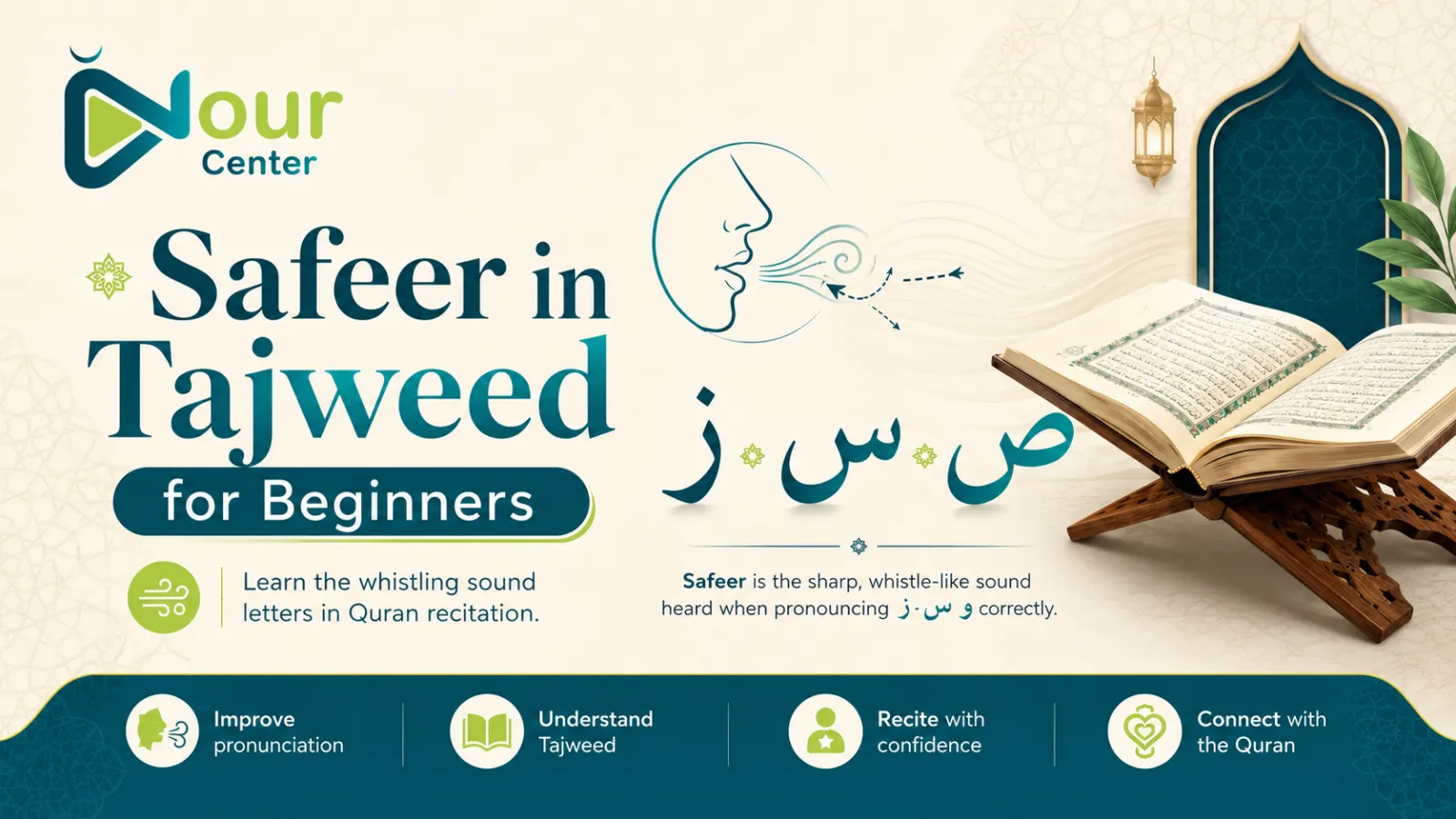
Learn Safeer in Tajweed for beginners, the three Safeer letters, how the whistling sound is produced, common pronunciati...
Read Article →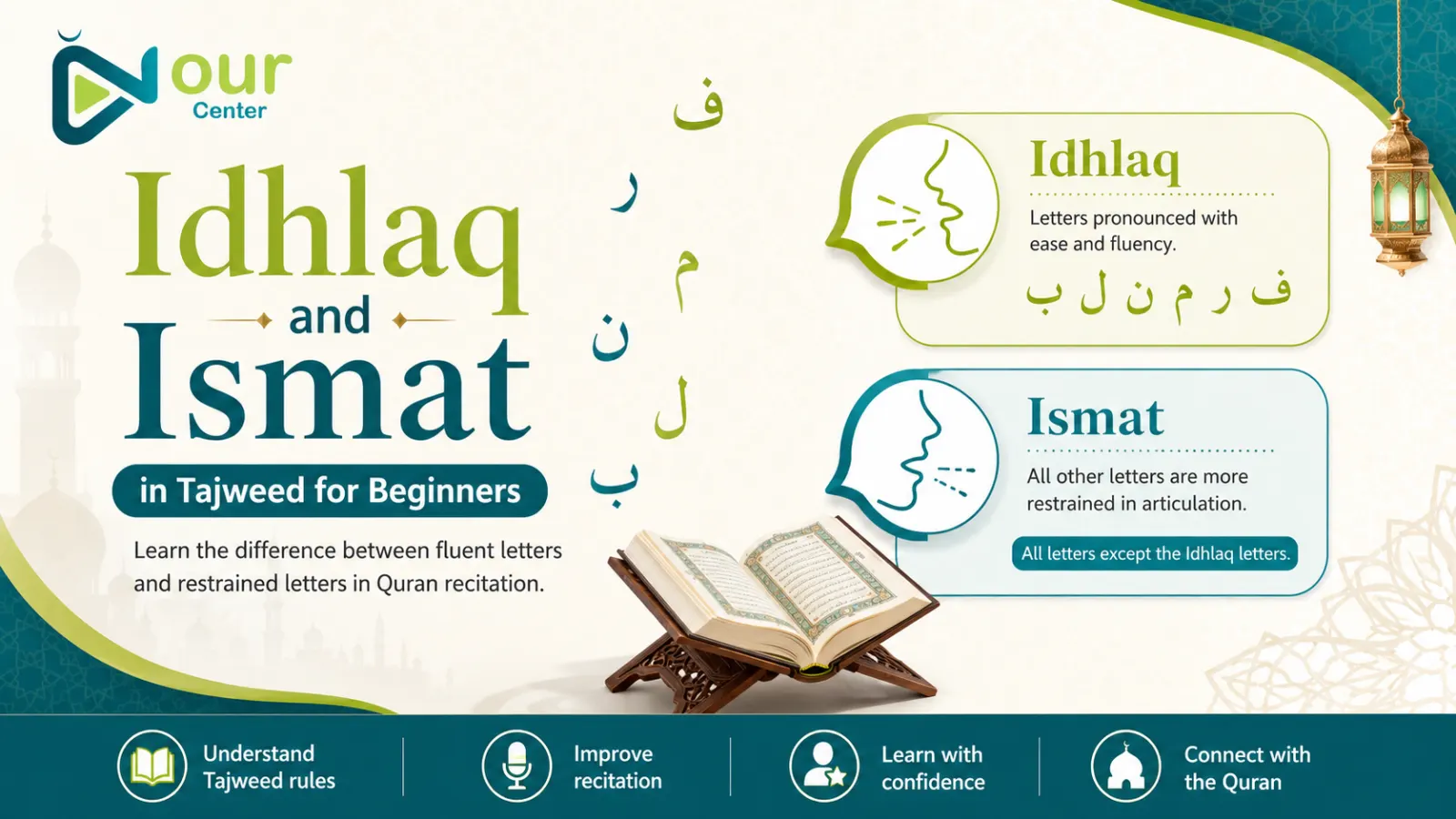
Learn Idhlaq and Ismat in Tajweed for beginners, the six Idhlaq letters, their pronunciation characteristics, the differ...
Read Article →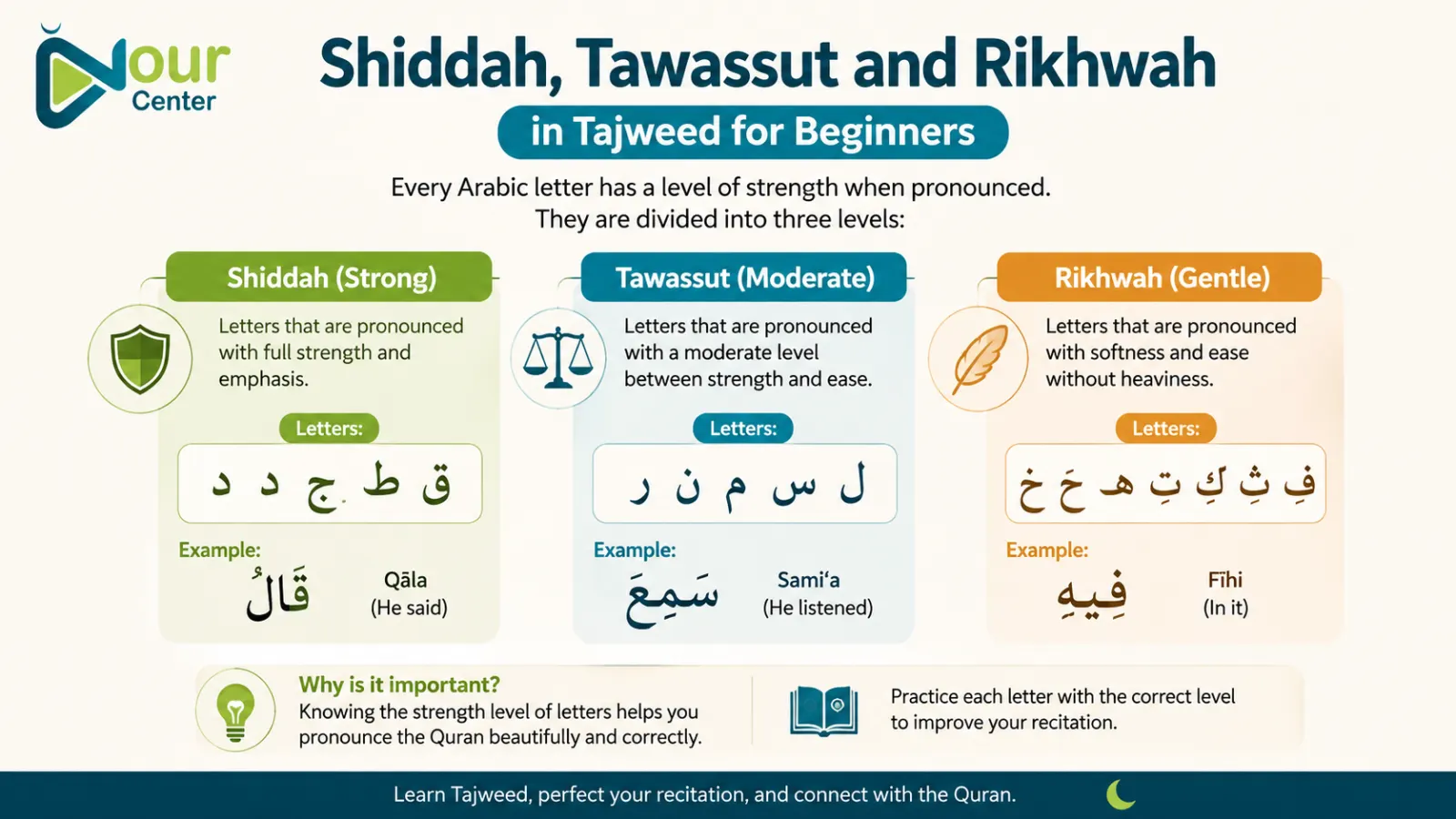
Learn Shiddah, Tawassut, and Rikhwah in Tajweed for beginners, how sound stops or flows through Arabic letters, common m...
Read Article →