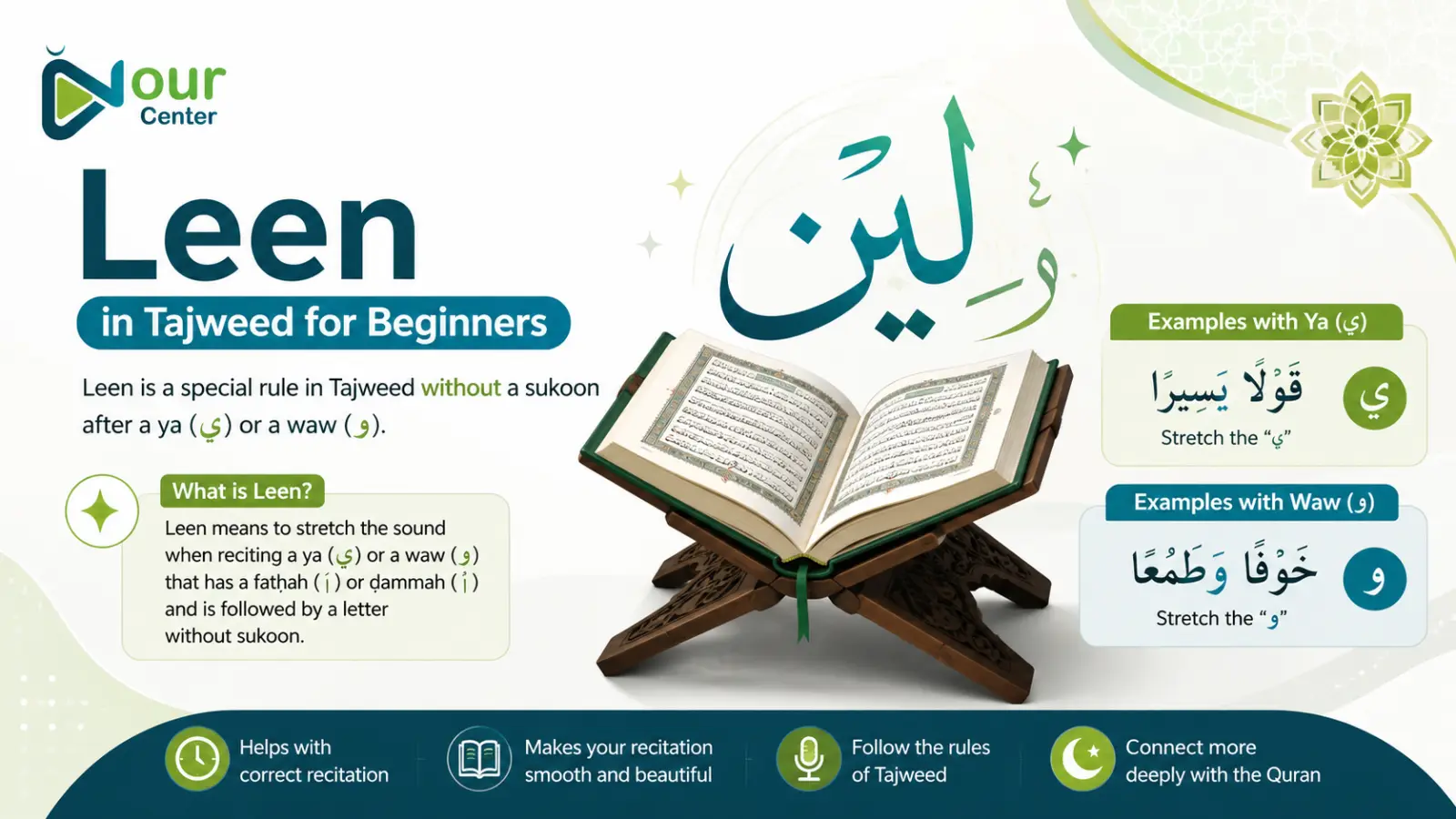
Leen in Tajweed for Beginners: Understanding the Soft Waw and Ya Sounds
Learn Leen in Tajweed for beginners, the conditions of Waw and Ya Leen, the difference between Leen and Madd, stopping r...
Read Article →
A Simple Guide to Lengthening in Tajweed
Madd rules for beginners explain when certain vowel sounds in Quran recitation should be lengthened and how long they should be held. For many new Tajweed students, Madd is one of the easiest rules to notice by ear. A teacher recites a word, and the learner immediately hears that one vowel lasts longer than an ordinary short vowel. The basic idea is simple. The challenge is consistency.
Beginners may shorten a sound that should be lengthened, stretch a sound too much, change the vowel quality while holding it, or use the same length for every type of Madd.
Learning Madd step by step helps the reader develop smoother Quran recitation and more accurate control of long vowels. This guide explains what Madd means, the main Madd letters, natural Madd, beginner categories of extended Madd, common mistakes, stopping rules, practice methods, and how to improve vowel length without exaggeration. What Is Madd in Tajweed? Madd means lengthening a vowel sound during Quran recitation according to specific Tajweed conditions.
It does not mean singing freely or extending a sound whenever the reader wants.
The lengthening happens because certain Arabic letters and recitation patterns require it.
A short vowel. A naturally long vowel. A longer Madd caused by another recitation condition. Once this distinction becomes clear, more detailed Madd categories become easier to understand.
Correct Madd helps preserve accurate Quran pronunciation. If a long vowel is shortened, the word may sound noticeably different. If a short vowel is stretched unnecessarily, the recitation can also become inaccurate.
Correct vowel length. Smooth recitation. Consistent Tajweed. Clear Arabic pronunciation. Better listening awareness. More controlled pacing. A learner who understands Madd also becomes more attentive to the written signs and letter patterns inside Quran words.
Alif. Waw. Ya. But the letter alone is not enough. The correct vowel pattern before the Madd letter matters. A beginner should learn these combinations carefully. Alif is associated with a preceding Fathah. Waw is associated with a preceding Dammah. Ya is associated with a preceding Kasrah. These combinations produce natural long vowel sounds.
When Alif follows a letter carrying Fathah in the correct long-vowel pattern, the sound is extended naturally.
Cutting the sound too short. Opening the mouth excessively. Changing the vowel into another sound. Stretching far longer than required. The teacher can model the vowel clearly, and the student can repeat until the length becomes stable.
Waw acts as a Madd letter when it appears in the appropriate pattern after Dammah. The lips usually take on a rounded shape. Beginners sometimes turn the long vowel into a stronger consonant-like Waw. This should be avoided. The sound needs to flow as a long vowel.
Ya acts as a Madd letter when it follows Kasrah in the relevant long-vowel pattern. Beginners may accidentally turn the sound into an obvious consonant Ya rather than maintaining the long vowel.
Long vowel Ya. Consonant Ya. That distinction is important throughout Quran reading. What Is Madd Asli? Madd Asli, also called natural Madd, is the basic form of lengthening. It is the foundation of the Madd system. For beginners, this is usually the first Madd type to master. The sound is held for a natural two-count length. This count is not meant to become a mechanical ticking exercise forever.
It is a teaching method that helps learners develop consistent timing.
Once the correct sound becomes natural, the reader no longer needs to consciously count every occurrence.
More advanced Madd categories build on the idea of controlled vowel length. If a learner cannot maintain a simple two-count Madd consistently, learning longer categories can become confusing.
Recognizing the Madd letter. Recognizing the vowel before it. Producing a clean long vowel. Holding it consistently. Continuing smoothly into the next sound. A strong foundation in Basic Tajweed Rules makes Madd easier to understand because the learner already recognizes Harakat, Sukoon, Shaddah, Makharij, and basic recitation patterns. How Long Is Natural Madd? Natural Madd is commonly taught as two counts. A count is not necessarily one exact clock second.
The important point is proportion and consistency. The teacher may demonstrate a steady pulse. The learner repeats the sound using the same timing. Over time, the student develops an internal sense of the correct duration.
One natural Madd is very short. The next is much longer. Another is exaggerated. Consistency is more important than dramatic sound.
Some beginners imitate melodic Quran recitation and assume every beautiful stretched sound is simply Madd. Melody and Tajweed are not the same thing. A reciter may use a pleasant voice while still following precise rules. The Madd length must remain tied to the Tajweed condition. The learner should therefore study the rule first and style second. Beautiful recitation should be built on correct pronunciation.
Short vowels are not Madd. Fathah. Kasrah. Dammah. These are short vowel sounds. Madd extends the appropriate vowel when the necessary Madd letter and pattern appear. A beginner who confuses short and long vowels may read Arabic words inaccurately even before advanced Tajweed is involved.
Short Fathah vs long Alif. Short Dammah vs long Waw. Short Kasrah vs long Ya. This contrast strengthens reading accuracy.
Use pairs. The teacher reads a short vowel. Then the long version. The student listens. Repeats both. Then identifies which sound is longer. After that, use simple Arabic words. Finally, read Quranic examples. This sequence connects visual recognition with sound.
Shortening Long Vowels
This is one of the most common beginner mistakes. The learner sees a Madd pattern but reads it like a short vowel.
Rushing. Weak Arabic reading. Poor recognition. Memorized pronunciation habits. Lack of listening practice. The solution is slow controlled reading. Do not simply say “make it longer.” Show the contrast between the incorrect short version and the correct long version.
Stretching Short Vowels
The opposite mistake also occurs. A student may stretch Fathah, Kasrah, or Dammah even when there is no Madd. This can happen when learners try to make their recitation sound more melodic.
Tajweed-required lengthening. Optional vocal style. A beginner should prioritize the first.
A student may correctly identify Madd but use inconsistent timing.
One occurrence lasts two counts. Another lasts nearly four. Another is extremely short. The learner needs rhythm practice. Reading several similar examples in sequence can help create consistency.
Changing the Vowel While Lengthening
When learners hold a vowel longer, the sound may drift. An Alif sound may become too wide. A Waw sound may change shape. A Ya sound may turn into a consonant-like sound. The goal is to extend the same vowel quality, not change it during the extension. Slow listening practice helps.
Adding an Extra Sound
Beginners sometimes finish the Madd with an unnecessary consonant-like movement. For example, a long Waw may end with an extra obvious Waw consonant. A long Ya may develop an added glide. The vowel should remain smooth. The next sound should begin only when the Madd is complete.
Makharij focuses on where Arabic consonants are articulated. Madd mainly involves vowel length. Even though these are different skills, they work together during Quran recitation. Correct Makharij for Beginners helps the learner enter and leave Madd sounds cleanly because the surrounding consonants remain clear and accurate. If the letter before or after the Madd is weak, the entire word may sound unclear. What Is Madd Far'i?
Madd Far'i refers broadly to extended forms of Madd that occur because of an additional condition beyond the basic natural Madd.
For beginners, there is no need to memorize every detailed subcategory immediately.
Natural Madd is the foundation. Some situations require longer extension. The exact amount depends on the specific rule. Teacher guidance helps the learner identify which category applies. As the student progresses, each type can be studied separately.
Madd Muttasil occurs when a Madd letter is followed by Hamzah within the same word. This creates a stronger lengthening condition than ordinary natural Madd. A beginner should first learn to recognize the pattern visually. Then listen to the teacher demonstrate the required length according to the recitation method being taught. The important point is consistency. Do not use one length in one verse and a completely different length in another identical condition.
A valid Madd letter. Followed by Hamzah. Inside the same word. Then apply the length taught by the teacher. At the beginner stage, recognition matters as much as memorizing the technical name.
Madd Munfasil occurs when a Madd letter appears at the end of one word and Hamzah begins the following word. Unlike Madd Muttasil, the Madd and Hamzah are separated across two words. This makes the visual pattern easier to understand when the learner compares both types side by side. Muttasil:Same word. Munfasil:Two separate words. The exact length depends on the recitation method being followed.
Beginners should follow one consistent teacher rather than mixing different timings from multiple sources.
The difference is mainly structural. Madd Muttasil:The Madd letter and Hamzah are in the same word. Madd Munfasil:The Madd letter is at the end of one word and Hamzah begins the next. Both involve more than ordinary natural Madd. For a beginner, do not overcomplicate the distinction. First identify where the Hamzah appears. Then follow the teacher's demonstrated length.
Madd Arid Lissukoon occurs when stopping causes a temporary Sukoon after a Madd letter. This is an important rule because the pronunciation changes depending on whether the reader continues or stops. While continuing, the word may not use the same extended length. When stopping, the final sound changes because of the temporary Sukoon. This teaches beginners that Waqf affects Tajweed.
A word may not always sound exactly the same when stopping as it does when continuing.
Read the word while continuing. Then read the same word and stop. Listen to the difference. The teacher can demonstrate the available valid lengths according to the recitation method being taught. The learner should practice stopping deliberately rather than only when running out of breath.
Leen refers to a soft sound involving Waw or Ya in specific conditions. It becomes especially noticeable when stopping creates Sukoon after the Leen letter. Beginners sometimes confuse Madd Leen with ordinary Madd. The main difference is in the vowel pattern before Waw or Ya. A qualified teacher can demonstrate the difference much more clearly than a written description alone.
Recognize the pattern. Hear the soft sound. Practice it while stopping. Avoid forcing or exaggerating the extension.
An Introduction
Madd Lazim is a stronger and more fixed type of lengthening. It involves a Madd letter followed by a permanent Sukoon or a structure that creates the relevant condition. Beginners do not need to begin with all its detailed subtypes. The important introduction is that some Madd conditions require a longer fixed extension and should not be shortened to natural Madd.
Once the learner has strong control of simpler categories, Madd Lazim can be studied in detail.
There are many Madd categories. Trying to memorize all of them in one lesson can create confusion.
Natural Madd. Short vs long vowel distinction. Madd with Hamzah. Madd when stopping. Leen. More advanced fixed categories. This allows each rule to build on previous understanding. A structured Tajweed for Kids program should introduce Madd gradually through listening and Quran examples rather than asking children to memorize every category before they can apply the basic sound.
Children often understand lengthening quickly when it is demonstrated clearly.
Short sound. Long sound. Hold this one. Stop here. Listen again. Repeat. Technical names can be introduced gradually. A young child may perform natural Madd correctly before they are ready to explain what Madd Asli means. This is perfectly acceptable. Practical recitation can come before formal terminology.
Use short examples. Avoid starting with a long chart.
One short vowel. One long vowel. Teacher comparison. Child repetition. A Quran word containing natural Madd. A second example. A short Surah containing several Madd sounds. The child hears the pattern repeatedly. Then the name of the rule can be added.
Familiar Surahs are excellent practice material. Because the learner already knows the wording, more attention can be given to vowel length. Choose one short Surah. Read slowly. Identify the Madd sounds. Listen to the teacher. Repeat. Then read the entire Surah naturally. The learner should avoid stopping after every Madd just to demonstrate the rule. The final goal is smooth recitation.
Many Common Quran Reading Mistakes include shortening Madd, stretching the wrong vowel, or making the length inconsistent from one occurrence to another.
Using a familiar passage makes these errors easier to isolate.
Madd should be corrected before a learner repeats a verse many times for Hifz. If the student memorizes a Surah with incorrect vowel length, the mistake may become strongly attached to the memorized recitation.
Pronunciation. Madd. Major Tajweed errors. Then the learner can repeat extensively. This makes repetition work in favor of accurate recitation.
What Is the Difference?
Madd and Qalqalah affect completely different parts of recitation. Madd:Lengthens a vowel. Qalqalah:Creates a controlled release of certain consonants in a Sukoon condition. Beginners sometimes make Qalqalah too long as if it were Madd. That is incorrect. Qalqalah is not stretched. Madd is. A learner who has already studied What Is Qalqalah can compare the two rules to understand the difference between extending vowels and releasing consonants.
Madd and Ghunnah can both involve holding a sound for a period of time, but the sound quality is different. Madd:Long vowel. Ghunnah:Nasal resonance. The learner should not turn Madd into a nasal sound unless another Tajweed rule independently requires nasalization in the surrounding context. Each rule should maintain its own quality.
Counting is a training tool.
Finger movement. A steady hand motion. Simple beats. Verbal count. The method is less important than consistency. A beginner should avoid counting so rigidly that the recitation becomes robotic. Eventually the timing should become natural. Use counting while learning. Then gradually reduce dependence on conscious counting. Should Madd Counts Be Measured in Seconds? Not exactly. Tajweed counts are relative rhythmic units rather than fixed clock seconds. Different recitation speeds can still maintain proper proportional timing.
The student should follow the teacher's recitation pace and develop a consistent internal rhythm. This is another reason learning from one qualified teacher is useful. Mixing several recitation speeds and styles can confuse a beginner.
Minutes 1–2:Review short vs long vowels. Minutes 3–4:Practice natural Madd. Minutes 5–6:Read several Quran words containing Madd. Minutes 7–8:Practice the current advanced Madd category. Minute 9:Read a short passage. Minute 10:Repeat any word where length was inconsistent. This routine can be repeated daily with different examples.
Short vs Long Vowels
Practice Fathah vs Alif. Kasrah vs Ya. Dammah vs Waw.
Practice consistent two-count length.
Madd With Hamzah
Introduce the visual difference between Muttasil and Munfasil.
Stopping and Madd
Practice Madd Arid Lissukoon examples.
Listen and practice soft Waw and Ya conditions.
Mixed Quran Examples
Identify several Madd types inside a short passage.
Teacher Assessment
Read without marking every rule first.
Recognition. Length. Consistency. Vowel quality. Natural fluency. The learner then knows which Madd category needs more practice.
Some learners benefit from temporarily marking Madd examples in a practice copy or worksheet.
Circle natural Madd. Underline Madd with Hamzah. Mark stopping examples. The markings are a study aid. The learner should eventually recognize the patterns directly without depending on extra marks. The objective is normal Quran reading.
Beginners sometimes become so focused on counts that every word sounds disconnected.
Tajweed should support recitation. Not break it apart. During practice, isolate the rule. During final recitation, reconnect the words naturally.
Slow technical reading. Correction. Repeat. Then smoother recitation. This combines accuracy with fluency. Can You Learn Madd Without a Teacher? Books and videos can explain Madd patterns. Audio can provide examples. These are useful tools.
Whether the length is correct. Whether the vowel quality changes. Whether the sound is too long. Whether they are mixing rule categories. Whether stopping changes the rule. A teacher can hear the student's actual recitation and correct the timing directly.
Madd is an auditory skill. The learner needs to hear duration and produce duration.
Too short. Too long. Correct. Hold the vowel without changing it. Do not add another sound. Try it again. This kind of instant feedback prevents repeated timing mistakes from becoming habits.
Live online Tajweed lessons can work well for Madd because timing and pronunciation can be corrected directly through voice interaction.
Demonstrate the rule. Hear the student's attempt. Compare durations. Correct vowel quality. Practice several examples. Move into Quran recitation. Review the same rule in later lessons. This allows beginners to study from home while still receiving personalized pronunciation feedback.
At Nour Center, live one-to-one Quran lessons can teach Madd according to the learner's current reading and Tajweed level.
Harakat. Long vowels. Makharij. Sukoon. Reading fluency. Natural Madd. Current Tajweed knowledge. Then the learner can progress from basic vowel length into more detailed Madd categories. A beginner may need more work on short vs long vowel distinction. Another student may already understand natural Madd but need help with Muttasil, Munfasil, or stopping. The sequence changes according to the learner.
Look for practical signs.
Recognizes natural Madd automatically. Maintains more consistent timing. Short vowels remain short. Long vowels remain stable. Vowel quality does not drift. Advanced Madd categories become easier to identify. Stopping no longer causes random length changes. Teacher corrections decrease. The learner notices some timing errors independently. Self-correction shows that the student is developing an ear for Tajweed.
Is every Alif a Madd? No. The correct long-vowel pattern must exist. Beginners should learn the relationship between the Madd letter and the preceding vowel. Is Madd always two counts? No. Natural Madd is commonly taught as two counts, but other Madd categories can require different lengths according to the specific rule and recitation method. Can I make Madd longer for a beautiful voice? You should not change Tajweed lengths arbitrarily for melody.
Vocal beauty should remain within correct recitation rules. Is Waw always a Madd letter? No. Waw can function as a consonant or as a long-vowel Madd letter depending on the surrounding vowel pattern. Is Ya always a Madd letter? No. Ya can also function as a consonant. The preceding vowel and word structure determine its role. What Comes After Learning Madd?
After a beginner gains control of basic Madd, the learner can study related Tajweed topics in greater depth.
Noon Sakinah and Tanween. Izhar. Idgham. Iqlab. Ikhfa. Meem Sakinah. Ghunnah. Heavy and light letters. Stopping and starting. Madd should continue being reviewed during every Quran lesson. It is not a rule that is learned once and then forgotten.
Madd rules for beginners become much easier when the learner starts with the basic distinction between short and long vowels.
Fathah vs Alif. Kasrah vs Ya. Dammah vs Waw. Then master natural Madd.
Madd with Hamzah. Madd while stopping. Leen. More advanced fixed Madd categories.
Shortening long vowels. Stretching short vowels. Using inconsistent timing. Changing vowel quality. Adding unnecessary sounds.
Listen. Recognize. Repeat. Count when needed. Apply in Quran. Receive feedback. Read again naturally. With regular practice and qualified correction, Madd can become a natural part of smooth, accurate Quran recitation rather than a confusing list of numbers and categories.
Note: Comments may require approval before appearing publicly.
Learn Leen in Tajweed for beginners, the conditions of Waw and Ya Leen, the difference between Leen and Madd, stopping r...
Read Article →
Learn Noon Sakinah and Tanween rules for beginners, including Izhar, Idgham, Iqlab, and Ikhfa, with simple explanations,...
Read Article →
Learn the Rules of Lam in Tajweed for beginners, when Lam is heavy or light, the Lam in Allah, common mistakes, and prac...
Read Article →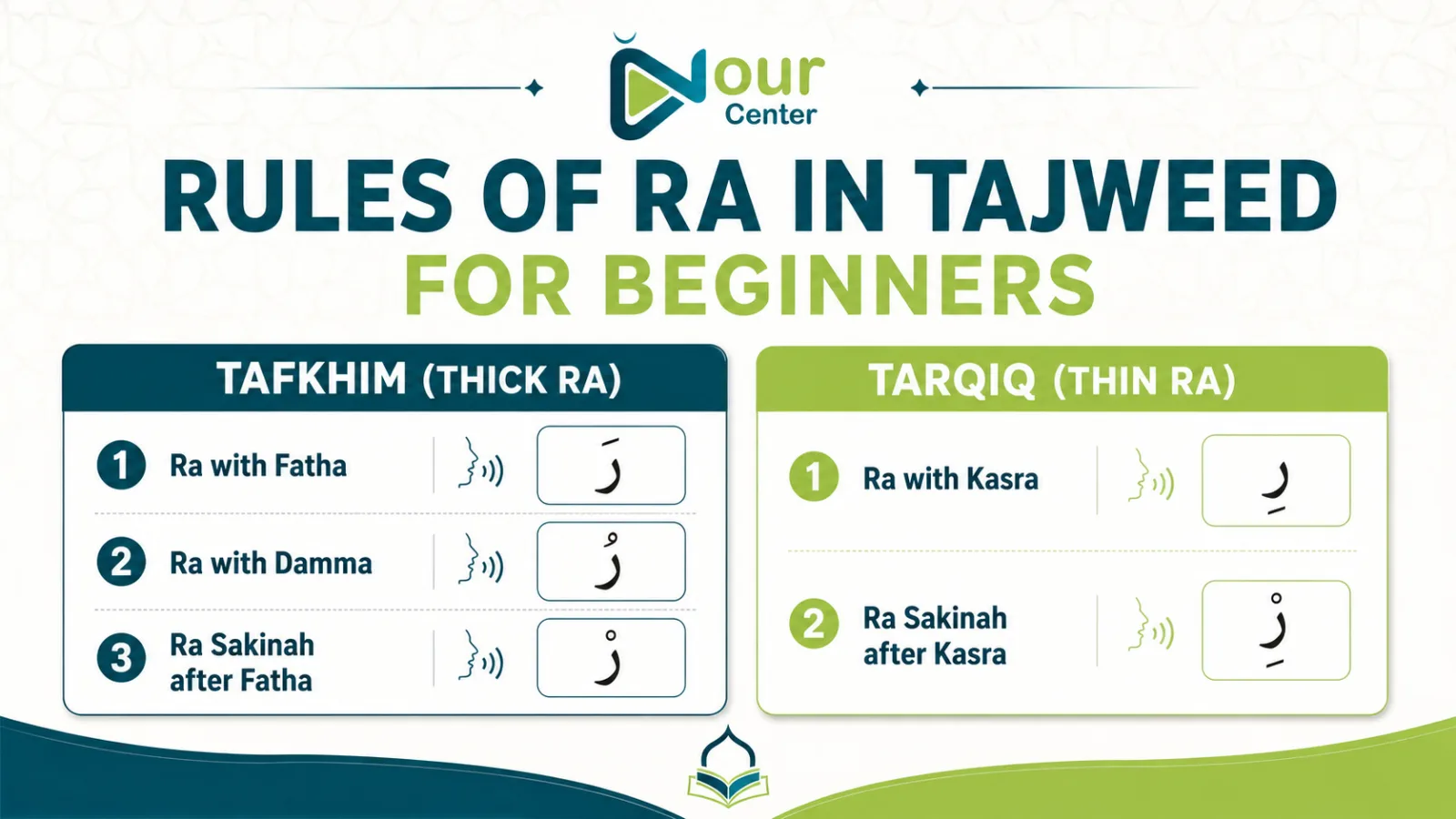
Learn the Rules of Ra in Tajweed for beginners, including when Ra is heavy or light, how vowels affect pronunciation, co...
Read Article →