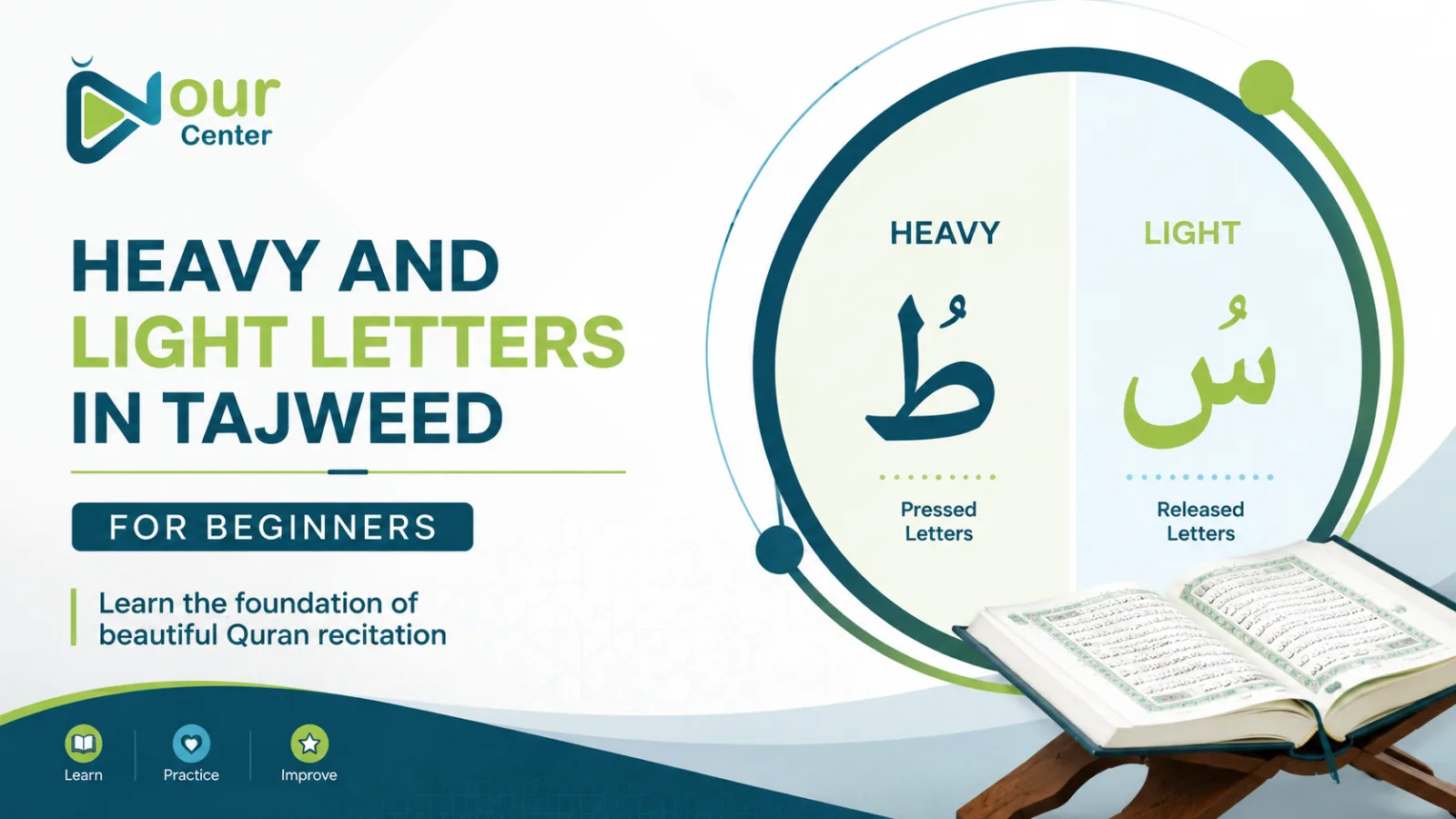
Heavy and Light Letters in Tajweed for Beginners: Tafkhim and Tarqiq Explained
Learn heavy and light letters in Tajweed for beginners, including Tafkhim, Tarqiq, the heavy Arabic letters, rules of Ra...
Read Article →
Learning the basic Tajweed rules can feel difficult when a beginner first encounters terms such as Makharij, Madd, Ghunnah, Qalqalah, Ikhfa, Idgham, and Noon Sakinah. But Tajweed becomes much easier when it is learned in the right order. A beginner does not need to memorize dozens of technical definitions before reading Quran.
The stronger approach is to begin with accurate Arabic letters, understand the signs that control pronunciation, learn one Tajweed rule at a time, hear it from a qualified teacher, and then apply it during real Quran recitation.
Correct Makharij. Harakat. Sukoon. Shaddah. Basic Madd. Ghunnah. Qalqalah. Noon Sakinah and Tanween. Meem Sakinah. Heavy and light letters. Basic stopping and restarting. These foundations appear repeatedly throughout Quran reading, so learning them gradually can produce a noticeable improvement in accuracy and confidence. This beginner Tajweed guide explains what each rule means, why it matters, common mistakes, and how to practice it without becoming overwhelmed. What Is Tajweed?
Tajweed is the system of correct Quran recitation that helps a reader pronounce Arabic letters accurately and apply the sound rules that occur when letters and vowel signs interact.
For beginners, Tajweed should first be understood as a practical recitation skill. The learner sees a letter or pattern. They recognize what should happen. They hear the correct sound. They reproduce it. Then they apply the same rule in another Quran word. This is different from memorizing a rule name without being able to use it while reading. A student may be able to explain what Qalqalah means and still fail to apply it.
Another student may correctly perform Ghunnah through imitation even before learning its technical name. The long-term goal is to combine both understanding and application.
Tajweed contains many rules, but introducing all of them at once can make Quran reading harder rather than easier.
Arabic letters. Harakat. Word connections. Pronunciation. Where the Ayah ends. The next word. Adding several new Tajweed rules simultaneously can overload the learner.
Establish the foundation. Learn one rule. Practice it repeatedly. Recognize it in Quran. Apply it with teacher correction. Review it later. Then introduce another rule. This allows each new skill to build on something the learner already understands.
Correct Makharij of Arabic Letters
Makharij is one of the most important foundations of Tajweed. Makharij refers to the articulation points from which Arabic letter sounds are produced.
Throat. Tongue. Lips. Oral cavity. Nasal passage in relevant sound situations. The purpose of studying Makharij is not simply to memorize a diagram. The purpose is to make each Arabic letter distinguishable and accurate during Quran reading.
Imagine learning complicated rules about a letter while pronouncing the letter itself incorrectly. The rule may be technically applied, but the basic sound remains inaccurate. This is why beginners should develop clear letter pronunciation early. A teacher can identify which sounds already work well and which require focused practice. Some learners may struggle mainly with throat letters. Others may confuse letters produced near the front of the tongue.
Others may make heavy Arabic sounds too light.
The correction should match the learner.
Choose one difficult sound. Listen to the teacher pronounce it. Repeat slowly. Compare it with a similar letter. Practice the letter with different vowels. Use it inside a short word. Then read a Quran phrase containing the same letter. Do not try to repair every Arabic letter in one session. Targeted practice is usually more effective.
Harakat and Accurate Short Vowels
Before learning advanced Tajweed, beginners need reliable control of the three basic short vowels: Fathah. Kasrah. Dammah. A student can pronounce the correct Arabic consonant but still read the word incorrectly by changing its vowel. This is particularly common when a beginner reads too quickly or depends heavily on memory. Correct Quran reading therefore requires attention to both the letter and its vowel.
Read slowly. Look directly at the vowel sign. Practice short syllables. Compare the same letter under different Harakat. Then return to full Quran words. Once accuracy becomes stable, reading can gradually become smoother.
Sukoon shows that a letter does not carry a short vowel. Beginners sometimes add an unnecessary vowel after a letter with Sukoon. This changes the sound of the word and interrupts correct pronunciation. Practicing Sukoon teaches the learner how to produce a clean consonant and connect it naturally to the surrounding sounds.
Begin with simple combinations. Pronounce the first moving letter. Reach the letter carrying Sukoon. Complete the consonant without adding an extra Fathah, Kasrah, or Dammah. Then continue into the next sound. Teacher feedback is useful because beginners may not notice the added vowel themselves.
Shaddah indicates a strengthened or doubled consonant. Ignoring Shaddah can make an Arabic word sound too weak. Beginners may see the symbol correctly but fail to give the consonant sufficient emphasis. The solution is to understand that a Shaddah is not merely decoration above the letter. It affects pronunciation directly.
Read the word slowly. Focus on the strengthened consonant. Listen to a teacher model. Repeat it without separating the word unnaturally. Then read the full word at normal controlled speed. Shaddah becomes especially important later when learning Ghunnah with Noon and Meem Mushaddadah.
Madd for Beginners
Madd refers to lengthening vowel sounds in Quran recitation according to specific patterns. Beginners should normally start with the simplest and most common form of Madd before studying its many detailed categories. The first goal is learning that some sounds are naturally extended and must not be read like short vowels.
Shorten a long sound. Lengthen a short sound. Stretch too much. Change the vowel quality while stretching. Apply Madd inconsistently. Rush through Madd when trying to read faster.
Listen to the teacher. Repeat the sound at a controlled length. Use a simple count if instructed. Practice several examples. Then apply the same length while reading continuously. The objective is consistency rather than exaggerated melody. As the student advances, more detailed Madd categories can be introduced separately.
Ghunnah is a nasal sound quality that occurs in specific Tajweed situations. For a beginner, the easiest way to understand Ghunnah is through hearing and imitation. The teacher demonstrates the sound. The learner listens. Then repeats. The student gradually learns to recognize where the sound occurs. A common beginner example involves Noon or Meem carrying Shaddah. The learner needs a controlled nasal quality rather than simply holding the ordinary letter longer.
Too short. Too long. Too weak. Exaggerated. Applied where it does not belong. Missing where it is required. The solution is repeated comparison with a qualified reciter or teacher.
Qalqalah is an echoing or bouncing sound associated with a specific group of letters when the relevant pronunciation condition occurs.
Qaf. Ta. Ba. Jeem. Dal. For beginners, recognizing the letters is only the first step. The more important skill is producing the sound correctly.
Some learners remove the Qalqalah almost completely. Others exaggerate it so much that an extra vowel seems to appear. Correct Qalqalah falls between these extremes. The consonant remains clear without turning into a separate syllable.
Choose one Qalqalah letter with Sukoon. Listen carefully. Repeat slowly.
No bounce. Correct controlled bounce. Exaggerated bounce. Then apply it inside a Quranic word. Once the sound is clear, practice it during connected recitation.
Noon Sakinah and Tanween
Noon Sakinah and Tanween are among the most important basic Tajweed patterns because the correct pronunciation depends on the letter that follows.
Izhar. Idgham. Iqlab. Ikhfa. Instead of attempting to memorize every letter group immediately, understand the decision process first. Find the Noon Sakinah or Tanween. Look at the next letter. Identify which rule applies. Then perform that sound correctly. This makes the system much easier to understand.
Clear Pronunciation
Izhar means the Noon sound is pronounced clearly before its specified group of letters. The beginner should avoid hiding or merging the sound. The important skill is clean pronunciation followed by a smooth transition to the next letter.
Idgham involves merging the Noon Sakinah or Tanween into a following letter in the appropriate cases. Some Idgham situations include Ghunnah while others do not. Beginners do not need to memorize every subcategory on the first day. First understand what merging sounds like. Then learn the relevant letter groups gradually.
Changing the Sound Before Ba
Iqlab occurs when Noon Sakinah or Tanween comes before Ba. In this situation, the Noon sound changes toward a concealed Meem-like sound with Ghunnah. The learner should hear this rule from a teacher because written explanation alone may not communicate the sound clearly.
Ikhfa sits between complete clarity and complete merging. The Noon sound is concealed with a controlled Ghunnah before its relevant group of letters. A common beginner mistake is either pronouncing Noon fully or removing it too much. Listening and guided repetition are essential.
Do not memorize a large chart and assume the rule has been learned.
Recognize Noon Sakinah or Tanween. Look at the following letter. Choose the rule. Listen to an example. Repeat. Find another example. Apply it in Quran reading. When one category becomes comfortable, move to another.
Meem Sakinah also changes its pronunciation behavior according to the letter that follows.
Ikhfa Shafawi. Idgham Shafawi. Izhar Shafawi. The lips are especially important because Meem is a lip-based sound. A teacher can often correct Meem Sakinah more easily when the student pays attention to both sound and lip movement.
This occurs in the relevant situation when Meem Sakinah is followed by Ba. The sound involves a controlled concealment with Ghunnah. Beginners should avoid pressing the lips excessively or separating the words unnaturally.
When the appropriate Meem combination occurs, the sounds merge with Ghunnah. Students should hear the difference between normal Meem and the merged sound.
In the remaining relevant cases, the Meem is pronounced clearly. The student should be especially careful when neighboring letters make the lip movement feel fast.
Heavy and Light Letters
Another important beginner Tajweed skill is learning that not every Arabic letter has the same sound quality. Some letters are consistently pronounced with a heavier quality. Many other letters are normally light. Certain letters may also change between heavier and lighter pronunciation depending on their context, which is usually studied in more detail later. For a beginner, start by recognizing the clearest heavy-letter group and comparing it with light letters.
English and other languages may not use the same contrast.
Make every letter light. Make heavy letters too weak. Overcorrect and make neighboring light letters heavy. The teacher should isolate the sound and then return it to the full word.
Tafkheem and Tarqeeq
Tafkheem describes heaviness or fullness in pronunciation. Tarqeeq describes lightness. These concepts become especially useful when a learner begins refining Quran pronunciation beyond basic letter recognition. The beginner should avoid thinking that heavy means shouting or using excessive force. The sound quality comes from articulation and mouth shape. Likewise, a light letter should remain clear rather than weak.
Waqf — Knowing Where to Stop
Correct Quran reading involves more than individual letters. Readers also need to know when and how to stop. Beginners often stop whenever they run out of breath. This can produce awkward breaks and make continuation difficult. The Quran contains stopping signs that help guide recitation. A beginner does not need to memorize every advanced rule immediately.
Start by learning the common signs taught by the Quran teacher and understanding that a stop should be deliberate rather than random.
Notice the likely stopping positions. Control breathing. Do not rush simply because you want to reach the next stop. When stopping, pronounce the final word according to the relevant stopping rules taught at your level. Then prepare to resume correctly.
Ibtida — Restarting Correctly
Knowing where to stop is only part of good recitation. The reader also needs to know where to begin again. If a learner stops in the middle of a passage and then resumes from an unsuitable point, the recitation can become disconnected. Beginners should therefore practice stopping and restarting together. A teacher may ask the student to return a few words before the stopping point rather than restarting from the immediately following word.
This creates smoother and more meaningful recitation.
Tajweed rules depend on clear Arabic letters. If the student confuses two letters, recognizing a rule may not be enough to recite accurately. A learner should therefore continue practicing pronunciation even while advancing through Madd, Qalqalah, Ghunnah, and other rules. Makharij is not a chapter that is completed and forgotten. It remains active during every Quran lesson.
A strong Makharij for Beginners foundation helps the learner distinguish Arabic sounds before applying more advanced Tajweed patterns to those same letters.
Tajweed rules rarely appear one at a time during normal recitation.
Makharij. A heavy letter. Madd. Ghunnah. A stopping sign. All within a few seconds. This is why beginners should not try to consciously process every rule simultaneously from the beginning. Practice individual skills first. Then combine them gradually. Over time, familiar rules become increasingly automatic.
A useful practice system follows five stages.
Listen to the teacher demonstrate the rule accurately.
Identify where the rule occurs in a word or short passage.
Imitate the teacher slowly.
Read a different example containing the same rule.
Return to the rule during later Quran lessons. A student who only completes stages one and two knows about Tajweed. A student who reaches stages four and five is beginning to use Tajweed.
Definitions are useful for organizing knowledge. But Tajweed is an oral recitation skill. A learner cannot fully master pronunciation only by reading descriptions. A book can explain where the tongue should go. A chart can show the rule letters. A video can provide a sound model. But none of these can reliably tell the learner whether their own attempt is correct. Live feedback closes this gap.
A teacher hears the result and corrects the individual student.
What Should You Learn First?
Arabic letter recognition. Harakat. Sukoon. Shaddah. Makharij. Basic Madd. Basic Ghunnah. Qalqalah. Heavy and light sounds. Noon Sakinah and Tanween. Meem Sakinah. Common stopping signs. More advanced Tajweed categories. The exact sequence can change according to the student's level. A learner who already reads Arabic fluently may progress through the early stages quickly. Another beginner may need more foundational work first.
A structured Tajweed for Kids program should therefore adapt the rules to the learner instead of expecting every child to progress through the same material at the same speed.
Rush through Quran. Confuse similar letters. Ignore Harakat. Add vowels after Sukoon. Miss Shaddah. Shorten Madd. Exaggerate Madd. Use weak Ghunnah. Exaggerate Qalqalah. Ignore heavy and light sounds. Know rules but fail to apply them. Stop randomly. Rely on transliteration. Repeat incorrect pronunciation. Try to learn too many rules simultaneously. These errors do not mean the learner is incapable of Tajweed. They show which skill needs attention.
A detailed guide to Common Quran Reading Mistakes can help learners identify recurring pronunciation, vowel, Tajweed, pacing, and stopping problems before those errors become long-term habits.
Three Makharij errors. Two Madd errors. A Qalqalah mistake. Two stopping mistakes. Several vowel errors. Interrupting after every sound may make the learner lose confidence and concentration. The teacher can prioritize the most important recurring issue.
Today we focus mainly on one difficult letter. Tomorrow we check Madd. The other necessary corrections still happen, but the learner has one clear improvement goal. This approach makes progress easier to measure.
Familiar short Surahs can be excellent Tajweed practice material. Because the learner already knows much of the wording, they can direct more attention toward pronunciation.
Makharij first. Then Madd. Then Ghunnah. Then Qalqalah. Then stopping. The text stays familiar while the Tajweed focus changes. However, learners should also read unfamiliar passages. Otherwise, memorization can hide reading weaknesses.
Transliteration may look helpful because it converts Arabic into familiar English letters. But English letters cannot accurately represent every Quranic Arabic sound. Transliteration also makes Makharij harder to learn because the student sees the English approximation instead of the actual Arabic letter.
Arabic script. Arabic sound. Articulation. Recitation. Students who still struggle with letters, vowels, Sukoon, Shaddah, or connected words may benefit from Noorani Qaida for Kids before moving deeply into advanced Tajweed rules. How Often Should Beginners Practice Tajweed? Regular short practice usually works better than occasional long sessions.
One difficult sound. One rule. One short passage. Then return to the same skill the following day. The brain and speech muscles need repeated accurate use. Tajweed should therefore become part of normal Quran reading rather than something studied only during occasional theory lessons.
Minutes 1–3:Review one difficult Arabic sound or Makhraj. Minutes 4–6:Review the current Tajweed rule. Minutes 7–10:Read a short Quran passage slowly. Minutes 11–13:Repeat the lines containing mistakes. Minutes 14–15:Read the passage again smoothly. The exact timing is flexible. The important part is having a clear skill target.
Pronunciation Foundations
Harakat. Sukoon. Shaddah. Difficult Arabic letters. Makharij. Do not rush forward if the basic reading remains unstable.
Madd and Controlled Vowel Length
Learn the simplest Madd patterns. Practice maintaining the correct sound while reading slowly.
Ghunnah and Qalqalah
Learn to hear and reproduce both sound qualities without exaggeration.
Noon Sakinah and Tanween
Introduce the four main categories gradually. Do not expect mastery of every letter group immediately.
Meem Sakinah and Heavy vs Light Letters
Practice lip control, Ghunnah where relevant, and the contrast between heavy and light sounds.
Stopping and Combined Quran Recitation
Read short passages containing several learned rules. Practice Waqf. Practice restarting. Identify which rules remain weak. After six weeks, the learner has not “finished Tajweed.” They have created a foundation from which more detailed study can continue.
Look for practical signs. You need fewer pronunciation corrections. You recognize some rules before the teacher points them out. Madd becomes more consistent. Qalqalah becomes controlled. Ghunnah becomes easier to hear. Similar letters become more distinct. You read slowly without losing accuracy. You can apply a rule in a new passage. You stop more deliberately. You sometimes recognize and correct your own mistakes. Independent correction is an especially important milestone.
It shows the learner is beginning to hear their own recitation more critically. Should Beginners Memorize Tajweed Rules? Some memorization is useful. Students eventually need to know which letters belong to important rule groups. But memorizing letters and definitions should support recitation rather than replace it.
Can you recognize the rule while reading? Can you apply it? Can you hear when you miss it? If not, more practical practice is needed. The objective is not simply passing a Tajweed terminology quiz. The objective is better Quran recitation. Can Children Learn Basic Tajweed Rules? Yes. Children can begin practical Tajweed from their earliest Quran lessons. The explanation should match their age.
A young child does not need a long technical lecture about every category.
Listen. Hold this sound longer. Make this letter heavier. Use your tongue here. Let the sound come through the nose. Try again. As the child becomes older, the formal terminology can be attached to skills they already recognize. Can Adults Learn Tajweed From Scratch? Yes. Adults may even benefit from more detailed explanations because they can understand articulation descriptions and rule categories more easily. However, adults may also have pronunciation habits developed over many years.
That means practice and teacher correction remain essential. An adult should not feel embarrassed about returning to basic Arabic letters if that is what produces better recitation. A strong foundation is more useful than progressing quickly through rule names.
Live online Tajweed classes can give beginners direct feedback while allowing them to study from home.
Listen to pronunciation. Identify Makharij errors. Correct vowel length. Demonstrate Ghunnah. Correct Qalqalah. Test Noon Sakinah rules. Monitor stopping. Assign targeted practice. The learner can then practice the exact weakness between lessons. This is especially useful for Muslim families and learners in the USA, UK, Canada, Australia, Europe, and other places where convenient local access to suitable Quran teachers may be limited.
Every beginner has a different starting point. One student may read Arabic fluently but know very little Tajweed. Another may know Tajweed terminology but have weak Makharij. Another may still struggle with basic Quran reading. A fixed group pace cannot always give each learner the same amount of targeted correction.
Lesson speed. Rule sequence. Reading level. Pronunciation drills. Homework. Correction frequency. This can make beginner Tajweed more efficient.
At Nour Center, live one-to-one Quran lessons allow the teacher to assess the learner before deciding where Tajweed instruction should begin.
Arabic letters. Harakat. Sukoon. Shaddah. Makharij. Reading fluency. Madd. Ghunnah. Qalqalah. Heavy and light letters. Noon Sakinah and Tanween. Meem Sakinah. Stopping. Recurring reading mistakes. The beginner can then follow a personalized sequence. A student with weak reading may strengthen Noorani Qaida first. A stronger reader may begin directly with Makharij and basic Tajweed rules. A student who already understands the theory may need mainly practical recitation correction. The lesson adapts to the actual learner.
What Comes After the Basic Tajweed Rules? Once the beginner understands and applies the foundations, each rule family can be studied in greater depth.
Detailed Qalqalah. Different Madd rules. Noon Sakinah and Tanween. Izhar. Idgham. Iqlab. Ikhfa. Meem Sakinah. Advanced heavy and light letter rules. Stopping and starting. This is why learning the basic Tajweed rules first is useful. They create the map. Later lessons add detail to each area.
The basic Tajweed rules every beginner should know are not meant to be mastered in one sitting. Begin with accurate Arabic letters. Strengthen Makharij. Understand Harakat, Sukoon, and Shaddah.
Madd. Ghunnah. Qalqalah. Noon Sakinah and Tanween. Meem Sakinah. Heavy and light pronunciation. Stopping and restarting. Most importantly, apply every rule during real Quran recitation.
Listen. Recognize. Repeat. Apply. Receive correction. Review. With regular practice and qualified guidance, rules that initially feel technical can gradually become natural parts of Quran reading.
Note: Comments may require approval before appearing publicly.
Learn heavy and light letters in Tajweed for beginners, including Tafkhim, Tarqiq, the heavy Arabic letters, rules of Ra...
Read Article →
Learn Izhar rules for beginners, including the six Izhar letters, clear Noon Sakinah and Tanween pronunciation, common m...
Read Article →
Learn Idgham rules for beginners, including the six Idgham letters, Idgham with and without Ghunnah, pronunciation, comm...
Read Article →
Learn Ikhfa rules for beginners, including the Ikhfa letters, Ghunnah, correct pronunciation, common mistakes, and pract...
Read Article →