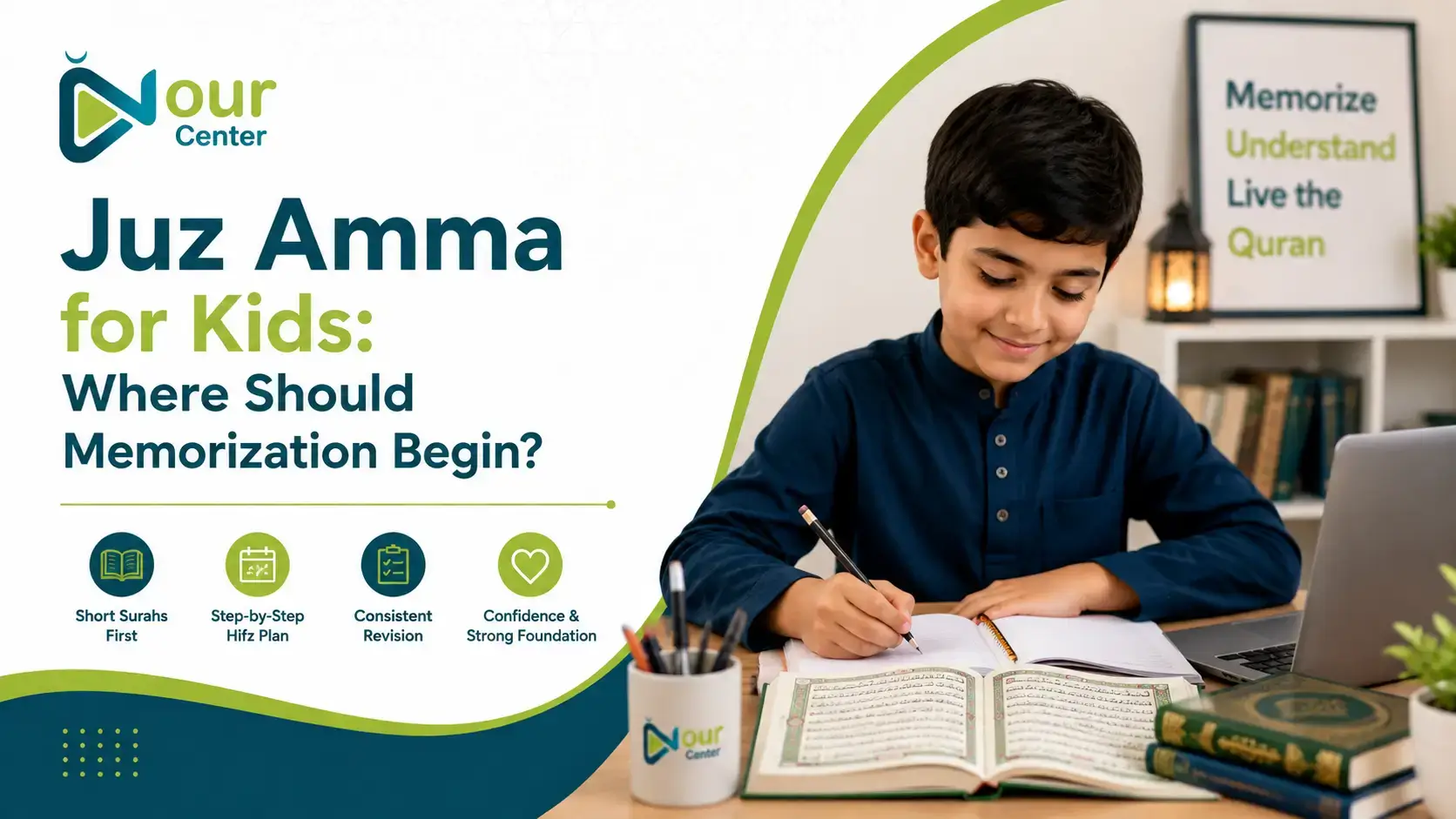
Juz Amma for Kids: Where Should Quran Memorization Begin?
Learn where children should start memorizing Juz Amma, which short Surahs to begin with, how to build a gradual Hifz ord...
Read Article →
A Step-by-Step Quran Memorization Guide
Memorizing short Surahs is one of the best ways to introduce children to the Quran. Short chapters are easier to repeat, easier to review, and give young learners a sense of achievement as they gradually build their memorization skills. For many Muslim families, learning short Surahs is also an important part of helping children become comfortable with Salah and daily Quran recitation.
However, successful memorization is not simply about repeating verses many times. Children need correct pronunciation, regular revision, an appropriate learning pace, and encouragement from parents and teachers.
At Nour Center, children can learn and memorize short Surahs through live one-to-one online Quran lessons. Teachers help students read correctly, memorize gradually, revise previous Surahs, and develop confidence in Quran recitation. Why Should Children Start With Short Surahs? Short Surahs are an excellent starting point for young Quran learners because they contain fewer verses and can usually be divided into small, manageable sections.
A child who is new to memorization may find a long Surah difficult. If the task feels too large, the child may lose motivation.
Short Surahs allow the student to experience progress quickly. Each completed Surah becomes a small achievement that encourages the child to continue. They also help children become familiar with Quranic pronunciation and repeated Arabic sounds. As children memorize more Surahs, their listening skills, concentration, pronunciation, and ability to remember Quranic passages can gradually improve. Which Short Surahs Can Children Memorize First? The best starting Surah depends on the child's current level.
Many children begin with Surahs from the final part of the Quran because they are relatively short and frequently recited.
Surah Al-Fatihah. Surah Al-Ikhlas. Surah Al-Falaq. Surah An-Nas. Surah Al-Kawthar. Surah Al-Asr. Surah An-Nasr. Surah Al-Kafirun. Surah Al-Ma'un. Surah Quraysh. Surah Al-Fil. The teacher does not necessarily need to follow one fixed order for every student. A child who already knows several Surahs may need to begin at a different point from a complete beginner. Why Is Surah Al-Fatihah Important for Children?
Surah Al-Fatihah has a particularly important place in a Muslim's daily worship because it is recited in Salah.
For this reason, children should learn to recite it accurately. Memorizing the words is only one part of the learning process. The teacher should also listen carefully to the child's pronunciation and correct mistakes. Young students may sometimes memorize a pronunciation error if they repeatedly hear or say a word incorrectly. Direct correction from a qualified teacher can help prevent this.
Before asking a child to memorize a Surah independently, it is important to make sure that the child hears the verses correctly. Memorization and pronunciation should develop together. If a child memorizes incorrect pronunciation, correcting it later can take additional effort. At Nour Center, teachers can first recite a verse or a short section clearly. The student listens and repeats. The teacher then corrects any mistakes before the child continues memorizing.
This approach helps children connect memorization with accurate Quran reading.
Young children usually learn better when the material is divided into small sections. Instead of asking a beginner to memorize an entire Surah in one session, the teacher may begin with one verse. The child listens to the verse, repeats it several times, and then tries to recite it without looking. Once the first verse becomes comfortable, the teacher introduces the next verse. The two verses can then be connected.
This process continues until the child can recite the complete Surah. Breaking memorization into small portions makes the task feel achievable.
Repetition is one of the most important tools in Quran memorization. However, repetition should be focused rather than random. A child may listen to the teacher recite a verse. The child then repeats the verse several times while looking at the Quran or lesson material. After that, the child attempts the verse without looking. If there is a mistake, the teacher corrects it immediately. The student then repeats the correct version.
Regular repetition strengthens memory and helps the words become familiar.
Listening can be especially useful for children. Young learners often remember sounds quickly when they hear them repeatedly. A teacher can recite a short passage slowly and clearly before asking the child to repeat. Parents may also help by playing a reliable recitation of the same Surah during appropriate practice times. The goal is not to replace live teaching. Listening should support the child's memorization and help reinforce the pronunciation already taught by the teacher.
One common memorization problem is that children can recite individual verses but struggle to connect them. For example, a child may know verse one and verse two separately but forget which verse comes next. Teachers can solve this through linking practice. After memorizing a new verse, the student should begin again from the previous verse and recite both together. When another verse is added, the child repeats the section again from the beginning.
This helps build a continuous memory of the Surah instead of a collection of disconnected verses.
Memorization without revision can disappear quickly. Children may memorize a Surah successfully and then forget parts of it several weeks later if they do not review it. Revision should therefore be part of the learning plan from the beginning. A child can revise previously memorized Surahs before learning something new. For example, part of a lesson may be used for old memorization and another part for new memorization. This balance helps protect previous progress.
How Often Should Children Revise Short Surahs? Regular short revision is usually more effective than waiting until the child has forgotten the Surah. Daily revision can be very helpful, even if it lasts only a few minutes.
One recently memorized Surah. One older Surah. The current Surah being learned. This allows children to keep earlier memorization active while continuing to make progress. The exact amount of revision should depend on the child's age, ability, and memorization level.
Parents naturally want their children to make progress, but speed should not become the main goal. A child who memorizes ten Surahs quickly but forgets them soon afterward may need a stronger revision system. Another child may progress more slowly but retain the Surahs accurately. Strong memorization is more important than completing a large number of Surahs quickly. Children also need time to improve pronunciation and fluency.
A good teacher can adjust the pace according to the individual student.
At Nour Center, children can learn Quran through live one-to-one online lessons. Individual teaching makes it possible to adapt memorization to each child's level. The teacher can determine which Surahs the student already knows, identify pronunciation mistakes, and create an appropriate learning plan.
Reviewing previous memorization. Listening to the teacher's recitation. Repeating new verses. Correcting pronunciation. Memorizing a small new portion. Connecting the new verses. Reciting the complete section without assistance. Assigning a manageable amount of home revision. This structured method can help children make steady progress.
Children learn at different speeds. In a group class, one child may need more repetition while another may be ready to continue. One-to-one lessons give the teacher more flexibility. If the student struggles with one verse, the teacher can spend additional time on it. If the student already knows the material well, the lesson can progress. The teacher can also hear every part of the child's recitation clearly. This makes pronunciation correction easier.
Correct pronunciation should be part of Quran memorization from the first lesson. Children may struggle with Arabic letters that are unfamiliar in their everyday language. Some sounds require more practice than others. The teacher can demonstrate the correct sound and ask the student to repeat it. If necessary, the verse can be broken into smaller parts. Correcting these issues early helps children develop a stronger foundation for future Quran and Tajweed study.
Make Memorization Appropriate for the Child's Age Young children have limited attention spans. A long lesson filled with constant repetition may become tiring. The learning method should therefore match the child's age.
Short memorization portions. Frequent repetition. Simple goals. Positive encouragement. Short revision activities. Regular breaks between longer study periods. Older children may be able to memorize larger portions and follow a more detailed revision schedule. Every student should be treated according to his or her ability.
A child may become discouraged if the goal seems too difficult. Instead of saying, "You must memorize many Surahs this month," it can be better to set smaller goals.
Learn one verse correctly. Recite yesterday's verse without help. Complete one short Surah. Review three previously memorized Surahs. Recite Surah Al-Fatihah without mistakes. Small goals allow children to see their progress. This can improve motivation and make Quran learning feel positive.
Mistakes are a normal part of learning. A child who is constantly criticized may become afraid to recite. Teachers and parents should correct errors without making the child feel embarrassed. Encouragement is especially important when the student is trying hard. A teacher can explain the mistake, demonstrate the correct pronunciation, and ask the child to repeat it. When the student improves, that progress should be recognized. The aim is to create confidence together with accuracy.
Parents can have a major influence on a child's memorization journey. They do not need to conduct the entire lesson themselves. Their main role can be to create consistency and support.
Making sure the child attends Quran lessons regularly. Providing a quiet place for online lessons. Setting a short daily revision time. Listening to memorized Surahs. Encouraging effort. Avoiding comparisons with other children. Communicating with the Quran teacher. Helping children follow their revision schedule. A supportive home environment can make Quran learning easier.
Once children can recite a short Surah accurately, they may use it appropriately in their Salah as they learn to pray. Regular recitation provides natural revision. A Surah that is used frequently becomes easier to remember. Parents can encourage children to rotate between the short Surahs they have learned rather than always reciting the same one. This helps keep multiple Surahs active in memory. How Much Should a Child Memorize Each Day?
There is no single amount that is suitable for every child. A complete beginner may need to work on only one short verse. Another student may be able to memorize several verses.
Age. Reading level. Concentration. Previous memorization experience. Arabic pronunciation. Lesson frequency. Available revision time. The new portion should be small enough that the child can memorize it accurately and still have time to revise previous lessons.
What Is the Best Time?
The best memorization time is the time when the child is alert and able to concentrate consistently. Some families prefer morning practice because the child is fresh. Others find that afternoon or evening works better around school schedules. Consistency matters more than choosing one universal time. A quiet environment without distractions is also helpful. Short daily sessions can often produce better results than irregular long sessions.
Children who do not speak Arabic can still memorize short Surahs successfully. However, pronunciation may require more attention. The student should not depend only on reading transliteration. Learning the actual Arabic letters and sounds is important for long-term Quran study. Children who cannot yet read Arabic may benefit from beginning with Noorani Qaida or another structured Arabic reading foundation alongside memorization. As their reading skills improve, they become less dependent on listening alone.
For beginner children, Noorani Qaida can support Quran memorization. It teaches Arabic letters, vowel signs, joined letters, Sukoon, Shaddah, and other fundamental reading skills. A student who understands these patterns may find it easier to read Quranic words correctly. At Nour Center, a teacher can decide whether the child should focus primarily on Qaida, memorization, or a combination of both. This depends on the child's current level. When Should Children Start Tajweed?
Basic pronunciation correction can begin from the start. Children do not need to memorize a large collection of technical terminology before reading Quran. As they become more comfortable with recitation, the teacher can gradually introduce Tajweed rules suitable for their level. The important thing is that children learn to apply correct pronunciation in practice. More detailed Tajweed study can develop as their reading ability grows.
Children may experience different challenges during memorization. Forgetting the Beginning of a Verse Sometimes a child knows a verse after hearing the first word but cannot begin independently. The teacher can practice starting the verse repeatedly without giving the child the opening words.
Children may confuse verses that contain similar sounds or phrases. Slow repetition and comparison can help separate them in memory.
This usually indicates that revision needs more attention. The solution is not always to stop memorizing completely, but the balance between new material and revision should be adjusted.
The child may remember the words but pronounce certain letters incorrectly. The teacher should correct the problematic sound individually before returning to the complete verse.
If learning becomes too difficult or repetitive, the child may lose interest. Reducing the new portion, celebrating progress, and varying revision activities can help.
A structured routine can make Quran memorization easier to manage.
Learn a new verse.
Review the first verse and add another verse.
Connect both verses and correct pronunciation.
Add the next small portion.
Review the complete section.
Recite without looking and revise older Surahs.
Light revision or rest depending on the child's schedule.
This is only an example. A teacher should adjust the plan to suit the individual child.
A Surah should not be considered secure only because the child recited it correctly once. The student should be able to recite it on different days without excessive prompting.
The child can begin independently. The verses are recited in the correct order. There are few or no pronunciation errors. The child does not repeatedly stop between verses. The Surah remains accurate after several days of revision. The student can recite it again after learning newer material. Retention is an important measure of successful memorization. Build a Long-Term Love of the Quran The greatest objective is not simply to collect a list of memorized Surahs.
Children should develop a positive relationship with Quran learning. They should see Quran lessons as a meaningful and regular part of their lives. This requires patience. Parents and teachers should avoid turning every lesson into a competition. A child who learns slowly but enjoys Quran study may continue learning for many years. Consistency, encouragement, and good teaching can build habits that remain into adulthood. What Comes After Memorizing Short Surahs?
After a child becomes confident with several short Surahs, the teacher can gradually introduce longer chapters. The next stage depends on the student's ability. Some children may continue through Juz Amma. Others may need additional reading or Tajweed practice first.
Quran reading fluency. Tajweed application. Longer Surah memorization. Regular revision habits. Juz Amma memorization. A structured Hifz program. A strong foundation in short Surahs makes these later stages easier. Why Choose Nour Center for Kids Quran Memorization? Nour Center offers online Quran learning for children with a focus on structured and personalized teaching. One-to-one lessons allow teachers to listen carefully to each student's recitation.
Children can receive immediate pronunciation correction, individual memorization targets, and regular revision.
The pace can also be adapted to school schedules and the child's learning ability. For families living outside Arabic-speaking countries, online lessons can provide children with regular access to Quran teachers without requiring travel. Parents can also follow their child's progress more closely.
Memorizing short Surahs is an excellent beginning for a child's Quran journey. The process should combine correct pronunciation, small memorization portions, frequent repetition, regular revision, and positive encouragement. Children should not be rushed. Every child has a different learning speed. Some may memorize quickly while others need additional repetition. What matters is building strong and lasting memorization.
At Nour Center, children can learn short Surahs through live one-to-one online Quran lessons designed around their individual level.
With qualified teaching, regular practice, and family support, children can gradually memorize the Quran while developing confidence, accurate recitation, and a lasting connection with the words of Allah.
Note: Comments may require approval before appearing publicly.
Learn where children should start memorizing Juz Amma, which short Surahs to begin with, how to build a gradual Hifz ord...
Read Article →
Learn Tajweed for kids step by step, from correct Arabic pronunciation and Makharij to Madd, Ghunnah, Qalqalah, stopping...
Read Article →
Help your child memorize the Quran with a realistic Hifz plan built around correct recitation, small daily portions, reg...
Read Article →
Noorani Qaida helps children build a strong foundation in Arabic letters, pronunciation, and Quran reading. Discover how...
Read Article →