
Noorani Qaida for Kids: How Nour Center Teaches Arabic and Quran Reading Step by Step
Noorani Qaida helps children build a strong foundation in Arabic letters, pronunciation, and Quran reading. Discover how...
Read Article →
A Beginner’s Guide to Correct Quran Recitation
Tajweed for kids should make Quran recitation clearer and more accurate, not turn a child’s lesson into a long list of difficult technical terms. For beginners, the most useful starting point is correct sound. A child needs to hear Arabic letters accurately, distinguish similar sounds, pronounce words carefully, notice how long vowels are held, and learn to stop and continue correctly. The names of Tajweed rules can gradually come later.
This approach is especially important for children who live in English-speaking homes or communities where Arabic is not used throughout the day. A child may recognize Arabic letters and even memorize several Surahs while still confusing sounds, shortening long vowels, rushing through words, or carrying pronunciation mistakes from one recitation to another. Learning Tajweed gradually helps correct these problems before they become deeply established habits.
This guide explains what Tajweed for kids means, which skills beginners should learn first, how parents can support practice, which mistakes to watch for, and how a structured teacher-led program can help a child develop confident Quran recitation.
What Is Tajweed for Kids? Tajweed for kids is the gradual process of teaching children to recite Quran with correct Arabic pronunciation and appropriate recitation rules. For a beginner, this includes learning how letters should sound, where those sounds are produced, how vowels are pronounced, when sounds are lengthened, when nasal sound is used, and how words should connect during recitation.
Children do not need to master every Tajweed definition before they can begin applying Tajweed.
In fact, a child may correctly imitate a rule before they know its technical name. This is similar to ordinary language learning. Children learn many sounds and sentence patterns through listening and imitation before they study grammar formally. Quran recitation can begin in the same practical way. The teacher recites. The child listens. The child repeats. The teacher identifies the mistake. The child tries again. Over time, the correct sound becomes increasingly natural.
Why Is Tajweed Important for Children? Correct Quran recitation is built through repeated habits. If a child repeatedly pronounces a word incorrectly, that pronunciation may become familiar and harder to change later. If the child learns the sound correctly from the beginning, repetition strengthens the correct version instead. This makes early correction valuable. Tajweed also helps children become more aware of what they are reading.
Letter differences. Vowel length. Heavy and light sounds. Stops. Nasal sounds. Repeated pronunciation patterns. Changes caused by neighboring letters. This careful listening can improve both recitation and Quran reading fluency.
One of the biggest mistakes in beginner Tajweed teaching is introducing too many definitions before the child can apply them. A young learner may be asked to memorize names such as Ikhfa, Idgham, Iqlab, Izhar, Madd, Ghunnah, Qalqalah, Tafkhim, and Tarqiq. These are useful terms. But memorizing the vocabulary is not the same as reading correctly. A child should first develop the ability to hear and produce the sound.
For example, instead of beginning with a long theoretical explanation about a pronunciation rule, the teacher can:
Read a simple example. Ask the child to listen. Repeat the sound slowly. Show the mouth or tongue position if useful. Ask the child to imitate. Correct the difference. Repeat using another example. Once the child can hear and apply the pattern, learning the name of the rule becomes much easier. Where Should a Beginner Start Learning Tajweed? A beginner Tajweed path should usually begin with the foundations of Quran reading.
Before moving deeply into rule categories, check whether the child can: Recognize Arabic letters. Distinguish similar letters. Read basic vowel marks. Recognize Sukoon. Recognize Shaddah. Read simple connected words. Pronounce common Arabic sounds reasonably accurately. If these skills are very weak, the child may need to strengthen foundational reading while beginning only simple practical Tajweed correction.
Children who are still developing Arabic letter recognition and basic Quran reading may benefit from building a stronger foundation through Noorani Qaida for Kids before adding more advanced Tajweed terminology.
This does not mean Tajweed must wait completely. Pronunciation correction can begin from the child's first Arabic letters. But the complexity of the explanations should match the learner's reading level.
The Foundation of Correct Quran Pronunciation
Makharij refers to the articulation points from which Arabic letters are pronounced. For children, the important goal is not memorizing a complicated anatomical chart. The goal is learning that Arabic letters are not interchangeable. Some sounds come from the throat. Some involve different parts of the tongue. Some depend mainly on the lips. Others use nasal resonance in particular situations. Children who speak English as their main language may find certain Quranic Arabic sounds unfamiliar.
They may confuse pairs of letters that seem similar to an inexperienced ear. A teacher can help the child hear the contrast and reproduce it correctly.
Start with one sound difference at a time. Do not attempt to correct every pronunciation issue in the same lesson.
Model the letter slowly. Show the child where the sound is produced. Compare it with the sound the child is making. Use a simple Quranic word. Ask the child to repeat. Correct gently. Return to the same sound during later lessons. Some children understand better through listening. Others benefit from seeing the teacher's mouth movement.
Some may benefit from simple physical cues, such as noticing whether a sound involves the lips, tongue, throat, or nasal passage.
The objective is consistency, not memorizing anatomical terminology.
Non-Arabic-speaking children may struggle to distinguish letters that sound close to them. These mistakes can continue even when the child reads fluently. The solution is targeted comparison. Instead of repeatedly telling the child, “That is wrong,” the teacher can isolate both sounds. The child hears the first. Then the second. Then alternates between them. After that, the sounds are practiced inside short words. This makes the difference easier to recognize.
Before a child studies complex Tajweed rules, basic vowel reading should be stable. Fathah, Kasrah, and Dammah change the sound of Arabic words. Reading the correct letter with the wrong vowel still produces an incorrect word. Children may sometimes rush and replace one vowel with another, especially during memorized Surahs where they rely more on memory than careful reading.
Letter pronunciation. Vowel pronunciation. Accuracy in these foundations makes later Tajweed much easier.
Sukoon tells the reader that a consonant is not carrying a short vowel. Shaddah indicates a doubled or strengthened consonant sound. These markings frequently affect how smoothly a child reads. A beginner may accidentally add a vowel where there should be Sukoon. Another may fail to give a Shaddah enough emphasis. Instead of presenting these only as written symbols, connect them to sound.
The incorrect version. The correct version. Then ask the child to identify the difference. This trains both the eye and the ear.
Learning Quran Vowel Length
Madd is one of the most noticeable areas of Tajweed for beginners. Children often understand the basic idea quickly because they can hear when a sound becomes longer. The difficulty is consistency. A child may stretch one Madd correctly but shorten the same type of sound a few lines later. For beginners, start with the most common and straightforward forms of lengthening before introducing detailed categories.
The child can practice keeping the sound steady using a simple count.
Stretch too little. Stretch too much. Change pitch dramatically. Add an unnecessary sound. Rush when reading faster. The aim is controlled vowel length, not exaggerated singing.
Learning the Nasal Sound
Ghunnah involves a nasal quality that appears in specific recitation situations. Children often learn Ghunnah effectively through listening and imitation. They may also notice the vibration associated with nasal sound. Instead of beginning with complicated definitions, a teacher can model a clear example and let the child compare the sound with a non-Ghunnah example. Once the sound becomes familiar, the teacher can gradually explain when it appears.
Hear it. Imitate it. Recognize it. Apply it. Learn the terminology. This keeps Tajweed connected to real Quran reading.
Practicing the Echoing Sound Carefully
Qalqalah is another rule children often notice because of its distinct sound. However, beginners sometimes exaggerate it. The sound should be controlled rather than turning into an additional full vowel.
Too weak. Correct. Too exaggerated. Then the child practices selected examples slowly. The objective is to develop the ear before expecting automatic application during faster recitation.
Some Arabic letters have a heavier quality in pronunciation while others remain lighter. Children may initially pronounce everything using the sound patterns of their first language. This can flatten important differences. For beginners, teach these contrasts through pairs of examples. The teacher reads a lighter sound. Then a heavier one. The child listens and imitates.
It is usually more effective to master a few common examples than to memorize a full theory table without practical control.
As a child's reading improves, they can begin learning how Noon Sakinah and Tanween behave when followed by different letters.
Izhar. Idgham. Iqlab. Ikhfa. Do not introduce every rule at once if the child is a beginner.
Teach one rule. Practice several Quranic examples. Find the same rule in familiar Surahs. Review it in the next lesson. Only then add another rule. Children need repeated recognition before a rule becomes automatic. A student who can define Ikhfa but fails to notice it while reading still needs practical training.
Worksheets can help children identify rules visually. But Tajweed is ultimately a recitation skill. The teacher must hear the child apply the rule.
Explanation. Recognition. Listening. Reading. Correction. Repetition. Independent application. A child may circle every Madd correctly on a worksheet and still read the Madd incorrectly. Practical recitation confirms whether the knowledge has become a skill.
Introducing a new Tajweed rule and a completely unfamiliar Surah at the same time can increase the learning load. A child who already knows a short Surah can focus more attention on pronunciation because they are not also struggling to remember every word.
Practicing Tajweed through familiar short Surahs can make correction easier because the child can focus on accurate pronunciation, vowel length, and recitation rules without learning completely new text at the same time.
Teachers can revisit familiar Surahs and ask the child to notice: Madd. Ghunnah. Qalqalah. Stopping points. Difficult letters. Repeated errors. This turns memorized Surahs into practical Tajweed lessons. Should Kids Learn Tajweed Before Memorizing Quran? Tajweed and Quran memorization do not have to be completely separate stages. A child can begin memorizing while also receiving pronunciation correction.
In fact, correcting the recitation before heavy repetition is useful because repetition strengthens whatever version the child is practicing.
If the child memorizes a pronunciation mistake hundreds of times, correcting it later may require additional effort. The teacher should therefore check new Hifz before the child repeats it extensively. A child following a Quran memorization plan should build accurate pronunciation into the Hifz process from the beginning so that repeated practice strengthens correct recitation rather than repeated mistakes. This does not mean the child must master advanced Tajweed theory before memorizing.
It means the memorized version should be supervised and corrected appropriately.
Children often repeat a predictable group of recitation mistakes.
Confusing similar letters. Changing short vowels. Ignoring Shaddah. Adding vowels to letters with Sukoon. Shortening Madd. Stretching sounds unnecessarily. Weak Ghunnah. Exaggerated Qalqalah. Rushing through words. Stopping in unsuitable places. Dropping letters when reading quickly. Applying a memorized pronunciation even when the written word differs. The teacher should keep track of recurring patterns. If the same error appears repeatedly, correcting it as a separate skill can be more effective than repeatedly interrupting every Surah.
A child who receives correction after almost every word may stop hearing the difference between important and minor mistakes. Prioritize.
One difficult letter. One Madd problem. One recurring Ghunnah mistake. The teacher still corrects necessary recitation errors, but the learning target remains clear. At the end of the lesson, the child should understand what they were working to improve. This makes progress easier to recognize.
Correction is necessary. The way correction is delivered also matters.
Listen once more. Try this sound again. Watch where I place my tongue. Hold this vowel slightly longer. Let's repeat these two words together. Instead of turning every mistake into criticism, treat it as a specific sound to improve. Tajweed lessons for children are more sustainable when correction remains clear and consistent without turning Quran learning into a constant source of pressure or fear of making mistakes.
A child should understand that mistakes are part of learning while also recognizing that careful correction matters.
Should Parents Correct Tajweed at Home? Parents can provide valuable support, but they should be careful about correcting sounds they are unsure about themselves. If a parent confidently teaches an incorrect pronunciation, the child may receive conflicting guidance between home and the teacher.
Reminding the child to practice. Playing the teacher's assigned recording if provided. Listening to homework. Noting difficult words. Encouraging slow reading. Helping maintain lesson consistency. Asking the teacher about recurring mistakes. The qualified Quran teacher should remain the main source for precise pronunciation correction.
Tajweed practice does not have to be long.
Two minutes of difficult letter practice. Reading a short familiar passage slowly. Practicing the current Tajweed rule. Repeating one difficult line. Reciting the passage again without interruption. The important factor is focused practice. Ten minutes spent carefully correcting one problem can be more useful than a long distracted session. How Often Should Children Practice Tajweed? Regular practice is usually more useful than irregular intensive sessions.
The child needs repeated exposure to the same sounds across different Surahs.
A rule that was understood on Monday may still need reminders during the following week. Tajweed becomes natural through repeated correct application. Parents should therefore expect gradual improvement rather than instant mastery. How Long Should a Tajweed Lesson for Kids Be? There is no universal lesson length.
Age. Attention span. Reading level. Lesson format. Difficulty of the current skill. Whether Tajweed is combined with reading or Hifz. A younger beginner may benefit from a shorter focused session. An older child with stronger reading may sustain longer practice. Quality of attention is more important than keeping a child seated for a fixed amount of time. When Should Formal Tajweed Rules Be Introduced?
Formal terminology becomes increasingly useful when the child can already read enough Quran to recognize the patterns being discussed.
At that stage, naming the rule helps organize knowledge.
I hear this sound. I recognize this pattern. Now I know what the rule is called. That is much easier than memorizing a definition with no recitation experience behind it. Different students reach this point at different times. There is no need to rush simply because another child is studying more advanced terminology.
Non-Arabic-speaking children often need additional attention to phonetics. They may read the Arabic script correctly while still producing a sound using the closest equivalent from English or another first language.
Throat letters. Heavy letters. Tongue placement. Vowel clarity. Letter endings. Transitions between sounds. Online one-to-one lessons can be particularly useful here because the teacher can repeatedly hear the individual child's pronunciation. Should Children Use Transliteration While Learning Tajweed? Transliteration may seem helpful at the beginning, but it has important limitations. English letters cannot accurately represent every Arabic sound.
Heavy dependence on transliteration can also encourage the child to process Quran through English spelling rather than Arabic script.
The long-term objective should be direct reading from Arabic. For beginners who struggle with the script, strengthening foundational reading is usually more useful than building dependence on transliteration.
Juz Amma contains many Surahs children already know or are actively memorizing. This makes it useful for beginner Tajweed practice. A teacher can choose one familiar Surah and focus on a specific skill.
general pronunciation.
Second reading: Madd.
difficult letters.
Fourth reading: stopping. The Surah remains the same while the attention changes. This prevents the child from having to learn new text every time a new Tajweed skill is introduced.
Parents can monitor improvement through practical signs.
Needs fewer pronunciation corrections. Can hear when a sound is wrong. Reads difficult letters more consistently. Maintains vowel length more accurately. Applies familiar rules without reminders. Reads more slowly when needed. Stops more carefully. Can correct some mistakes independently. Transfers a rule from one Surah to another. The last point is especially important. Real learning occurs when the child recognizes the same rule in unfamiliar text, not only in the example used during the lesson.
A simple error list can improve practice.
Heavy letter too light. Madd consistently short. Qalqalah exaggerated. One specific letter confused. Shaddah missed. Stopping too abruptly. The teacher can review the list regularly. Once a problem becomes stable, remove it and focus on the next one. This creates measurable progress.
Pronunciation Foundations
Difficult Arabic letters. Short vowels. Sukoon. Shaddah. Slow Quran reading. Choose only a few recurring pronunciation problems. The goal is accuracy.
Makharij and Sound Differences
Where difficult sounds come from. Similar letter pairs. Heavy and light sound awareness. Words containing the target letters. Use short passages rather than isolated letters only.
Madd, Ghunnah, and Qalqalah
Basic vowel length. Nasal sound. Controlled Qalqalah. Do not overload the child with every subcategory. The goal is hearing and applying the basic sound correctly.
Apply Tajweed in Short Surahs
Choose Surahs the child already reads or memorizes.
Read slowly. Identify known rules. Apply the rule while reciting. Accept correction. Repeat difficult sections. At the end of the month, compare the child's recitation with the beginning. The teacher can then decide what skill should come next.
What Comes Next?
After the foundations become stable, the child can gradually study more structured rule groups.
Noon Sakinah and Tanween. Mim Sakinah. Types of Madd. Detailed Ghunnah. Qalqalah levels. Heavy and light letters. Rules of stopping and starting. Each of these subjects deserves focused study. They should not all be introduced in one lesson. The aim is usable recitation knowledge.
Online Tajweed classes for kids can provide direct access to qualified Quran teachers without requiring families to travel to a local center several times each week.
Hear the child's voice. Observe pronunciation. Correct mistakes immediately. Repeat difficult sounds. Adjust the lesson pace. Track recurring errors. Assign targeted practice. This is different from simply watching prerecorded Tajweed videos. Videos can demonstrate a rule, but they cannot tell the child whether their own pronunciation is accurate. Live feedback is especially valuable in pronunciation-based learning.
Group classes can offer structure and interaction. However, pronunciation mistakes are highly individual. One child may struggle with Makharij. Another may read Madd incorrectly. Another may have strong pronunciation but weak rule recognition. Another may read too quickly. In a one-to-one Tajweed lesson, the teacher can spend more time on the student's specific mistakes. The lesson does not have to move forward because the rest of a group is ready.
Likewise, a strong student does not have to wait while several other learners repeat a skill they have already mastered.
At Nour Center, Tajweed can be taught through live one-to-one Quran lessons adapted to the child's current level. The teacher first identifies what the child can already do.
Arabic letter recognition. Reading fluency. Makharij. Short vowels. Madd. Ghunnah. Qalqalah. Common pronunciation errors. Current memorized Surahs. The teacher can then create a gradual lesson sequence. A beginner may need more reading and pronunciation work. A stronger reader may begin structured Tajweed rules. A Hifz student may focus on correcting and protecting the pronunciation of memorized passages. The learning path changes according to the child rather than forcing every student into the same starting point.
Tajweed is a practical oral skill. Books, charts, apps, videos, and worksheets can all support learning. But they cannot fully replace a trained listener. A child may think a letter sounds correct. A parent may not notice the difference. A qualified teacher can hear the error and explain exactly what needs to change. Immediate feedback also prevents the child from repeating the same incorrect sound for weeks.
Look for more than knowledge of Tajweed terminology.
Explain simply. Listen patiently. Correct clearly. Adjust the pace. Work with non-Arabic speakers. Notice repeated pronunciation patterns. Keep the child engaged. Communicate progress to parents. A knowledgeable teacher who cannot adapt explanations to a child may struggle to produce consistent progress. Teaching skill matters alongside subject knowledge.
Parents sometimes expect that once a rule has been explained, the child should never make that mistake again. Real recitation development is rarely that immediate. A child may apply Madd correctly in one Surah and forget it in another. They may pronounce a difficult letter correctly while reading slowly but lose the sound when reading quickly. This is normal during skill development. The teacher repeatedly returns to the rule until correct application becomes more automatic.
The objective is steady reduction of errors.
Learning advanced terminology quickly is not the same as becoming a strong Quran reader. A child who can define many rules but reads inaccurately still needs practical work.
Correct letters. Clear vowels. Controlled pace. Basic lengthening. Accurate common rules. Confident application. Advanced details can build on this foundation later. The sequence protects the child from becoming overwhelmed.
Tajweed for kids should begin as a practical journey toward correct Quran recitation. Children need to hear accurate Arabic sounds, imitate them, receive feedback, repeat carefully, and gradually recognize the rules behind what they are reading.
Correct letter pronunciation. Makharij. Short vowels. Sukoon and Shaddah. Basic Madd. Ghunnah. Qalqalah. Heavy and light sounds. Simple stopping. Gradual Noon and Meem rules. The objective is not to teach every Tajweed term as quickly as possible. It is to help the child read Quran more accurately and become increasingly able to notice and correct their own recitation.
Parents can support this process through regular practice, familiar Surahs, patience, consistent lessons, and communication with the teacher.
With a structured approach and personalized correction, Tajweed can become a natural part of a child's Quran reading rather than a difficult subject added on top of it.
Note: Comments may require approval before appearing publicly.
Noorani Qaida helps children build a strong foundation in Arabic letters, pronunciation, and Quran reading. Discover how...
Read Article →
Learn Ikhfa rules for beginners, including the Ikhfa letters, Ghunnah, correct pronunciation, common mistakes, and pract...
Read Article →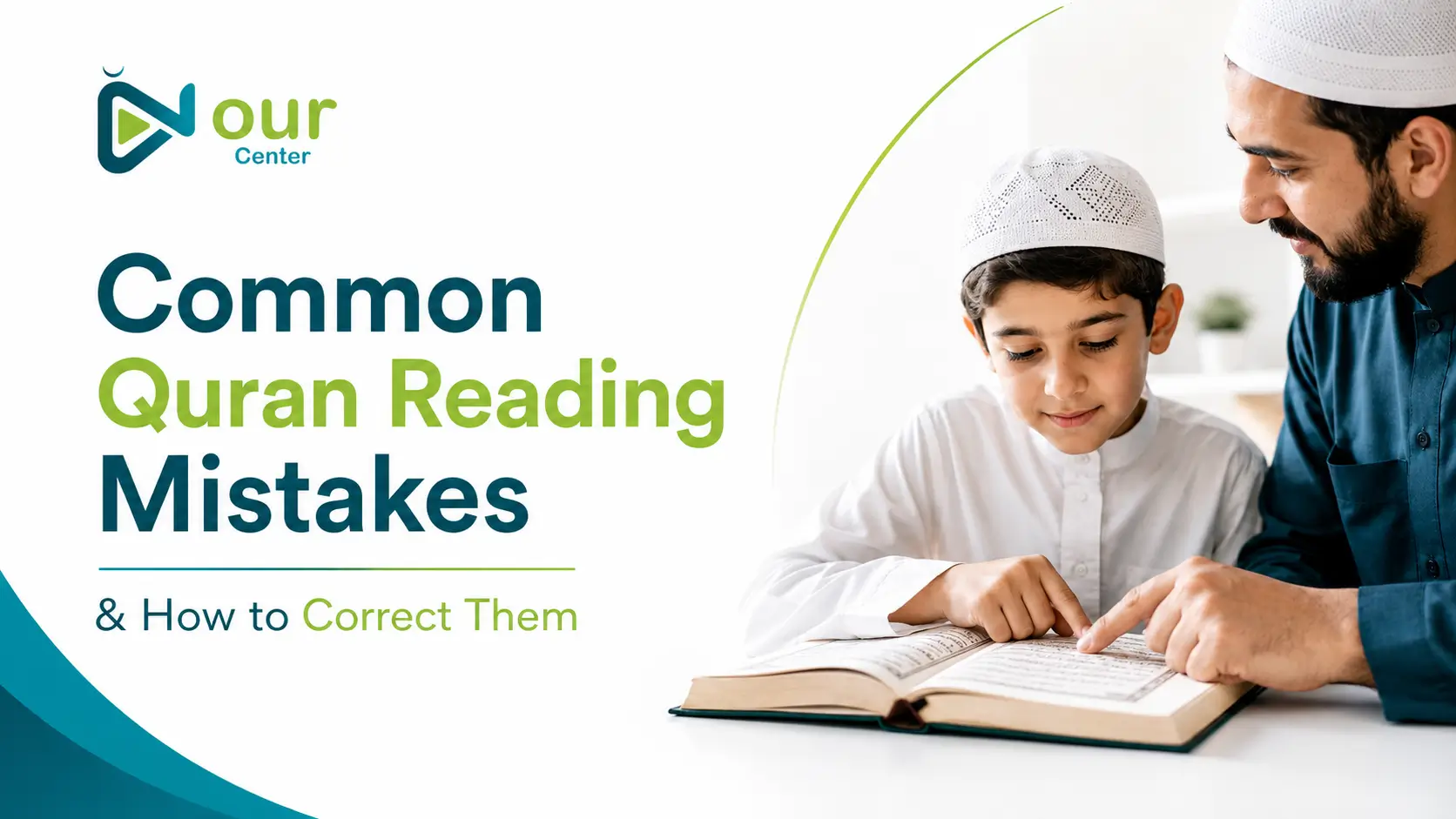
Discover the most common Quran reading mistakes beginners and children make, including pronunciation, Makharij, vowels,...
Read Article →
Help your child memorize the Quran with a realistic Hifz plan built around correct recitation, small daily portions, reg...
Read Article →