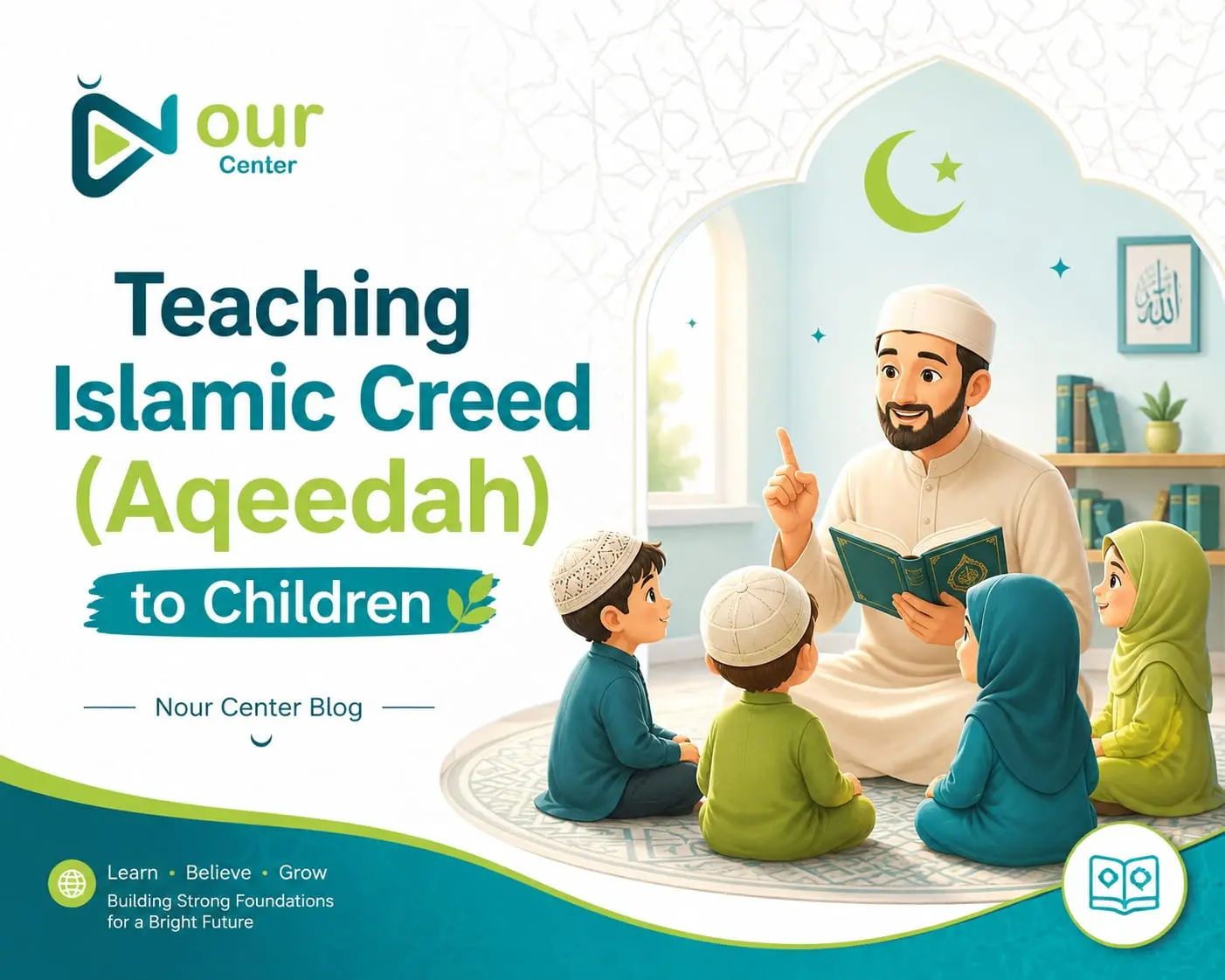
The journey of building a Muslim child's character begins with planting the seeds of faith in their heart and mind from a young age. Teaching Islamic Creed (Aqeedah) to children is not merely about memorizing information; it is about building a solid psychological and moral fortress that will accompany them throughout their lives. In this article, we at Nour Center provide a comprehensive guide to simplifying the concepts of Aqeedah for little ones in an engaging and accessible way.
What is Islamic Creed? (Simplified for Children)
Aqeedah is the firm belief and unwavering certainty in the heart. To simplify this concept for a child, we can compare Aqeedah to a good, healthy tree: its roots are deeply planted in the earth (faith in the heart), and its beautiful branches reach up to the sky (good deeds and morals).
The Islamic Creed is based on the Six Pillars of Faith (Iman), which we explain to children at Nour Center as follows:
- Belief in Allah: Believing that Allah is the Great Creator and the Provider who loves and cares for us, and that He is unlike any of His creations.
- Belief in the Angels: They are pure creatures created by Allah from light. They always obey Allah, and among them is the Angel Jibril (Gabriel), peace be upon him.
- Belief in the Holy Books: Believing that Allah sent down books to teach people goodness, the last and greatest of which is the Holy Quran.
- Belief in the Prophets: They are human beings chosen by Allah to teach people good morals and how to worship Him. The final messenger is our Prophet Muhammad ﷺ, who is our ultimate role model.
- Belief in the Day of Judgment: This is the day when Allah rewards those who do good with beautiful Jannah (Paradise), where they will have everything they ever wish for.
- Belief in Divine Decree (Qadar): Knowing that everything that happens to us is by Allah's knowledge and wisdom, and that Allah always chooses what is best for us, even if we don't immediately understand why.
Why Should We Teach Aqeedah Early? - Educators are keen on introducing Aqeedah at an early age for several core reasons:
- A Sense of Security: A child's belief that there is a strong, merciful God watching over and protecting them provides immense peace of mind and psychological stability.
- Building an Internal Conscience: Aqeedah plants the seed of self-monitoring in a child. They learn right from wrong because they know Allah sees them, not just out of fear of their parents' punishment.
- Answering Innate Questions: Children are born with a massive curiosity about the universe ("Who made the sky?", "Where do people go after they die?"). Correct Aqeedah provides clear, comforting answers to these natural questions.
Nour Center’s Methodology for Instilling Faith
- At Nour Center, we believe that education should be interactive and enjoyable, especially when dealing with abstract concepts. Our educational platform relies on:
- Educational Stories: Using Quranic stories and the stories of the Prophets to simplify concepts and bring them closer to the child's understanding.
- Reflecting on Creation: Linking the child's faith to their surrounding environment (the sky, stars, animals) to reinforce their belief in the greatness of the Creator.
- Dialogue and Persuasion: Encouraging children to ask questions, completely avoiding fear and intimidation tactics, and focusing instead on Allah's boundless love and mercy
Teaching the Islamic Creed to children is a lifelong investment in their future and happiness in both worlds. Let’s make this journey an experience filled with love and discovery. We at Nour Center are delighted to be your partners in building a conscious, believing generation that deeply loves its religion..
Frequently Asked Questions
What is the right age to start teaching Aqeedah to a child?
You can start as early as three years old indirectly by connecting blessings to Allah (e.g., saying, "Alhamdulillah, Allah gave us this delicious food"). By age seven, you can begin teaching the pillars of faith systematically and simply
How do I answer my child's questions like "Where is Allah?" or "What does He look like?"
Answer simply and truthfully in a way that suits their age. You can say: "Allah is above the heavens. He is very great and does not look like anything we see in this world. We cannot see Him now, but we will see Him in Jannah, Insha'Allah." Avoid making up fictional answers.
My child is afraid when we talk about death and Hellfire, what should I do?
In early childhood, the focus must be exclusively on Allah's love, mercy, and Jannah (Paradise). Hellfire and punishment should not be discussed with young children so that religion does not become associated with fear and anxiety in their minds.
How can I evaluate my child's understanding of the Pillars of Faith?
The best way is through observation and daily dialogue. Ask open-ended questions like: "What should we say when we see something beautiful?" or "Who helps us when we are in trouble?"
How can "Nour Center" programs help me in this mission?
The center offers innovative educational materials and lesson plans specifically tailored to match the cognitive development of children. This helps parents and teachers present religious content in a professional, smooth, and engaging manner
Comments
No comments yet. Be the first to comment.
Note: Comments may require approval
before appearing publicly.