Tajweed for Kids: A Beginner’s Guide to Correct Quran Recitation
Learn Tajweed for kids step by step, from correct Arabic pronunciation and Makharij to Madd, Ghunnah, Qalqalah, stopping...
Read Article →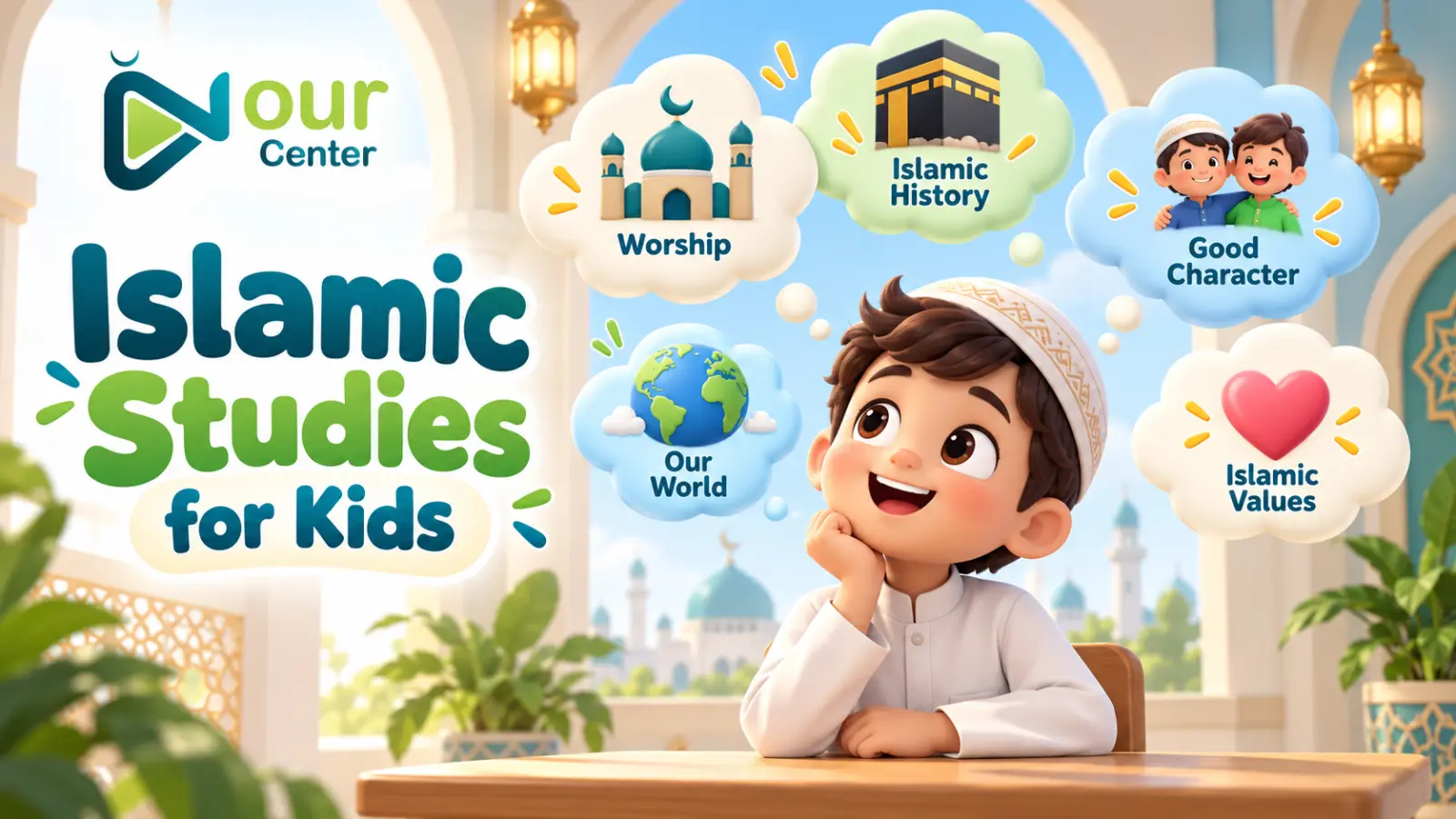
A Complete Beginner's Guide
Islamic Studies for Kids can help children understand their faith, develop good character, learn how to worship Allah, and see Islam as something that shapes everyday life rather than a collection of facts to memorize. For young learners, Islamic education should be clear, gradual, encouraging, and appropriate for their age. A child does not need to begin with complicated theological terminology or lengthy legal discussions.
Who is Allah? Why did Allah create us? What does it mean to be Muslim? Who was Prophet Muhammad? What is the Quran? Why do Muslims pray? What are the Five Pillars of Islam? What are the Six Pillars of Iman? How should a Muslim treat parents, family, friends, neighbors, and other people? How can a child ask Allah for help? These questions create the foundation for a much deeper Islamic education later.
Aqidah and belief. The Five Pillars of Islam. The Six Pillars of Iman. Quran learning. Salah. Dua and Dhikr. Seerah. Stories of the Prophets. Islamic manners. Good character. Basic halal and haram awareness. Everyday Islamic habits. Love of Allah and His Messenger. Responsibility and accountability. Respect for parents and others. This guide explains Islamic Studies for Kids step by step and shows parents and learners what a balanced beginner Islamic education can include.
What Are Islamic Studies for Kids? Islamic Studies for Kids refers to age-appropriate learning that teaches children the foundations of Islam. It is broader than Quran reading alone. A child may learn to read Quran beautifully while still needing lessons about: Belief. Worship. Character. The Prophet's life. Islamic manners. Daily responsibilities. Likewise, a child may know many Islamic facts but still need help applying them in everyday life.
A balanced Islamic Studies program brings these areas together.
“How much information can the child memorize?”
“What does the child understand, remember, believe, and know how to practice?” Why Are Islamic Studies Important for Children? Children naturally ask questions. They want to know why things happen and why their families do certain things.
Why do we pray five times a day? Why do we fast Ramadan? Why do we say Bismillah? Why do we read Quran? Why should we tell the truth? Why do Muslims make Dua? Why do we follow Prophet Muhammad? These questions are opportunities for meaningful Islamic education. If children receive clear explanations, they can begin connecting Islamic practice with understanding.
A clear Muslim identity. Love for Allah. Love for the Prophet Muhammad. Respect for the Quran. Awareness of worship. Good manners. Personal responsibility. A desire to learn more. This foundation becomes increasingly valuable as children grow older and encounter more complicated questions.
One of the most important foundations of Islamic Studies is helping children understand who Allah is. Young learners can begin with simple truths. Allah is the Creator. Allah created people, animals, the earth, the heavens, and everything that exists. Allah knows everything. Allah hears and sees. Allah is Merciful. Allah provides for His creation. Allah alone deserves worship. The lesson should help the child develop both knowledge and love.
Islamic belief should not be presented only as a list of definitions.
Children should gradually understand that worship, Dua, gratitude, trust, and obedience are connected to knowing Allah.
Tawhid is the foundation of Islam.
We worship Allah alone. We make our worship for Allah. We ask Allah for help and depend upon Him while also taking the practical steps available to us. We thank Allah for His blessings. We learn about Allah through what Islam teaches us. As children mature, teachers can gradually introduce more detailed Aqidah concepts. The important point is to build the foundation clearly without introducing unnecessary confusion.
Children should understand the Shahadah as the central declaration of Islam. It teaches that Allah alone deserves worship and that Muhammad is the Messenger of Allah. Do not let the Shahadah become only a sentence that a child repeats. Explain its meaning gradually.
We worship Allah alone. We believe Prophet Muhammad was sent by Allah. We follow what the Prophet taught. We try to live as Muslims. The Shahadah connects belief to action.
The Five Pillars provide an excellent structure for beginner Islamic Studies.
Shahadah. Salah. Zakah. Fasting Ramadan. Hajj. Children can learn the names early. Then each pillar can be studied separately. Young learners do not need every legal detail immediately. They first need to understand what each pillar represents.
The Shahadah is the declaration of faith. It establishes the central beliefs upon which Muslim life is built. Teach children that Islam begins with belief. Actions are then connected to that belief.
Salah is the five daily prayer.
Why Muslims pray. The names of the five prayers. Wudu. Prayer times. Prayer movements. What is recited according to their learning level. How to behave during prayer. Why concentration and respect matter. Salah should be taught practically, not only theoretically. Children learn effectively by watching, practicing, and receiving gentle correction.
Helping eligible people in need. Sharing from the wealth Allah has provided. Caring about others. Obeying Allah. As the learner becomes older, more detailed rules can be introduced. Do not confuse the child by presenting complex calculations before they understand the purpose and basic concept.
Ramadan is one of the easiest Islamic subjects to connect with a child's lived experience.
Wake for Suhoor. Fast. Break the fast at Maghrib. Pray more. Read Quran. Make Dua. Give charity. Teach children that fasting is an act of worship.
Patience. Self-control. Gratitude. Generosity. Quran connection. Good character. Children who are not yet required to fast can still learn about Ramadan and participate in age-appropriate family activities.
Children can learn the basic story and purpose of Hajj long before studying detailed rulings.
Makkah. The Ka'bah. Pilgrims gathering to worship Allah. Ihram. Tawaf. Arafah. The connection of Hajj with Prophet Ibrahim and his family. As the learner becomes older, the steps and rulings can be studied more precisely.
Islamic Studies for Kids should also introduce the Six Pillars of Iman.
Allah. His angels. His Books. His Messengers. The Last Day. Divine decree. For children, each topic should be explained at an appropriate level.
This returns to the foundation of Tawhid. Children learn that Allah is their Creator and Lord and that worship belongs to Him alone. Belief in the Angels Children can learn that angels are part of the unseen creation of Allah and obey Him. Avoid filling lessons with imaginative details that are not supported by reliable Islamic sources. Children do not need fantasy added to Islamic belief to make the subject interesting.
The authentic teachings themselves are sufficient. Belief in the Revealed Books Children can learn that Allah sent revelation to guide people and that the Quran is the final revealed Book given to Prophet Muhammad. This creates a natural connection to Quran study. Belief in the Messengers Allah sent messengers to guide people.
Adam. Nuh. Ibrahim. Musa. Isa. Muhammad.
Faith. Patience. Obedience. Trust in Allah. Courage. Truthfulness. Avoid presenting prophets merely as entertaining historical characters. Their stories teach faith and guidance. Belief in the Last Day Children should gradually learn that life has purpose and that people are accountable to Allah. Age-appropriate teaching is important here. The goal is not to frighten young children unnecessarily.
Accountability. Allah's justice. Hope. Mercy. Good deeds. Repentance. Preparing for the Hereafter.
Children can begin with a simple understanding that Allah knows and decrees all things and that Muslims trust Him while still making choices, taking responsibility, making Dua, and doing what is right. More detailed theological questions can be introduced later according to the child's age and maturity. Teach the Quran as Guidance The Quran should be central to children's Islamic education. Children should understand that the Quran is not simply a book used during lessons.
It is the revelation of Allah and a source of guidance for Muslims.
Arabic letter recognition. Reading. Pronunciation. Tajweed. Memorization. Understanding age-appropriate meanings. Applying lessons. Children who are beginning Quran reading can use Arabic Alphabet for Beginners to strengthen letter recognition before moving into more advanced Islamic learning activities. A child who cannot yet read Arabic can still learn about the Quran's importance and listen to Quran recitation while developing reading skills.
A complete beginner should not be expected to read long passages immediately.
Arabic letters. Letter sounds. Harakat. Sukoon. Shaddah. Tanween. Joining letters. Reading words. Reading short Quranic passages. Basic Tajweed. This gradual approach reduces frustration. Families who want a structured reading foundation may also use Noorani Qaida for Kids to help children progress from Arabic letters and vowel marks toward more confident Quran reading. The goal should be accurate and sustainable progress.
Memorization can be a valuable part of Islamic education. But Hifz should not become a race.
A manageable amount. With accurate pronunciation. With consistent review. With some understanding appropriate to their level. Short Surahs are often useful for beginners because children can use them in Salah.
New memorization. Old revision. Teacher correction. Listening. Repetition. Patience. Parents should avoid comparing children constantly. Different children memorize at different speeds.
Even young children can learn basic meanings.
What is it generally about? What does it teach us? What should we remember from it? Age-appropriate understanding can make memorization more meaningful. As reading develops, students ready to connect Arabic reading with meaning can progress to Quranic Arabic for Beginners to begin recognizing recurring vocabulary and simple language patterns. This builds a bridge between recitation and comprehension.
Tajweed can begin gradually once a child has enough reading ability.
Correct letter pronunciation. Clear Makharij. Accurate short vowels. Basic Madd. Avoiding major reading mistakes. Then additional rules can be added progressively. Older children who can already read may benefit from Basic Tajweed Rules as they begin refining Quran pronunciation beyond simple letter recognition. Children should not be overwhelmed with technical terminology before they can apply the basic sound. Sometimes imitation should come before definition.
Salah is one of the most important practical areas of Islamic Studies for Kids. A child needs more than a written list of steps. Use demonstration.
How to prepare. How to make Wudu. How to stand. How to perform Ruku. How to perform Sujud. How to sit. How the prayer ends. What is recited according to the child's learning stage. Practice repeatedly. Correct calmly. The goal is to help prayer become familiar and meaningful.
Fajr. Dhuhr. Asr. Maghrib. Isha.
When each prayer occurs. How many obligatory units each has. How to prepare for the prayer. The importance of praying on time. Younger children may begin with recognition and participation. Older children can build greater independence.
Wudu is a practical skill. Children usually learn it best through demonstration.
Why Muslims make Wudu. Which parts are washed. The correct basic sequence. What invalidates Wudu at an age-appropriate level. Let the child practice. A parent or teacher can observe and gently correct missing steps. This practical approach is more effective than memorizing a paragraph about Wudu.
Children should understand that Salah is worship and a connection with Allah. Teaching should emphasize both responsibility and meaning.
Praying together as a family when possible. Preparing calmly for prayer. Helping children learn short Surahs. Celebrating progress without turning worship into a competition. Answering their questions. Modeling consistent prayer. Children notice adult behavior. A parent who repeatedly talks about the importance of Salah but regularly delays it sends a conflicting message.
Dua is one of the most accessible forms of worship for children.
Guidance. Help. Protection. Forgiveness. Goodness. Benefit for their family. Success in what is good. A child does not need to wait until they memorize many formal supplications before making Dua. They can also ask Allah sincerely for good things using language they understand. Over time, teach authentic daily Duas from reliable sources.
Children can gradually learn supplications connected with daily routines such as: Before eating. After eating. Before sleeping. After waking. Entering or leaving appropriate places. Travel. Seeking protection. Asking forgiveness. Do not give a child twenty Duas in one lesson. Teach one. Use it every day. Then add another. Repeated use creates long-term memory.
Children can also learn simple forms of remembrance. The lesson should explain that Dhikr is worship and remembrance of Allah, not simply words repeated mechanically. Teach the meaning when appropriate.
Gratitude. Love. Hope. Repentance. Awareness of Allah.
Seerah is a major part of Islamic Studies for Kids. Children should know who Prophet Muhammad was.
His family and early life. His reputation for honesty. The beginning of revelation. His patience during hardship. His treatment of others. The Hijrah. Life in Madinah. His leadership. His mercy. His worship. His final years. Seerah helps children see Islamic principles in action.
A child does not only need dates.
What can we learn from this event? What did the Prophet do? What character did he show? How can we apply that today?
Truthfulness. Patience. Forgiveness. Courage. Mercy. Responsibility. Reliance upon Allah. Good treatment of others. This makes history relevant. Teaching Love for the Prophet Muslim children should grow in love and respect for Prophet Muhammad.
Learning about his life. Following his authentic Sunnah. Respecting his teachings. Following his example of worship and character. Children should understand that following the Prophet is part of Muslim life, not simply admiring a historical personality. Stories of the Prophets for Kids Stories of earlier prophets can teach important lessons. But they should come from reliable Islamic sources.
Legends. Unverified dramatic stories. Modern fictional additions presented as fact. If a detail is unknown, it is better not to invent it. Children can still enjoy a well-told lesson without fictionalizing Islamic history.
Islamic education should affect behavior. A child who memorizes many facts but consistently behaves badly needs help connecting knowledge with character.
Truthfulness. Kindness. Patience. Respect. Humility. Keeping promises. Helping others. Using good words. Controlling anger. Sharing. Forgiving. Being grateful. Avoiding mockery. Respecting privacy. Treating animals well. Caring for the environment and property.
How does this lesson change our behavior?
Children should learn the importance of honoring parents.
Speaking respectfully. Helping at home. Showing gratitude. Listening to reasonable instructions. Making Dua for parents. Avoiding rude speech. At the same time, Islamic teaching should never be used to tell a child to accept abuse or dangerous behavior. Children should know they can speak to a safe and trusted adult if they are being harmed.
Listen when someone is teaching. Ask questions politely. Do not mock mistakes. Respect classmates. Take care of learning materials. Complete responsibilities. Thank those who help them. These habits benefit both Islamic education and general learning.
A Muslim child should learn how faith affects friendship.
Tell the truth. Do not bully. Do not insult. Do not spread private information. Help friends when appropriate. Apologize when wrong. Forgive. Choose good influences. Avoid encouraging harmful behavior. These are practical lessons children can understand.
Do this. Do not do that. Rules are important. But they should also understand the purpose of responsibility.
Why do Muslims tell the truth? Why is stealing wrong? Why should we care for other people's property? Why should we control anger? Why do we apologize? Understanding develops moral reasoning alongside obedience.
Children can gradually learn that Islam provides guidance about what is permitted and prohibited. Start with clear age-appropriate examples. Avoid overwhelming very young learners with complex disputed legal questions.
Honest speech. Food basics. Stealing. Cheating. Hurting others. Respecting privacy. Behavior online for older children. Responsible use of money. As children mature, Islamic rulings can become more detailed.
Children make mistakes. Islamic education should teach them what to do afterward.
Recognize the mistake. Stop the wrong action. Feel genuine regret. Ask Allah for forgiveness. Correct harm when appropriate. Try not to return to the mistake. This creates responsibility without making a child believe one mistake permanently defines them.
Hope. Fear of wrongdoing. Love. Responsibility. Mercy. Accountability. Do not make Islam feel to a child like a constant list of threats. At the same time, do not teach that actions have no consequences. Balanced teaching helps children understand both Allah's mercy and the seriousness of moral responsibility.
Short stories. Pictures that respect Islamic guidelines. Simple questions. Role play. Games. Matching exercises. Short Quran listening. Repeated daily Duas. Practical Salah demonstrations. Positive examples. Lessons should be short. A five-year-old should not be expected to sit through an hour of abstract theology. Use repetition and activity. Islamic Studies for Ages 7 to 10 Children in this age range can often handle more structured learning.
Five Pillars. Six Pillars of Iman. Wudu. Salah. Short Surahs. Basic Tajweed. Seerah. Stories of Prophets. Daily Duas. Islamic manners. Basic halal and haram. Simple accountability. Lessons should still include activities and questions.
Older children can begin exploring deeper questions.
Evidence for belief. Why Muslims worship Allah. Purpose of life. More detailed Salah. Fasting rulings. Responsibility. Friendship. Online behavior. Modesty. Peer pressure. More detailed Seerah. Basic Fiqh. Islamic identity. Respectful discussion of doubts and questions.
“Do not ask that question” can be counterproductive. Good teachers take sincere questions seriously.
Questions are part of learning.
Where is Allah? Why do we pray? Why can't we see angels? Why did Allah create people? Why does Allah test us? Why do Muslims follow the Prophet? Why are some things halal and others haram? Do not mock the child for asking. If you know the answer, explain it appropriately.
“I don't know. Let's find a reliable answer.” This teaches honesty and intellectual confidence.
Quran. Authentic Sunnah. Established Islamic teachings. Scholarly explanation. Cultural practices. Personal opinion. Not every family tradition is an Islamic rule. Not every viral story is authentic. Not every quote online is a Hadith. Teachers and parents should verify material before teaching children.
Children remember stories extremely well. This makes fabricated religious stories especially problematic. If a dramatic story is later discovered to be false, the child may become confused about what else they were taught. Use authentic material. If an illustration or fictional scenario is used purely as a teaching activity, make clear that it is an example rather than a historical religious event.
Muslim families come from many cultures.
Arab culture. South Asian culture. African culture. Turkish culture. Western Muslim culture. Or any single community. Cultural practices can be good, neutral, or problematic.
“This is something our family does.”
“This is something Islam requires.” This is especially valuable for children growing up in multicultural environments.
Children should feel comfortable understanding themselves as Muslims.
Knowing what Muslims believe. Understanding worship. Being confident asking questions. Respecting others. Keeping good character. Avoiding embarrassment about Islamic practice. Knowing that Muslims live in many cultures and countries. Identity should be built through knowledge and practice rather than slogans alone.
Children should learn how Islamic manners apply outside the home.
Being honest in exams. Not cheating. Respecting teachers. Treating classmates well. Avoiding bullying. Keeping promises. Taking care of school property. Being responsible with homework. Respectfully handling differences. Islam is not limited to the mosque or Quran lesson. Character follows the child into everyday life.
Older children increasingly spend time online. Islamic character should apply there too.
Do not insult people behind a screen. Do not share someone's private information. Do not spread rumors. Do not deliberately embarrass others. Avoid inappropriate content. Ask a parent or trusted adult when something online feels unsafe. Think before posting. Digital manners are part of modern character education.
Parents do not need to turn the home into a formal classroom. Small habits can make Islamic learning part of family life.
Pray together. Review one Dua. Read a short Islamic story. Ask what the child learned in class. Discuss one character lesson. Listen to Quran. Review memorization. Talk about gratitude. Answer questions. Model the behavior being taught. Consistency is more important than creating a complicated home curriculum.
Children observe adults.
Tell the truth. but frequently lies in front of the child, the practical lesson is stronger than the verbal lesson.
Respect others. but regularly insults people, the child notices.
Prayer. Honesty. Patience. Apology. Gratitude. Respect. Learning. Nobody models these perfectly. What matters is taking the values seriously and correcting mistakes.
Islamic education can happen naturally. A child sees someone in need. Discuss generosity. A child loses patience. Discuss anger. The family receives good news. Discuss gratitude. The child makes a mistake. Discuss repentance. A beautiful part of creation catches the child's attention. Discuss Allah as Creator. Short natural conversations can sometimes teach more effectively than long formal lectures. How Often Should Kids Study Islamic Studies?
Age. Attention span. School workload. Quran lessons. Family schedule. Learning goals. For many children, shorter regular lessons are more effective than occasional long sessions.
Two or three structured lessons per week. Plus short daily Islamic habits.
Salah. Dua. Short Quran review. A brief family reminder. The exact schedule should remain realistic.
Review the previous lesson.
Learn one new concept.
Story, example, or activity.
Ask questions.
One practical action to apply. This format works well for younger learners.
Review.
New Islamic Studies topic.
Quran or Hadith-related learning appropriate to the lesson.
Activity or discussion.
Questions.
Practical takeaway and homework. Older children may be able to study longer.
Aqidah.
Quran and reading.
Salah or worship.
Seerah or Prophets.
Islamic manners.
Dua and practical review.
Family review or application. This is only one possible structure. Topics can be combined according to the child's schedule.
Children forget. That is normal. A curriculum that constantly introduces new information without revision may look impressive but produce weak retention.
Five Pillars. Six Pillars of Iman. Prayer names. Daily Duas. Previously studied Seerah. Islamic manners. Past vocabulary. Use quizzes and games. Revision should be part of the curriculum.
Teaching Only Memorization
Memorization is valuable. But children also need understanding.
What does this mean? Why is it important? How can we apply it?
Making Islamic Studies Frightening
Accountability is part of Islam. But constantly frightening children can create an unhealthy understanding of religion.
Allah's mercy. Hope. Love. Responsibility. Repentance. Consequences. Balance matters.
Teaching Rules Without Purpose
Children remember rules better when they understand what the lesson is teaching. Explain at an appropriate level.
Giving Answers the Child Cannot Understand
A technically correct answer can still be unsuitable for a six-year-old. Simplify without changing the core truth. Then add detail as the child matures.
Refusing Questions
Children should be able to ask sincere questions. A safe learning environment strengthens understanding.
Using Weak or Fabricated Stories
Verify Islamic content. Do not use a dramatic story merely because it is popular online.
Confusing Culture With Religion
Teach children which practices are Islamic requirements and which are cultural habits.
Ignoring Character
Islamic Studies is incomplete if it never affects behavior. Connect every topic to real life when possible.
Comparing Children
One child memorizes quickly. Another asks deeper questions. Another reads well. Another excels in practical application. Teach the learner in front of you.
Making Lessons Too Long
Attention declines. Short effective lessons often outperform long exhausting sessions.
Expecting Adult-Level Understanding
Children develop gradually. Teach foundational concepts first. Advanced theological and legal detail can come later.
Teaching Without Application
Practice giving.
Make Dua.
Practice Salah.
Choose one behavior to improve. Application strengthens memory.
Ignoring the Child's Reading Level
A child studying Islam may need support with Arabic reading. Islamic Studies and Quran skills can develop together.
Using Shame as the Main Motivation
Shaming children can damage their relationship with learning. Correct mistakes clearly but respectfully. Encourage improvement.
Expecting Teachers to Do Everything
Parents have an important role. A child who receives one Islamic Studies lesson a week but no reinforcement at home may forget much of it. Small family habits can greatly strengthen learning.
Fun does not mean turning every religious lesson into entertainment. It means using teaching methods that help children participate.
Quizzes. Matching games. Timelines. Maps. Flashcards. Story sequencing. Role-play for manners. Salah demonstrations. Dua challenges. Family projects. Question cards. The content remains meaningful. The method becomes more engaging.
Create a Five Pillars poster. Match each prayer with its time of day. Build a Seerah timeline. Keep a gratitude journal. Practice Wudu step by step. Choose one good character habit for the week. Learn one new Dua. Create cards for the Six Pillars of Iman. Identify Islamic manners in everyday scenarios. Review Quran vocabulary. Activities should reinforce the lesson rather than distract from it.
Do not measure Islamic Studies only through written exams. Look for several types of progress.
Can the child explain the Five Pillars?
Can the child explain why Muslims pray?
Can the child perform Wudu correctly for their level?
Is the child trying to apply honesty and kindness?
Is Quran reading improving?
Does the child remember previous lessons?
Is the learner becoming more thoughtful? Progress can appear in different forms.
Some families begin Islamic learning together. A parent may be new to Islam. A child may also be learning from the beginning. This can be a beautiful opportunity. Do not feel required to learn everything immediately.
Who Allah is. Shahadah. Salah. Basic Quran learning. Five Pillars. Six Pillars of Iman. Daily Islamic habits. Good character. Learn progressively as a family.
A child does not need to speak Arabic fluently before learning Islam. Islamic concepts can be explained in the language the child understands best. At the same time, gradually introduce important Islamic terminology such as: Allah. Islam. Iman. Salah. Dua. Quran. Sunnah. Seerah. Tawhid. This allows understanding to develop alongside familiarity with Islamic vocabulary.
Arabic learning can help children access more Islamic material over time. Islamic Studies can also motivate Arabic learning. A child who understands why Quran is important may become more motivated to learn Arabic letters. A child studying Dua may want to improve pronunciation. A child learning Seerah may become curious about Arabic vocabulary. The subjects support one another.
At Nour Center, one-to-one online Islamic Studies lessons can be adapted according to the child's age, current knowledge, reading ability, and family goals.
Knowing Allah. Tawhid. Five Pillars of Islam. Six Pillars of Iman. Salah. Wudu. Quran learning. Daily Duas. Seerah. Stories of the Prophets. Islamic manners. Good character. Basic halal and haram. Muslim identity. Age-appropriate questions. Lessons can also connect with Quran and Arabic study so that the child does not experience each subject as completely separate.
Children learn at different speeds.
Know the Five Pillars but struggle with Salah.
Read Quran well but know little Seerah.
Know Islamic stories but need stronger Aqidah foundations.
Have many questions. One-to-one teaching allows the teacher to adapt. The lesson can spend less time on what the child already knows and more time on the areas that need development.
“Did you memorize the answer?”
“Can you explain it?” “Why is it important?” “What would you do in this situation?” “How can we use this lesson today?” These questions turn passive knowledge into understanding. What Should Parents Look for in an Online Islamic Studies Course?
Reliable Islamic content. Age-appropriate explanations. A structured curriculum. Qualified teachers. Opportunities for questions. Practical worship instruction. Character education. Revision. Clear communication with parents. Flexible pacing. A safe online learning environment. The best course is not necessarily the one that covers the most pages. It is the one that helps the child learn, understand, remember, and apply.
Knowing Allah and basic Tawhid.
Shahadah and Muslim identity.
Five Pillars.
Six Pillars of Iman.
Wudu and Salah.
Quran reading and basic Tajweed.
Daily Dua and Dhikr.
Seerah.
Stories of Prophets.
Islamic manners and character.
Basic halal and haram.
More detailed Fiqh, Aqidah, and Islamic history as the child matures. The topics can overlap. The roadmap simply keeps the learning organized. What Comes After This Guide? This article provides the overall foundation for the Islamic Studies for Kids series. The next lessons will explore major topics separately.
Simple Guide for Young Muslims.
Six Pillars of Iman for Kids. How to Teach Salah to Kids Step by Step. Islamic Manners for Kids. Dua for Kids. Each article will develop one part of the foundation in greater detail.
Islamic Studies for Kids should help children know Islam, understand its foundations, practice worship, build good character, and develop a meaningful relationship with their faith.
Knowing Allah. Tawhid. The Shahadah. Five Pillars of Islam. Six Pillars of Iman. Quran. Salah. Wudu. Dua. Dhikr. Seerah. Stories of the Prophets. Islamic manners. Basic halal and haram. Muslim identity. Responsibility. Repentance. Good character.
Gradual. Reliable. Age appropriate. Interactive. Practical. Encouraging. Do not reduce Islamic education to memorizing answers. Help children understand. Let them ask sincere questions. Show them how worship is practiced. Connect lessons to everyday life. Use reliable Islamic sources. Review old lessons. Adapt the pace to the child.
Most importantly, help children see Islam not only as a subject they study for thirty minutes each week, but as guidance that shapes worship, family life, friendship, honesty, gratitude, responsibility, and the choices they make every day.
With a strong foundation, children can continue growing into more detailed study of Aqidah, Fiqh, Seerah, Quran, Arabic, and Islamic character as they mature.
Note: Comments may require approval before appearing publicly.
Learn Tajweed for kids step by step, from correct Arabic pronunciation and Makharij to Madd, Ghunnah, Qalqalah, stopping...
Read Article →
Help your child memorize the Quran with a realistic Hifz plan built around correct recitation, small daily portions, reg...
Read Article →
Discover the most common Quran reading mistakes beginners and children make, including pronunciation, Makharij, vowels,...
Read Article →
Learn where children should start memorizing Juz Amma, which short Surahs to begin with, how to build a gradual Hifz ord...
Read Article →