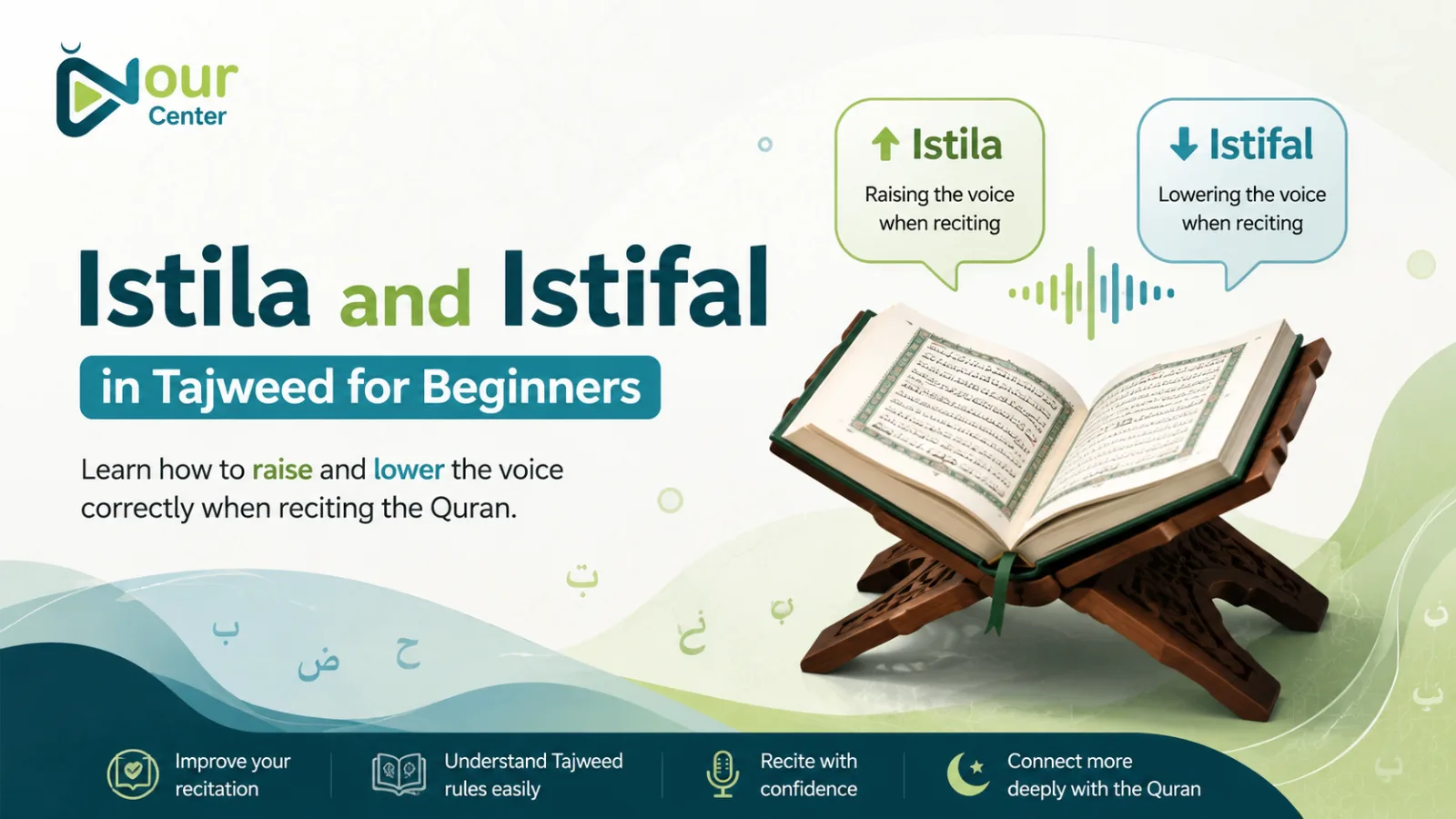
Isti'la and Istifal in Tajweed for Beginners: Understanding Heavy and Light Tongue Position
Learn Isti'la and Istifal in Tajweed for beginners, the seven elevated letters, tongue position, heavy and light pronunc...
Read Article →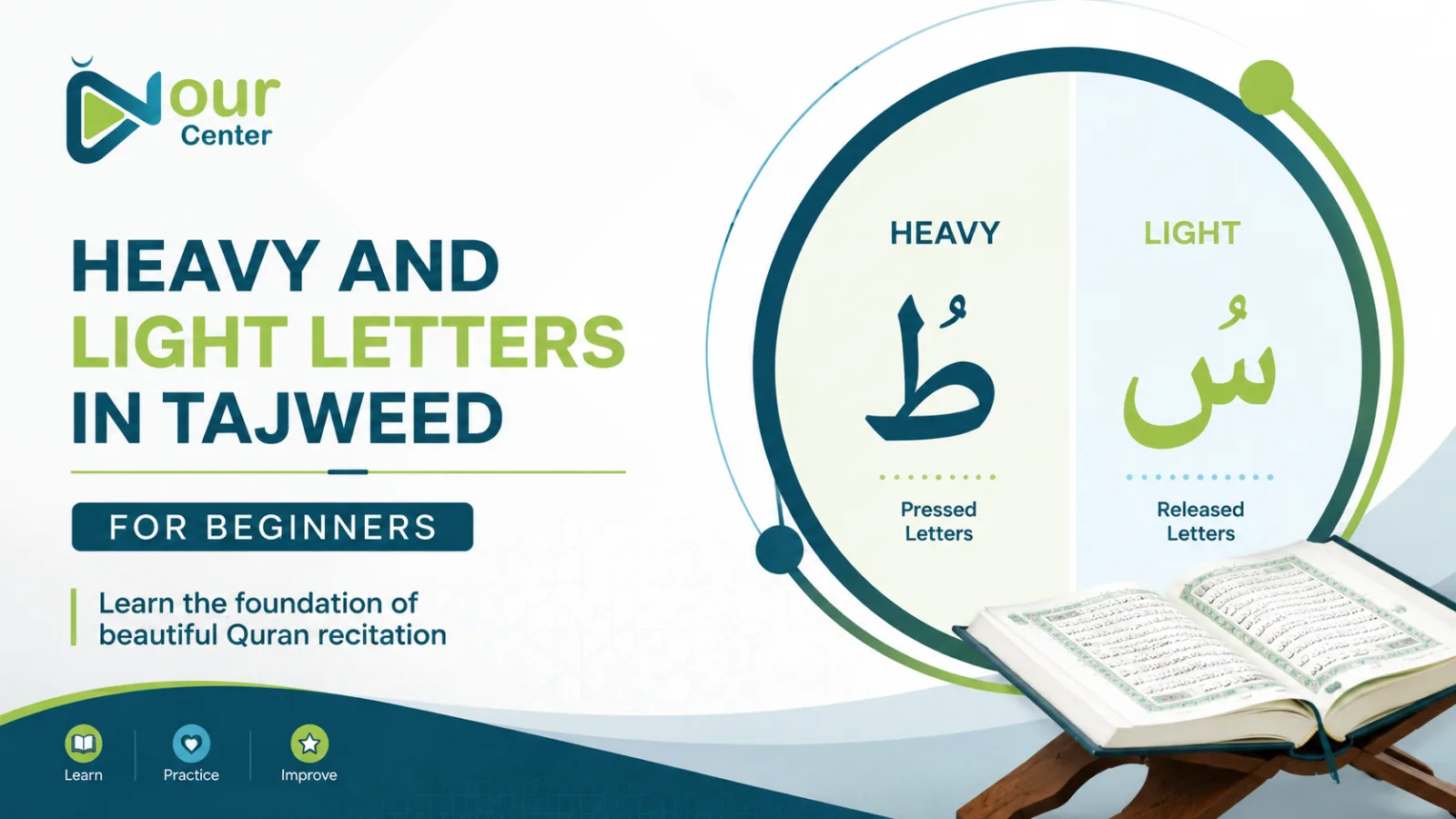
Tafkhim and Tarqiq Explained
Heavy and light letters are an important part of correct Quran pronunciation. A learner may pronounce the correct Arabic letter from the correct articulation point but still make the word sound inaccurate if the letter is made too heavy or too light. In Tajweed, heaviness is commonly associated with Tafkhim, while lightness is associated with Tarqiq.
Some Arabic letters are naturally pronounced with a fuller, heavier quality. Most other letters are generally pronounced with a lighter quality. A few letters, especially Ra and the Lam in the name of Allah, can change between heavy and light pronunciation depending on their surrounding vowels and recitation conditions. This means that correct Tajweed does not depend only on knowing which letter you see.
You also need to know how that letter should sound in its particular context.
This guide explains heavy and light letters in Tajweed for beginners, the meaning of Tafkhim and Tarqiq, the main heavy letters, how vowels affect sound quality, common pronunciation mistakes, and practical exercises for improving Quran recitation. What Is Tafkhim in Tajweed? Tafkhim means giving a letter a fuller or heavier sound. A heavy letter has a deeper and broader sound quality than a light letter. This does not mean shouting.
It does not mean lowering the voice dramatically. It also does not mean stretching the letter. The heaviness comes from the quality of articulation itself. A beginner should learn to hear the difference before trying to exaggerate the physical movement. Correct Tafkhim sounds full and controlled. What Is Tarqiq in Tajweed? Tarqiq means pronouncing a letter with a lighter sound quality. Most Arabic letters are generally light unless a specific rule makes them heavy.
Light pronunciation should remain clear. A light letter is not weak. It should still come from its correct articulation point and retain its full identity.
Light does not mean unclear. Heavy does not mean loud. Both must be precise.
Arabic pronunciation is sensitive to sound quality. If a naturally heavy letter is pronounced too lightly, it may sound closer to another letter. If a light letter is exaggerated, the word may lose its proper sound.
Differentiate similar Arabic letters. Improve Quran pronunciation. Maintain accurate Makharij. Avoid introducing foreign accent patterns. Develop clearer listening skills. Read more naturally. Apply the rules of Ra and Lam correctly. Build stronger Tajweed fluency. Students who already understand Makharij for Beginners will find Tafkhim and Tarqiq easier because correct articulation gives the heavy or light quality a stable foundation.
A group of Arabic letters is consistently associated with heavy pronunciation. These are commonly taught as the letters of Isti'la.
Kha. Sad. Dad. Ghayn. Ta emphatic. Qaf. Za emphatic. These seven letters should generally retain their heavy quality. For beginners, memorizing this group is an important first step. However, memorization alone is not enough. The learner also needs to hear what heaviness sounds like. What Does a Heavy Letter Sound Like? A heavy letter has a fuller resonance. The sound feels broader than its light counterpart.
The back of the tongue often plays an important role in creating this quality.
But beginners should avoid forcing the tongue upward excessively.
Teacher demonstration. Listening. Makharij practice. Repetition. Quran examples. Trying to imitate heaviness without proper articulation can create distortion.
One of the most common beginner misunderstandings is to pronounce heavy letters more loudly. Volume and heaviness are different. You can pronounce a heavy letter quietly and it should still sound heavy. You can pronounce a light letter loudly and it should remain light. The distinction is sound quality, not volume.
Another common mistake is extending heavy letters unnecessarily. Tafkhim does not create Madd. A heavy letter should not be lengthened unless a separate Madd rule applies. Students who learned Madd Rules for Beginners should keep these concepts separate. Madd controls length. Tafkhim controls sound quality. They may occur together, but they are not the same rule.
Heavy letters remain heavy, but the strength of their heavy quality can vary depending on the vowel. A letter with Fathah may sound somewhat different from the same letter with Dammah or Kasrah. For beginners, the most important objective is not memorizing every level of Tafkhim immediately.
The letter is heavy. Keep its identity. Do not turn it into a light sound. Advanced distinctions can be refined later with a teacher.
When a heavy letter carries Fathah, the learner should preserve a full sound. Do not make the vowel excessively wide. The heaviness belongs to the consonant quality. The vowel itself should remain correct.
Dammah naturally involves rounded lips. When combined with a heavy consonant, beginners may exaggerate the depth of the sound. The teacher should help the learner keep the pronunciation controlled. The letter remains heavy without becoming unnatural.
Kasrah can make heavy-letter pronunciation difficult for beginners because they may automatically lighten the consonant too much. The heavy letter should still retain its characteristic quality. However, its degree of heaviness may sound less strong than in some other vowel conditions. For beginners, simply avoid turning the letter into its light counterpart.
Sad is heavy. Seen is light. They are not interchangeable. Beginners sometimes pronounce Sad too lightly and make it resemble Seen.
Listen to both letters. Say them separately. Compare their articulation. Then practice short vowel combinations. Correct Makharij helps preserve the difference.
The emphatic Ta is heavy. Ordinary Ta is light. If the heavy letter is weakened, it may begin to resemble ordinary Ta. If ordinary Ta is exaggerated, it may become unnecessarily heavy. Practice them side by side. This comparison is especially useful for non-Arabic speakers.
The emphatic Za has a heavy sound quality. Learners who do not have this sound in their native language may replace it with a lighter consonant. The solution is not simply speaking more strongly. The learner must develop correct articulation and heaviness together.
Qaf is heavy. Kaf is light. Both involve the back portion of the tongue but are articulated differently. Beginners may weaken Qaf and make it sound closer to Kaf. A strong Makharij foundation helps prevent this. The learner should hear the full quality of Qaf without adding an unnecessary vowel or Qalqalah when no Qalqalah condition exists.
Kha has a heavy quality and throat articulation. Some learners pronounce it too lightly. Others exaggerate the friction and make it harsh. Correct pronunciation should remain clear and controlled. Teacher feedback is particularly useful because throat sounds can be difficult to evaluate independently. What Are Light Letters? Arabic letters outside the consistently heavy group are generally light unless a specific rule changes their pronunciation.
This means the majority of Arabic letters should not receive the same deep sound quality as the heavy letters.
A beginner should avoid transferring heaviness from one letter to neighboring letters. This is a very common problem. For example, a heavy letter may influence the learner to make the next light consonant unnecessarily heavy. Each letter must keep its own sound quality.
Heavy letters can influence how beginners perceive neighboring vowels and consonants. This does not mean those letters automatically become heavy. The learner needs to keep each sound independent.
Read the heavy letter. Then the neighboring light letter. Pause. Repeat. Then connect them naturally. This helps prevent heaviness from spreading through the whole word. What Is Tarqiq in Practice? Tarqiq is the opposite of exaggerated heaviness. The letter remains lighter and clearer. The learner should avoid pulling the tongue backward unnecessarily. A light letter should sound natural. It should not become thin to the point of weakness.
Clear. Accurate. Light. Not weak.
Ra is especially important because it can be pronounced with Tafkhim or Tarqiq depending on its condition. This makes Ra different from the seven consistently heavy letters. Beginners should not use one Ra sound everywhere. Sometimes Ra is heavy. Sometimes Ra is light. The surrounding vowels and other conditions determine which pronunciation is correct. When Is Ra Heavy? At a beginner level, Ra is commonly heavy in several situations involving Fathah or Dammah.
The exact rules become more detailed when Sukoon and surrounding vowels are involved.
Ra with Fathah commonly has a heavy quality. Ra with Dammah commonly has a heavy quality. Some Ra with Sukoon conditions are also heavy. A dedicated Ra lesson is useful because the rule deserves separate attention. When Is Ra Light? Ra is commonly light when it carries Kasrah. There are also specific Sukoon conditions that make Ra light. Again, beginners should not try to master every exception in one lesson.
First learn to distinguish heavy Ra from light Ra by sound. Then add the detailed conditions gradually.
One Sound Everywhere
Many beginners settle into one habitual Ra pronunciation. Some make every Ra heavy. Others make every Ra light. Both approaches create errors. Train the ear by comparing examples.
Heavy Ra. Light Ra. Heavy Ra. Light Ra. Then ask the learner to identify the difference.
Lam is generally pronounced lightly. However, there is one especially important context where learners study heaviness: The Lam in the name of Allah. Its pronunciation can change depending on the vowel immediately before the name. This rule should be learned carefully because the word appears very frequently in Islamic recitation and speech. Lam in the Name of Allah The Lam in the name Allah may be heavy or light depending on the preceding vowel.
After Fathah or Dammah, the Lam is commonly pronounced heavy. After Kasrah, the Lam is pronounced light. This is an important practical rule and an early introduction to context-dependent Tafkhim and Tarqiq.
Tajweed pronunciation often depends on context. The same written letter can behave differently because of what comes before or after it. This is why beginners should avoid reading letter by letter without noticing connections.
The letter. Its vowel. The previous sound. The following sound. The specific Tajweed rule.
Tafkhim cannot compensate for incorrect Makharij. If Qaf is articulated incorrectly, making the voice deeper will not fix it. If Sad is produced from the wrong place, exaggerated heaviness will not make it correct. Students who have learned Basic Tajweed Rules should continue applying Makharij while studying Tafkhim and Tarqiq. Correct articulation comes first. Sound quality is then refined.
Some heavy letters are also Qalqalah letters. For example, Qaf and Ta emphatic can appear in Qalqalah conditions. This does not mean heaviness and Qalqalah are the same rule. Tafkhim = heavy sound quality. Qalqalah = controlled release when the Qalqalah condition applies. A heavy letter may need both rules at the same time. For a complete explanation of the echoing rule, read What Is Qalqalah before comparing Qalqalah with Tafkhim.
Each rule should remain distinct.
A Madd letter may occur after a heavy consonant. The learner may notice that the vowel quality is affected by the surrounding pronunciation. However, Madd length must remain controlled according to its own rule. Do not increase Madd counts simply because the consonant is heavy. Length and heaviness are separate dimensions of recitation.
Ghunnah is nasal resonance. Tafkhim is heavy sound quality. These should not be confused. A learner who has studied Ghunnah in Tajweed for Beginners should not make nasal sounds heavy simply because a nearby consonant is heavy. The Ghunnah should remain correct while the surrounding consonants maintain their own qualities.
Some students learn that heavy pronunciation sounds deeper and then begin applying that style throughout their recitation. This often happens when they imitate a reciter's overall voice rather than individual Tajweed rules. Tajweed is not about making the whole recitation sound deep. It is about giving each letter its correct quality. Heavy letters remain heavy. Light letters remain light.
Making Every Letter Heavy
This can make Arabic pronunciation sound unnatural.
Alif. Lam. Meem. Noon. Ta. Seen. Other naturally light letters. The learner should isolate the heavy consonant rather than allowing heaviness to spread.
Making Heavy Letters Too Light
This is especially common among beginners whose first language does not contain emphatic Arabic consonants. The letter may sound like a lighter Arabic consonant. Teacher comparison can help. Listen to the heavy letter and its closest light counterpart side by side.
Using Volume Instead of Tafkhim
Speaking more loudly does not create correct heaviness. Try pronouncing the heavy letter quietly. If the sound quality remains heavy, the articulation is developing correctly. This is a useful self-test.
Pulling the Whole Mouth Back
Learners sometimes force the entire mouth or jaw backward while attempting heavy pronunciation. This creates tension. Tafkhim should come from correct articulation, not exaggerated facial movement. Relaxed precision is better than force.
Distorting the Vowel
A learner may make the consonant heavy but change the vowel too much. For example, Fathah may become excessively broad. The consonant should remain heavy while the vowel maintains its correct identity. Teacher listening is useful for this subtle distinction.
Making Ra Always Heavy
Ra has both heavy and light conditions. Do not use one pronunciation automatically. Learn the surrounding vowel pattern. Then practice examples from the Quran.
Making Lam in Allah Always Heavy
The Lam in Allah does not always have the same sound quality. When preceded by Kasrah, it is light. This is a common beginner correction. Practice examples of both conditions.
Forgetting Neighboring Light Letters
A heavy letter can cause the learner to make the entire syllable or word heavy. Practice isolating the heavy consonant and returning immediately to a lighter sound when the next letter requires it.
Start with the seven heavy letters. Do not begin with complete verses.
The isolated consonant. The consonant with Fathah. The consonant with Dammah. The consonant with Kasrah. Then compare it with a similar light letter. After that, move into Quran words. This makes correction much easier.
Choose several common light letters. Pronounce them clearly. Make sure you are not pulling the tongue backward. Then place a heavy letter beside them. Practice moving from heavy to light.
Heavy sound. Light sound. Heavy sound. Light sound. This contrast trains the tongue and ear.
Sad and Seen. Qaf and Kaf. Heavy Ta and light Ta. Heavy Ra and light Ra. Listen first without repeating. Identify which sound is heavy. Then repeat each pair. Listening discrimination often improves pronunciation.
Review the seven heavy letters.
Practice heavy letters with short vowels.
Compare heavy and light pairs.
Practice heavy and light Ra.
Read a short Quran phrase. This can be repeated daily.
Review heavy letters.
Practice Sad, Dad, and the emphatic letters.
Practice Qaf, Kha, and Ghayn.
Compare heavy and light Ra.
Practice Lam in the name Allah.
Read a short passage naturally.
Understand Tafkhim and Tarqiq
Listen to clear heavy and light examples.
Learn the Seven Heavy Letters
Memorize and pronounce the group.
Compare Similar Letters
Practice Sad vs Seen, Qaf vs Kaf, and emphatic vs light sounds.
Practice Vowel Changes
Read heavy letters with Fathah, Dammah, and Kasrah.
Compare heavy and light Ra examples.
Focus on the Lam in the name Allah.
Quran Reading Assessment
Read a short passage while the teacher checks heaviness, lightness, vowels, and Makharij.
Children can learn Tafkhim and Tarqiq through listening games.
Heavy. Light. Heavy. Light. Then ask the child to identify the sound. There is no need to begin with complex terminology. Once the child can hear and imitate the difference, introduce the words Tafkhim and Tarqiq gradually. Visual grouping can also help children remember the seven heavy letters. Should Children Memorize the Heavy Letters? Yes, but memorization should accompany pronunciation. A child who can list seven letters but pronounces them lightly still needs practice.
Learn two letters. Practice them. Add two more. Compare sounds. Complete the group. Use Quran examples. This combines memory and recitation.
Adults often understand the theory quickly. However, changing established pronunciation habits may take time. If a learner's native language lacks emphatic consonants, they may need repeated mouth-position and listening practice. The teacher can focus on one contrast at a time.
Sad vs Seen. Then Qaf vs Kaf. Then heavy and light Ra. Small corrections build stronger pronunciation. Can Tafkhim Be Learned Without a Teacher? Beginners can learn which letters are heavy from reliable educational material. Audio examples also help. However, self-correction can be difficult.
Increasing volume. Changing the vowel. Pulling the tongue too far back. Adding unnecessary tension. Making neighboring letters heavy. A qualified teacher can distinguish these problems immediately.
Record the same word several times.
Is the heavy letter clearly different? Did the vowel change? Did I increase volume unnecessarily? Did heaviness spread to the next letter? Is my Ra heavy or light according to the rule? Compare with a reliable model. Recording makes subtle sound habits easier to notice. Using a Mushaf for Practice Choose a short Quran passage. Mark the seven heavy letters for study. Identify Ra. Identify the Lam in the name Allah.
Read slowly. Pay attention to each heavy-light transition. Then read the passage again at a natural pace. The learner should eventually apply the rules without needing visual markings. How Often Should Beginners Practice? Five to ten minutes daily can produce better results than one long weekly practice session. Heavy pronunciation is partly a physical habit. Frequent short repetition gives the tongue time to adapt. Accuracy should come before speed.
Once the correct sound becomes stable, increase reading fluency.
Heavy and light pronunciation contains subtle differences.
Sad sounds like Seen. Qaf sounds too weak. A vowel is distorted. Ra is using the wrong quality. Lam is unnecessarily heavy. Heaviness spreads into nearby letters. The learner is using volume instead of correct Tafkhim. Immediate feedback saves time.
At Nour Center, live one-to-one Tajweed lessons can teach heavy and light letters according to the learner's current pronunciation level.
Makharij. Heavy letters. Light letters. Ra. Lam. Vowel quality. Qalqalah. Madd. Ghunnah. General Quran reading. The lesson can then focus on specific pronunciation contrasts. A learner who struggles with Qaf may receive focused Qaf and Kaf practice. Another learner may need more work on Ra. A third may exaggerate heaviness throughout entire words. Individual correction allows each student to work on the sounds that actually need improvement.
The seven heavy letters sound naturally full. You do not need to increase volume. Light letters remain light. Vowels stay accurate. Sad and Seen are clearly different. Qaf and Kaf are clearly different. Heavy and light Ra become easier to distinguish. Lam in the name Allah changes correctly according to context. Heaviness no longer spreads through the whole word. Your teacher corrects fewer examples. The final goal is automatic sound control.
What Should You Study Next? After learning the general principles of Tafkhim and Tarqiq, the next useful topic is the Rules of Ra. Ra deserves a dedicated lesson because it changes between heavy and light pronunciation depending on several conditions.
Rules of Lam. The Lam in Allah. Stopping and starting. Advanced Madd. More detailed Makharij. Advanced Tafkhim levels.
Heavy and Light Letters in Tajweed for Beginners become easier once the learner understands the basic distinction between Tafkhim and Tarqiq. Tafkhim means giving the correct letters a fuller, heavier sound. Tarqiq means maintaining a lighter sound quality. The seven main heavy letters should be memorized and practiced carefully. Most other letters remain light unless a specific rule changes them.
Beginners should pay special attention to Ra and the Lam in the name Allah because these letters can change according to context.
Heavy does not mean loud. Heavy does not mean long. Light does not mean weak. Makharij must remain correct. Vowels should not be distorted. Heaviness should not spread to neighboring letters. The best way to improve is through listening, heavy-light comparisons, short daily exercises, Quran practice, and qualified teacher correction. With consistent practice, Tafkhim and Tarqiq become natural parts of clear and accurate Quran recitation.
Note: Comments may require approval before appearing publicly.
Learn Isti'la and Istifal in Tajweed for beginners, the seven elevated letters, tongue position, heavy and light pronunc...
Read Article →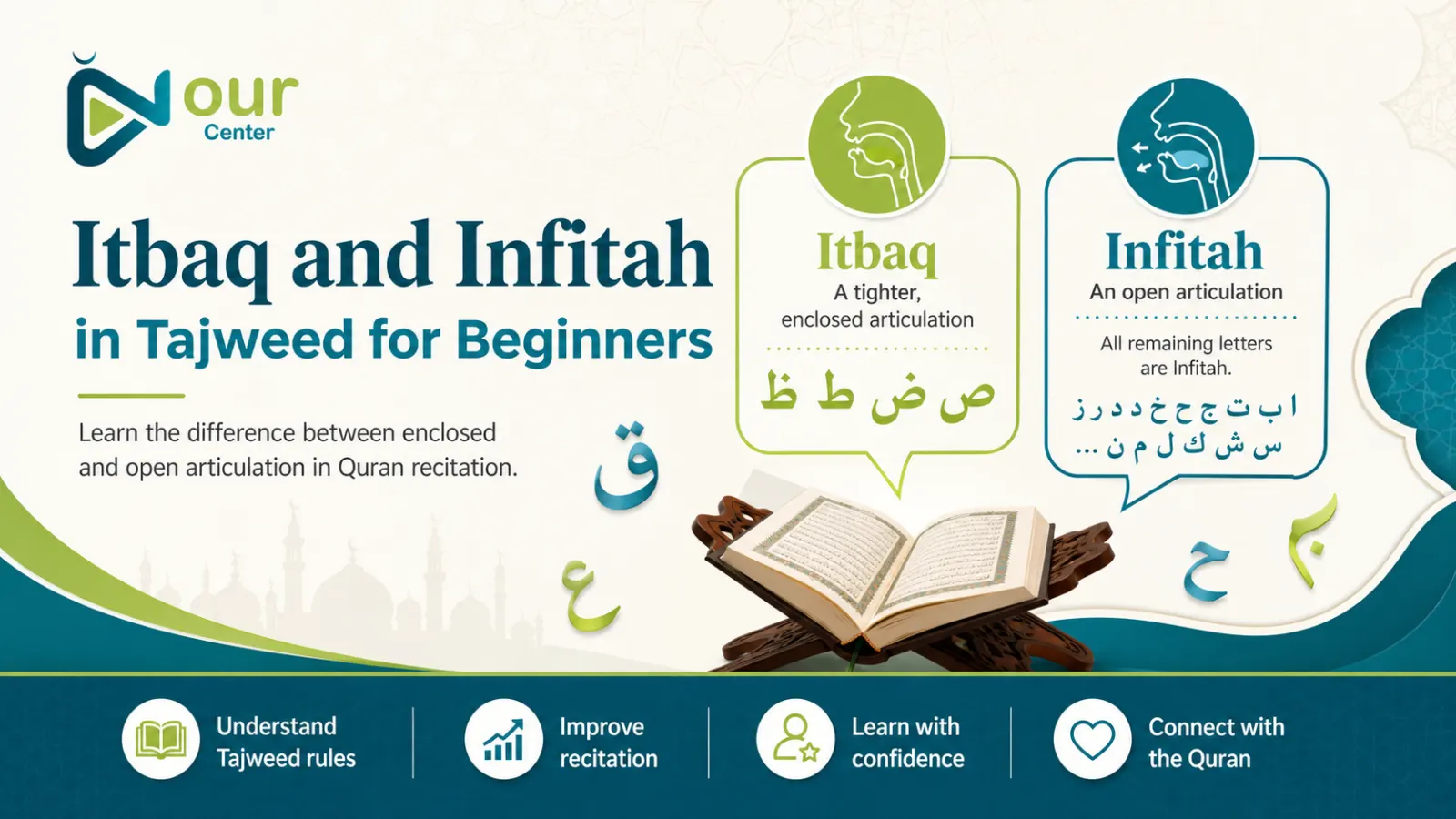
Learn Itbaq and Infitah in Tajweed for beginners, the four Itbaq letters, tongue position, heavy pronunciation, common m...
Read Article →
Learn Hams and Jahr in Tajweed for beginners, including their letters, breath flow, sound differences, common mistakes,...
Read Article →
Learn the basic Tajweed rules every beginner should know, including Makharij, Madd, Ghunnah, Qalqalah, Noon Sakinah, Mee...
Read Article →