Islamic Studies for Kids: A Complete Beginner's Guide
Discover Islamic Studies for Kids with a clear beginner guide covering faith, the Five Pillars, Quran learning, Salah, S...
Read Article →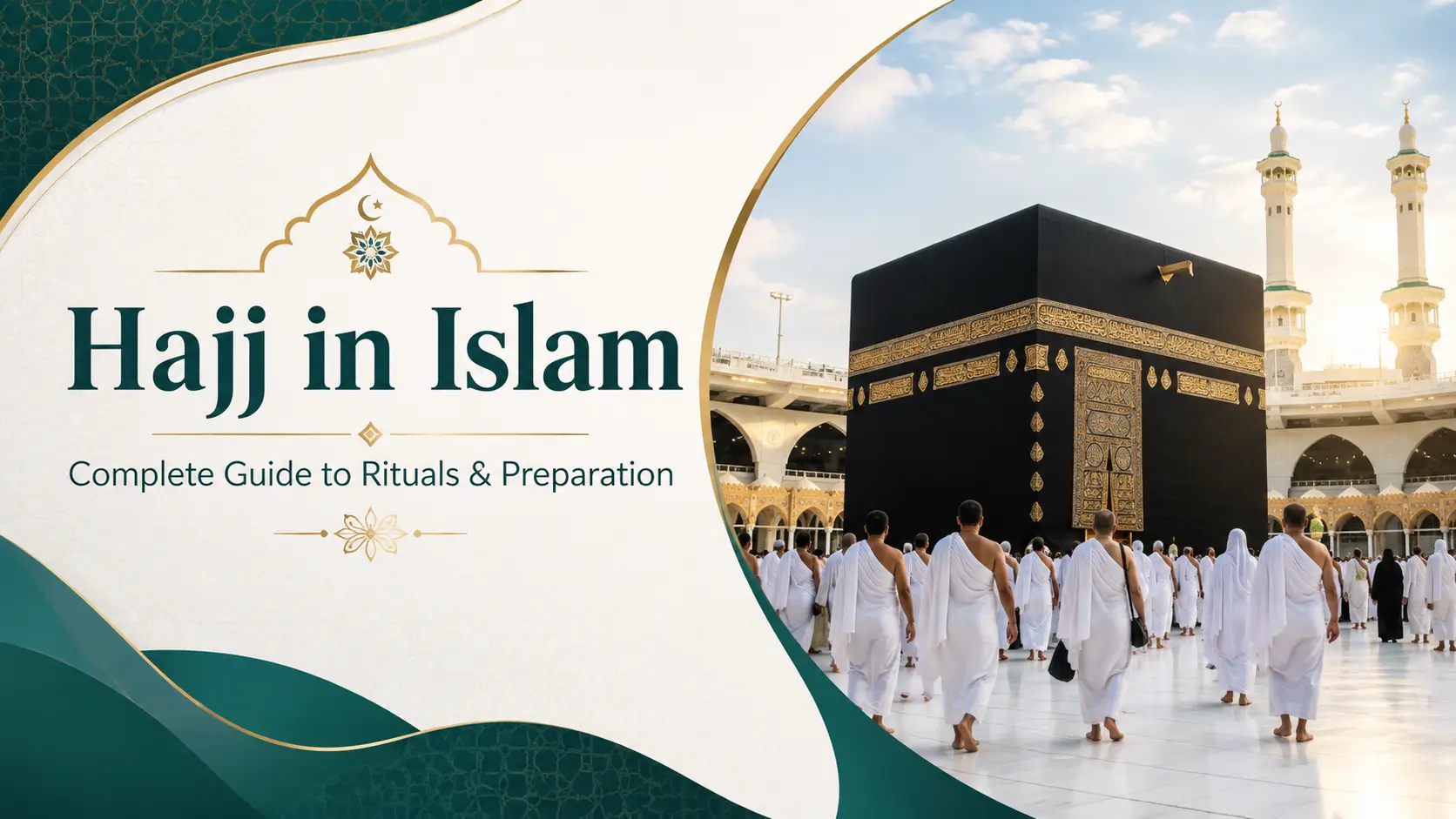
A Complete Guide to the Pilgrimage, Rituals, Meaning, and Lessons
Hajj is one of the greatest acts of worship in Islam. Every year, Muslims from different countries, cultures, languages, and backgrounds travel to Makkah with one shared purpose: to worship Allah and perform the pilgrimage prescribed in Islam. For many Muslims, Hajj is the journey of a lifetime. It is not simply a physical trip to sacred places.
It is a deeply spiritual experience that teaches humility, patience, repentance, equality, sacrifice, and complete submission to Allah.
Understanding Hajj is important even for Muslims who have not yet performed it. Learning its meaning, conditions, rituals, and spiritual lessons can help Muslims appreciate one of the Five Pillars of Islam and prepare properly when the opportunity to perform Hajj comes. What Is Hajj in Islam? Hajj is the major Islamic pilgrimage to Makkah in Saudi Arabia. It takes place during specific days of the Islamic month of Dhul Hijjah.
Muslims perform a series of acts of worship at sacred locations including the Kaaba, Mina, Arafah, and Muzdalifah. The word Hajj refers to intentionally traveling to the Sacred House of Allah to perform specific acts of worship at their prescribed times and places. Hajj is different from an ordinary journey. Every part of the pilgrimage is connected to worship, obedience, remembrance of Allah, and important events in Islamic history. Why Is Hajj Important?
Hajj is one of the Five Pillars of Islam. The Five Pillars form the foundation of a Muslim's religious practice: Shahadah, the testimony of faith. Salah, the five daily prayers. Zakah, obligatory charity. Sawm, fasting during Ramadan. Hajj, pilgrimage to Makkah for those who are able. Hajj therefore holds a central position in Islam. It reminds Muslims that worship is not limited to prayer or fasting.
A believer may also worship Allah through travel, patience, physical effort, financial sacrifice, remembrance, and obedience.
Who Must Perform Hajj? Hajj is required once in a lifetime for a Muslim who meets the necessary conditions. In general, a person should be Muslim, mature, mentally capable, physically able to undertake the journey, and financially able to pay for the pilgrimage without neglecting essential responsibilities. The ability to perform Hajj is an important condition. Islam does not require a Muslim to undertake a journey that is genuinely beyond his or her ability.
Financial preparation should also include the needs of dependents who remain at home. People with medical conditions or difficult personal circumstances should seek reliable religious and medical guidance before making arrangements. When Is Hajj Performed? Hajj takes place during Dhul Hijjah, the final month of the Islamic calendar. Although Muslims may visit Makkah for Umrah at different times of the year, the main rituals of Hajj occur during specific days of Dhul Hijjah.
The Day of Arafah, which falls on the ninth day of Dhul Hijjah, is one of the most important days of Hajj. Eid al-Adha follows on the tenth day of Dhul Hijjah. What Is Ihram? Ihram refers to the sacred state a pilgrim enters before performing Hajj or Umrah. For men, the visible clothing of Ihram usually consists of two simple unstitched white cloths.
Women wear modest Islamic clothing that meets the requirements of Islamic dress without using a special uniform identical to the men's Ihram.
Ihram is more than clothing. It is a state of worship with particular rules and restrictions. Before entering Ihram, pilgrims prepare themselves, make their intention, and begin reciting the Talbiyah. The Talbiyah expresses the pilgrim's response to the call of Allah and his or her readiness to worship Him.
The simplicity of Ihram carries powerful lessons. A wealthy person and a poor person stand beside one another without the usual signs of status or social position. The pilgrim is reminded that every human being is a servant of Allah. Ihram also reminds Muslims of death and the Hereafter because worldly distinctions become less important and attention turns toward worship and accountability. What Is Tawaf?
Tawaf is the act of walking around the Kaaba seven times.
Pilgrims perform Tawaf as an act of worship and devotion to Allah. Muslims do not worship the Kaaba. The Kaaba is the sacred direction toward which Muslims face during prayer, while worship belongs to Allah alone. During Tawaf, pilgrims may make dua, remember Allah, recite Quran, and reflect on their relationship with their Creator. Seeing thousands of Muslims moving together around the Kaaba is also a powerful reminder of the unity of the Muslim Ummah.
What Is Sa'i Between Safa and Marwah? Sa'i is performed by walking between the hills of Safa and Marwah seven times. This ritual is connected to the story of Hajar, the mother of Prophet Ismail. When she searched for water for her child, she moved between Safa and Marwah with trust in Allah while making every possible effort.
reliance upon Allah does not mean abandoning effort.
A believer trusts Allah while also taking practical steps. Sa'i therefore represents faith, effort, patience, hope, and dependence upon Allah. What Happens in Mina? During Hajj, pilgrims travel to Mina, an area near Makkah. Pilgrims stay there as part of the prescribed sequence of Hajj. The time spent in Mina includes prayer, remembrance of Allah, preparation for the Day of Arafah, and later the ritual of stoning the Jamarat.
Although the journey involves movement between several locations, every stage is connected to worship and obedience.
Why Is the Day of Arafah So Important? The Day of Arafah is one of the most important parts of Hajj. Pilgrims gather in the area of Arafah and spend the day in worship, remembrance, repentance, and dua. Standing at Arafah is an essential part of Hajj. It is often one of the most emotional moments of the pilgrimage.
People raise their hands in dua and ask Allah for forgiveness, guidance, mercy, and goodness for themselves, their families, and the Muslim Ummah.
Arafah reminds the believer of the Day of Judgment, when humanity will stand before Allah. It encourages sincere repentance and reflection on how a person has lived his or her life. What Happens at Muzdalifah? After leaving Arafah, pilgrims travel to Muzdalifah. They spend time there in worship and preparation for the next stage of Hajj. Pilgrims also collect small stones that may be used for the ritual of stoning the Jamarat.
The journey from Arafah to Muzdalifah teaches discipline and patience, especially because millions of people may be moving between the sacred sites during the same period. What Is the Stoning of the Jamarat? Pilgrims perform the ritual of throwing small stones at designated pillars known as the Jamarat. This ritual is associated with Prophet Ibrahim and his rejection of Satan's attempts to prevent him from obeying Allah.
The act teaches Muslims to resist temptation and reject anything that pulls them away from obedience to Allah.
The deeper lesson is not simply throwing stones. It is learning to recognize temptation, control harmful desires, and remain firm upon faith. Why Do Muslims Offer a Sacrifice During Hajj? Sacrifice during the days of Hajj is connected to the obedience of Prophet Ibrahim and his willingness to submit to the command of Allah. Muslims remember the importance of submission, sincerity, and trust.
The sacrifice also reminds believers that true devotion may require giving up something valuable for the sake of Allah.
Eid al-Adha, celebrated by Muslims around the world, occurs during this period. Cutting or Shaving the Hair After completing certain rituals, male pilgrims shave or shorten their hair. Women shorten a small portion of their hair. This marks an important stage in completing the pilgrimage and leaving some of the restrictions of Ihram. Like many elements of Hajj, it represents obedience and humility. What Is Tawaf al-Ifadah?
Tawaf al-Ifadah is one of the essential acts of Hajj.
Pilgrims return to the Sacred Mosque and perform Tawaf around the Kaaba. Depending on the type of Hajj being performed and the pilgrim's circumstances, Sa'i may also be required at the appropriate stage. Because the details of Hajj can differ according to the type of pilgrimage and Islamic legal rulings, pilgrims should study the rituals carefully with a qualified teacher before traveling. What Are the Main Types of Hajj?
There are three commonly discussed forms of Hajj.
The pilgrim performs Umrah during the Hajj season, leaves the state of Ihram, and later enters Ihram again for Hajj.
The pilgrim combines Hajj and Umrah within the same Ihram.
The pilgrim enters Ihram intending Hajj alone. Each type has specific rulings. Anyone preparing for Hajj should learn which form applies to his or her travel arrangement. What Is the Difference Between Hajj and Umrah? Hajj and Umrah both include worship at the Sacred Mosque in Makkah, but they are not identical. Hajj occurs during specific days of Dhul Hijjah and includes rituals such as standing at Arafah, staying at Muzdalifah, and visiting Mina.
Umrah may generally be performed throughout the year and involves fewer rituals. Hajj is one of the Five Pillars of Islam and is obligatory once in a lifetime for those who meet its conditions. Umrah has its own important place in Islamic worship, but its legal ruling is discussed separately by scholars.
One of the most visible lessons of Hajj is equality. Muslims arrive from Africa, Asia, Europe, North America, South America, Australia, and many other regions. They may speak different languages and belong to different cultures, but they worship the same Allah. During Hajj, social distinctions become much less important. People pray together, walk together, make dua together, and perform the same rituals.
The pilgrimage reminds Muslims that superiority is not based on wealth, nationality, race, or social status.
True honor comes through faith and righteousness.
Hajj requires patience. Pilgrims may experience heat, tiredness, crowds, long journeys, delays, unfamiliar surroundings, and physical discomfort. These challenges are part of the spiritual training of Hajj. A pilgrim should avoid unnecessary arguments, remain calm, treat other pilgrims kindly, and remember that everyone around them may also be tired. Learning to control anger during difficulty is one of the valuable lessons that can continue after returning home.
Many Muslims approach Hajj as an opportunity for sincere repentance. A pilgrim reflects on past mistakes and asks Allah for forgiveness. True repentance should also encourage a person to change. Returning from Hajj should ideally mark the beginning of a stronger relationship with Allah. The pilgrim should try to become more consistent in prayer, Quran, good character, honesty, family responsibilities, and avoidance of sin. Hajj and the Story of Prophet Ibrahim
Many rituals of Hajj are closely connected to Prophet Ibrahim, his wife Hajar, and their son Ismail. Their lives demonstrate remarkable trust in Allah. Hajar's search for water is remembered through Sa'i. Prophet Ibrahim's willingness to obey Allah is remembered during the days of sacrifice. The Kaaba is also deeply connected to the legacy of Ibrahim and Ismail. Learning these stories before traveling helps pilgrims understand that Hajj is not a collection of unrelated movements.
Its rituals carry lessons from the history of Tawhid, sacrifice, trust, and obedience. How Should a Muslim Prepare for Hajj? Good preparation should begin before boarding an airplane or entering Makkah. Learn the Rules of Hajj Pilgrims should study the sequence of rituals, conditions, obligations, restrictions of Ihram, and common mistakes. Learning beforehand reduces confusion during the pilgrimage.
A Muslim should try to correct his or her relationship with Allah before Hajj. This includes repenting from sins and making a serious intention to improve.
Debts and financial obligations should be taken seriously. A person should make appropriate arrangements before traveling.
If a person has wronged someone, Hajj preparation can be an opportunity to repair the relationship where possible.
Hajj involves considerable walking and movement. Regular walking before traveling may help pilgrims improve their stamina. People with medical conditions should seek professional medical advice.
Pilgrims may need comfortable footwear, suitable clothing, medication, identification documents, hygiene supplies, and other travel essentials.
Pilgrims should understand that they can make sincere dua in the language they understand. Preparing a personal list of duas may help them remember important requests during spiritually significant moments.
Some mistakes are caused by insufficient preparation. Pilgrims should avoid treating Hajj merely as tourism. Taking photographs, shopping, and social activity should never become more important than worship. Arguments should also be avoided as much as possible. Crowded conditions require patience and concern for the safety of other people. Another common mistake is becoming excessively worried about memorizing long lists of specific duas while forgetting sincerity and understanding.
It is better to make meaningful dua with presence of heart than to rush through words without reflection.
Pilgrims should also avoid following uncertain religious information from social media when qualified guidance is available. How Can Hajj Change a Muslim's Life? The impact of Hajj should continue after the journey ends. A successful spiritual experience should encourage lasting improvement. A Muslim may return with stronger commitment to prayer, greater love of the Quran, better treatment of family, more patience, increased charity, and greater awareness of the Hereafter.
One of the best signs of benefiting from worship is positive change afterward.
Hajj therefore should not be viewed only as an event that happened in the past. Its lessons can shape the believer's future.
Children can learn about Hajj even when they are too young to perform the pilgrimage themselves. Parents and teachers can explain the Kaaba, Ihram, Tawaf, Safa and Marwah, Arafah, Mina, Muzdalifah, and the story of Prophet Ibrahim in simple language. Maps, illustrations, stories, and practical activities can make the topic easier to understand.
Worshipping Allah alone.Trusting Allah.Helping others.Being patient.Treating Muslims equally.Following the example of the Prophets.Making sincere dua.Being grateful for Allah's blessings. This approach helps children understand that Hajj is much more than traveling to Makkah.
A Muslim who understands the meaning of the rituals can experience Hajj more consciously. For example, knowing the story behind Sa'i changes the way a pilgrim views the journey between Safa and Marwah. Understanding the meaning of Arafah helps a pilgrim appreciate the importance of dua and repentance. Knowing the lesson behind Ihram makes its simplicity more meaningful. Islamic education therefore plays an important role in preparing Muslims for Hajj.
Students can study Aqeedah, Fiqh, Seerah, Quran, and Islamic manners with qualified teachers before undertaking the pilgrimage. Hajj and the Unity of the Muslim Ummah Few experiences demonstrate the worldwide nature of Islam as clearly as Hajj. Millions of Muslims gather in one region while sharing the same fundamental beliefs and acts of worship. A pilgrim may pray beside someone from a country he has never visited and whose language he does not understand.
Yet both know why they are there. This experience can increase love for the Muslim Ummah and remind believers of their responsibility to care about Muslims beyond their own communities.
Hajj is a journey of faith, worship, repentance, patience, sacrifice, and unity. Its rituals connect Muslims with the legacy of Prophet Ibrahim and his family while directing the heart toward Allah alone. The journey begins with preparation, but its most important results should appear after the pilgrim returns home. A Muslim who learns the meaning of Hajj can better understand why this pilgrimage occupies such an important place in Islam.
Whether you are preparing to travel soon or simply studying the Five Pillars, learning Hajj step by step can strengthen your understanding of Islamic worship and help you appreciate the spiritual lessons behind every ritual. At Nour Center, students can learn Quran, Arabic, Islamic Studies, Aqeedah, Fiqh, and other essential subjects through structured online lessons with qualified teachers.
Learning the foundations of Islam before Hajj can help Muslims approach this important journey with greater understanding and confidence.
Note: Comments may require approval before appearing publicly.
Discover Islamic Studies for Kids with a clear beginner guide covering faith, the Five Pillars, Quran learning, Salah, S...
Read Article →
Learn how to learn Arabic online with a practical step-by-step plan covering the alphabet, pronunciation, reading, vocab...
Read Article →
Learn Quranic Arabic for beginners step by step, build essential Quran vocabulary, understand common word patterns, reco...
Read Article →
Learn how to read Arabic words for beginners step by step by combining connected letters, Harakat, Sukoon, Shaddah, and...
Read Article →