Arabic Alphabet for Beginners: Learn Arabic Letters Step by Step
Learn the Arabic alphabet for beginners step by step, discover all 28 Arabic letters, understand their shapes and sounds...
Read Article →
Learning How to Read Arabic Words for Beginners is the stage where separate Arabic lessons finally begin working together.
The 28 Arabic letters. Basic Arabic letter sounds. Fathah. Kasrah. Dammah. Sukoon. Shaddah. Tanween. How Arabic letters connect. But knowing these skills separately does not automatically mean that reading complete words will feel easy. The next challenge is combining them quickly and accurately. A beginner may look at a connected Arabic word and think: “I know all these letters, but I still cannot read the word smoothly.
” This is completely normal during the transition from letter recognition to real reading.
The solution is not to memorize hundreds of words. The solution is to develop a reliable decoding method. Students who have studied How to Join Arabic Letters and Read Words already have the visual foundation needed to recognize isolated, initial, medial, and final Arabic letter forms inside complete words. Now the goal is to turn those visual forms into sounds and blend those sounds into complete words.
This guide explains how to read Arabic words for beginners step by step, how to break words into manageable sound units, how to use Harakat, Sukoon, Shaddah, and Tanween, how to avoid guessing, and how to gradually build reading fluency.
What Does It Mean to Read an Arabic Word? Reading an Arabic word involves more than naming its letters.
Which letters are present? How are they connected? Which letters have Fathah, Kasrah, or Dammah? Is there Sukoon? Is there Shaddah? Is there Tanween? Are there long vowel patterns? Are any letters difficult to pronounce? Then the reader needs to combine everything into one continuous spoken word. This is called decoding. At first, decoding is slow. With practice, it becomes automatic.
Start From the Right
Arabic is read from right to left. This sounds simple, but beginners sometimes return unconsciously to left-to-right habits when a word becomes difficult. Always begin with the rightmost letter. Move gradually toward the left. Do not reverse the word mentally. Do not try to reorganize it into English reading direction. Train your eyes to follow Arabic naturally.
Identify the Letters
Before worrying about the vowels, identify the consonants.
What is the first letter? What is the second? What is the third? Continue until the whole word is visually clear. Do not rely only on the isolated alphabet shapes. Arabic letters can change form when connected.
At the beginning. In the middle. At the end. Or visually isolated because a previous letter breaks the connection. The letter remains the same. Only its shape changes.
ع but hesitate when Ayn appears in a medial form.
م but fail to recognize connected Meem. This does not mean the alphabet has been forgotten. The learner simply needs more exposure to connected forms.
The main shape. The dots. The connection pattern. Eventually the different forms become automatic.
Look at the Dots
Dots are essential parts of Arabic letters. They can distinguish letters that otherwise share almost the same basic shape.
ب ت ث
ج ح خ
د ذ
ر ز
س ش
ص ض
ط ظ
ع غ When a connected word looks confusing, dots can provide the fastest clue. Never treat dots as decoration. They identify the consonant.
Identify the Harakat
After recognizing the letters, examine the vowel marks. Students who understand Arabic Harakat for Beginners should identify Fathah, Kasrah, and Dammah before attempting to blend a new Arabic word.
a.
i.
u. For example, the same consonant can produce different sounds depending on the Harakah. A beginner should not guess the vowel from memory. Read the mark that is actually written.
In fully vocalized Arabic, Harakat guide pronunciation. Without them, beginners may know the consonants but not know which vowels belong between them. Educational Arabic books and Quran-learning materials therefore often use extensive vowel marks. At this stage, use them actively. Look at every relevant mark. Do not rush.
Check for Sukoon
Sukoon tells you that a consonant has no short vowel after it. Students who understand Sukoon in Arabic for Beginners should connect a Sakin consonant directly to the preceding sound instead of adding an extra Fathah, Kasrah, or Dammah. This is one of the biggest differences between reading isolated letter-vowel combinations and reading real Arabic words.
ba bi bu They may unconsciously add a vowel after every consonant. Sukoon prevents that. The consonant remains pronounced. But no new short vowel follows it.
Sukoon does not make the consonant disappear.
Pronounce the consonant. Do not add a vowel afterward.
Add an unnecessary vowel. Or skip the consonant. Both are incorrect.
Look for Shaddah
Shaddah represents a doubled consonant. Students who understand Shaddah in Arabic for Beginners should preserve the doubled consonant while reading complete words instead of treating the letter as though it appeared only once.
The first occurrence of the consonant is Sakin. The second occurrence carries the vowel. This means the reader needs to give the consonant enough articulation to preserve the doubling.
Skip the Shaddah. Make the vowel longer instead. Pause awkwardly. Shout the consonant. The goal is natural doubling.
A student may pronounce Shaddah correctly on an isolated exercise.
Letter shapes. Dots. Vowels. Sukoon. Word blending. The Shaddah may be overlooked.
ّ
Double this consonant.
Check the Word Ending for Tanween
Tanween often appears at the end of words.
Fathatain. Kasratain. Dammatain.
-an. -in. -un. Students should preserve these endings when reading connected Arabic. Do not stop at the final consonant and ignore the Tanween. A strong reading habit is to look all the way to the end of the word before speaking. Students who understand Tanween in Arabic for Beginners should read the final -an, -in, or -un sound when the relevant Tanween mark appears instead of stopping after the final consonant.
This is particularly important in fully vocalized Arabic and Quranic Arabic practice.
Separate the Word Into Sound Units
A long Arabic word may look intimidating. Do not try to process the whole visual form at once. Break it into smaller sound units.
First consonant + vowel. Second consonant with Sukoon. Third consonant + vowel. Doubled consonant. Final Tanween. Then read the units one by one. After that, blend them. This technique reduces cognitive overload.
Ba. Ta. Meem. Instead of producing the actual word sounds. Letter names are useful when learning the alphabet. Word reading requires letter sounds.
ba.
The long-term goal is immediate decoding. You see the written form and produce the sound.
Read the Sounds Slowly
Once you have identified the letters and marks, read each sound slowly. Do not rush. Accuracy is more important than speed.
Sound 1. Sound 2. Sound 3. That is acceptable. The next goal is to reduce the pauses gradually.
Blend the Sounds
Blending means connecting the individual sounds into one continuous word. This is one of the most important reading skills.
Sound A. Sound B. Sound C.
smoothly. Do not change the sounds. Simply reduce the pauses between them. This is how decoding becomes reading.
A beginner's brain is doing many jobs simultaneously.
Recognize the letters. Remember their sounds. Read the Harakat. Notice Sukoon. Notice Shaddah. Track reading direction. Pronounce difficult consonants. Blend everything. That is a lot of information. The solution is repetition. As individual skills become automatic, the brain has more attention available for blending.
Read the Word Again
After decoding a word slowly, read it again. The second reading should be smoother. Then read it a third time. This simple technique is extremely effective.
Decode.
Blend.
Build fluency. Do not immediately move to the next word after struggling through the first one once. Repeat until the pattern feels more stable.
Read Without Looking at Transliteration
Transliteration can help at the earliest stage. But it can also prevent real Arabic reading. If Arabic is written above an English transliteration, beginners often look at the Latin letters instead. This trains the wrong script. Gradually remove transliteration.
Arabic script → Arabic sound.
Arabic script → English letters → Arabic sound. Direct recognition creates stronger fluency.
A useful beginner approach is to scan from right to left and identify pronunciation groups.
Letters with short vowels. Letters with Sukoon. Letters with Shaddah. Long vowel structures. Tanween endings. Do not necessarily divide according to English-style syllable rules. The goal is simply to create manageable reading chunks. After the chunks are correct, blend the full word.
An experienced reader can process upcoming letters while speaking. Beginners can start developing this skill slowly. Before pronouncing the first sound, glance across the full word.
Any Shaddah? Any Sukoon? Any difficult letter? Any Tanween? This quick scan helps prevent surprises halfway through the word. Do not stare for ten seconds. A brief preview is enough.
Familiar consonants. Simple Harakat. No unusual combinations.
Sukoon.
Shaddah.
Tanween.
Longer words. This progressive order is much better than jumping immediately into the hardest text available. The brain builds fluency through successful repetition.
Some Arabic consonants are more challenging for non-native speakers.
ح خ ع غ ق ص ض ط ظ A beginner may pronounce these accurately in isolation but lose them inside a word. This is normal.
Slow the word down. Establish the Makhrij. Read the surrounding vowels. Blend again. Do not permanently replace the difficult letter with an easier one.
Visual confusion can also cause errors.
ب ت ث ج ح خ د ذ ر ز س ش ص ض ط ظ ع غ
Shape. Dots. Position. Context. Do not guess based only on the first half of the letter.
س and ص ت and ط د and ض ه and ح ك and ق ء and ع ح and خ خ and غ This is why reading practice should continue alongside pronunciation practice. Fluency should never come at the cost of changing the consonants.
Many beginners want to read quickly. But speed built on guessing creates weak reading habits.
Correct. Smooth. Then fast. If you read a word accurately in five seconds today and two seconds next week, that is progress. Do not force speed before recognition is stable.
When a learner recognizes the first few letters of a familiar word, they may guess the remainder. Sometimes the guess is correct. This creates false confidence. Then the habit produces errors with unfamiliar words. Read all the letters. Read all the marks. Do not turn Arabic reading into a memory game. Reading unfamiliar words accurately is the true test of decoding.
Use words you have never studied before. Fully vocalized beginner material is ideal. Cover the meaning if necessary. Focus only on reading. If you can decode unfamiliar words correctly, your reading system is becoming stronger.
Reading the same word repeatedly can improve fluency. But repetition should be used carefully. If you memorize the word visually, you may stop decoding.
Repeated words. New words. Random words. This ensures both fluency and real reading ability.
Start with words where most consonants carry Fathah. This reduces the number of vowel decisions. Read each consonant. Keep every Fathah short. Blend gradually. Once this becomes easy, mix in Kasrah and Dammah.
Real Arabic words do not keep one vowel throughout.
Fathah. Then Kasrah. Then Dammah. The learner must read each mark independently. Do not allow the first vowel to control the rest of the word. Look at every consonant and mark.
Read the preceding vowel. Move directly into the Sakin consonant. Do not add another vowel. Then continue. This often creates a tighter sound structure. Practice slowly at first.
Identify the consonant. Preserve the doubling. Read the accompanying vowel. Then continue smoothly. Do not make the whole word pause around the Shaddah. The doubling should be heard inside natural reading.
At the end of a fully vocalized word, check whether you see: ً ٍ ٌ
-an -in -un as appropriate. Do not turn the short vowel into a long vowel. Do not add another vowel afterward.
Eventually, a single word may include several beginner features at once.
A connected initial form. A consonant with Fathah. A Sakin consonant. A doubled consonant. A final Tanween. Do not panic. You already know every component. Decode systematically. This is the point where Arabic starts becoming a real reading system rather than a collection of separate lessons.
Use this method until it becomes automatic. Eventually, you will perform all five steps almost instantly.
Am I starting from the right? Do I recognize every letter? Are there non-connecting letters? What Harakat are present? Is there Sukoon? Is there Shaddah? Is there Tanween? Are any letters difficult for me? Then read. This checklist is especially useful during the first weeks of word reading.
Remember the six commonly taught letters that do not connect to the following letter on the left: ا د ذ ر ز و These can create visual breaks inside a word. Do not interpret every break as a new word. Students who have studied How to Join Arabic Letters and Read Words already have the visual foundation needed to recognize isolated, initial, medial, and final Arabic letter forms inside complete words.
Use actual spacing to identify word boundaries. Connection breaks only affect the written joining pattern. They do not automatically end the word.
At first, you decode every letter consciously. Later, common combinations become familiar. Eventually, complete words become recognizable. This is normal reading development. But the ability to decode should remain underneath that word recognition. When you meet a new word, you should still be able to read it. This prevents dependence on memorized vocabulary.
Yes, beginners can practice decoding words before understanding every meaning. Reading and vocabulary are related but separate skills.
Pronunciation.
Meaning. Eventually, the two combine. Do not stop every five seconds to translate if the goal of the exercise is reading fluency. Likewise, do not ignore meaning forever if your goal is learning Arabic as a language.
Read a word correctly without knowing its meaning. Know the meaning of a spoken word without recognizing its written form. A strong Arabic learner develops both. At the beginner reading stage, decoding should become stable first. Then vocabulary study becomes easier because written words are no longer visually intimidating.
Students learning Arabic to understand the Quran need both decoding and vocabulary. Reading skills allow the learner to recognize the written word accurately. Vocabulary allows the learner to understand it. Later grammar helps explain how words relate to one another. Do not try to master all three at once.
Learn to read. Learn common vocabulary. Build simple grammar. Then increase Quranic understanding.
Tajweed. A beginner should first be able to recognize and decode Arabic words. Then Tajweed refines pronunciation.
Makharij. Madd. Ghunnah. Qalqalah. Noon Sakinah rules. Meem Sakinah rules. Stopping. Other recitation principles. If basic decoding consumes all of the learner's attention, applying Tajweed simultaneously becomes much harder.
Structured Qaida methods are designed to move students gradually from letters into complete reading patterns.
Letters. Harakat. Sukoon. Shaddah. Tanween. Madd. Connected words. This gradual progression can be useful for children and adults preparing to read Quranic Arabic. The important goal is not merely finishing pages. The goal is developing automatic reading.
Saying Letter Names
Ba. Ta. Meem. This is spelling, not fluent reading. Move from letter names to letter sounds.
Guessing the Word
Never assume the rest of the word based on the beginning. Decode the complete written form.
One dot can change the letter. Read carefully.
Ignoring Harakat
When vowel marks are provided, use them. Do not invent your own vowels. Students who understand Arabic Harakat for Beginners should identify Fathah, Kasrah, and Dammah before attempting to blend a new Arabic word.
Adding Vowels After Sukoon
Students who understand Sukoon in Arabic for Beginners should connect a Sakin consonant directly to the preceding sound instead of adding an extra Fathah, Kasrah, or Dammah. Listen carefully for hidden vowels.
Ignoring Shaddah
Students who understand Shaddah in Arabic for Beginners should preserve the doubled consonant while reading complete words instead of treating the letter as though it appeared only once. Do not let speed erase doubling.
Ignoring Tanween
Students who understand Tanween in Arabic for Beginners should read the final -an, -in, or -un sound when the relevant Tanween mark appears instead of stopping after the final consonant. Always check the ending.
Reading Every Letter With a Pause
This may help during initial decoding. But gradually remove the pauses. Arabic words should become continuous sound units.
Reading Too Fast
Missed dots. Missed Harakat. Skipped Shaddah. Incorrect consonants. Build accuracy first.
Staying Too Slow
Once a word becomes accurate, repeat it more smoothly. Do not preserve beginner pauses forever.
Depending on Transliteration
If you are reading English letters underneath the Arabic, you are not fully training Arabic decoding. Gradually remove transliteration.
Ignoring Difficult Consonants
ق with ك. ص with س. ض with د. ح with ه. ع with a vowel. Slow down and pronounce the actual consonant.
Stretching Short Vowels
Fathah. Kasrah. Dammah. should remain short unless a long vowel structure is present.
Confusing Connection Breaks With Spaces
ا د ذ ر ز و can break the written connection inside a word. Look at actual word spacing.
Practicing Only Familiar Words
Include new words regularly. New words test genuine reading ability.
Review connected letters.
Read five simple fully vocalized words.
Read words containing Sukoon.
Read words containing Shaddah or Tanween.
Repeat the difficult words smoothly.
Warm up with individual letters and Harakat.
Read new short words.
Practice Sukoon and Shaddah words.
Practice Tanween endings.
Read all the words again without long pauses.
Record yourself.
Alphabet and connected-form review.
Harakat review.
Sukoon and Shaddah practice.
Tanween and long-vowel review.
Read unfamiliar words.
Repeat difficult words.
Read a short sentence or beginner passage. Consistency is more valuable than occasional long practice.
Simple Vocalized Words
Use short words with Fathah, Kasrah, and Dammah.
Connected Forms
Focus on recognizing letters in initial, medial, and final positions.
Read words containing Sakin consonants.
Practice doubled consonants inside complete words.
Read words ending with Fathatain, Kasratain, and Dammatain.
Combine all previously studied features.
Short Sentences
Read several short fully vocalized sentences. Repeat this cycle with new material.
Speed should come from recognition, not rushing.
Reviewing letter forms. Reading daily. Repeating difficult words. Using unfamiliar words. Reducing pauses gradually. Looking slightly ahead. Building vocabulary. Reading complete sentences. Do not try to physically move your eyes faster before the decoding process is ready. Fluency develops from automatic recognition. What Is Reading Fluency?
Accuracy. Reasonable speed. Smoothness. Appropriate sound connection. A fluent beginner does not necessarily read as quickly as a native adult. The important improvement is that reading no longer sounds like disconnected letter identification. The word becomes one coherent unit.
You start automatically from the right. You recognize connected letters quickly. You notice dots without consciously searching for them. Harakat become automatic. Sukoon no longer causes extra vowels. Shaddah remains audible. Tanween endings are preserved. You read unfamiliar short words. You make fewer guesses. You need less transliteration. You blend sounds more smoothly. You repeat fewer letter names. Your difficult Arabic consonants remain clearer inside words.
Your second reading of a word is noticeably faster than the first.
You stop thinking about every individual rule while reading. You simply read.
Children benefit from very short words at first.
Two-letter sound patterns. Three-letter words. Words with Sukoon. Words with Shaddah. Words with Tanween. Short sentences. Avoid presenting a page filled with long words immediately. Success builds confidence. A child who reads five short words accurately has achieved something meaningful.
Build the word from letter cards. Find the first letter. Find the final letter. Circle the Shaddah. Find the Sukoon. Choose the correct Harakah. Read the word before the timer ends. Match a word to its spoken pronunciation. Keep the activity focused on actual Arabic script.
Adults can usually understand decoding rules quickly. Their main challenge is building automatic recognition. Adults should spend less time repeatedly discussing definitions and more time: Reading. Blending. Recording. Correcting. Repeating. A short daily reading routine can produce major improvements over time. Should Beginners Read Out Loud? Yes. Reading aloud is extremely useful during the beginner stage.
You to hear your pronunciation. A teacher to correct you. You to notice hesitation. You to practice blending. Silent reading can be added later. For early pronunciation and Quran preparation, audible reading is especially valuable.
Choose ten words. Read them aloud. Record the session. Listen afterward.
Did I miss any Harakat? Did I add vowels after Sukoon? Did I skip Shaddah? Did I pronounce Tanween? Did I confuse similar consonants? Did I guess any word? Did I pause after every letter? Then record the same words again. This provides a clear progress comparison. Should You Use a Timer? A timer can help after accuracy is stable.
Read ten words accurately. Record the time. Repeat the same exercise several days later. But never sacrifice accuracy to beat the clock.
Accurate reading becoming faster naturally.
Fast inaccurate reading. Can I Learn to Read Arabic Without Understanding Arabic? Yes. Many students first learn Arabic decoding so they can read Quranic or religious texts. They may pronounce words before understanding their meanings. However, if your broader goal is Arabic language learning, reading should eventually be combined with: Vocabulary. Listening. Speaking. Grammar. Comprehension. Decoding is the foundation, not the entire language. Can Adults Learn to Read Arabic From Zero?
Yes.
Alphabet recognition. Letter sounds. Harakat. Sukoon. Shaddah. Tanween. Connections. Word reading. The key is systematic practice. Age does not remove the need for repetition, but adults often benefit from understanding the patterns logically. How Long Does It Take to Read Arabic Words? There is no fixed timeline. Some learners begin decoding short words relatively quickly. Smooth reading takes longer.
Practice frequency. Previous exposure. Native language. Teacher support. Pronunciation difficulty. Age. Reading goals.
“How many days?” Track practical milestones. Can I read the alphabet? Can I read Harakat? Can I read Sukoon? Can I recognize connected letters? Can I read short unfamiliar words? This gives a more useful picture of progress.
At Nour Center, one-to-one online Arabic lessons can help beginners combine all foundational reading skills inside complete words.
Arabic letter recognition. Connected forms. Letter sounds. Harakat. Sukoon. Shaddah. Tanween. Sound blending. Difficult pronunciation. Word reading. Reading speed. Quranic Arabic preparation. Quran-reading foundations. A teacher can see exactly where the student's reading breaks down.
The learner identifies letters but cannot blend them. The learner blends correctly but ignores Shaddah. The learner reads vowels correctly but struggles with connected forms. The learner recognizes words but guesses too frequently. Each problem requires a different solution.
Reading errors can happen quickly.
Added a small vowel. Missed a dot. Skipped a doubled consonant. Changed Qaf into Kaf. Read from memory instead of the page. A teacher can interrupt the incorrect habit and immediately demonstrate the correct sound. This feedback accelerates learning.
Once short word reading becomes stable, begin reading short sentences.
Moving between words. Maintaining rhythm. Recognizing familiar vocabulary. Keeping pronunciation accurate while reading longer sequences. Do not jump immediately into long paragraphs. Start with short fully vocalized sentences. Read one sentence. Repeat it. Then move to the next.
Word reading opens the door to comprehension. Once the learner can decode Arabic script, vocabulary study becomes much easier. Instead of learning Arabic words only through transliteration, the student can connect: Arabic spelling. Arabic pronunciation. Meaning. This is the foundation for the next stage of the series: Quranic Arabic for Beginners. What Should You Study Next?
Start Understanding Quran Vocabulary.
The alphabet. Letter sounds. Harakat. Sukoon. Shaddah. Tanween. Connected letters. Word reading. The next step is beginning to understand frequently occurring Quranic Arabic vocabulary rather than only pronouncing the words.
“I can read Arabic.”
“I can begin understanding what I read.”
Learning How to Read Arabic Words for Beginners becomes much easier when you use a consistent decoding process.
Start from the right. Identify every letter. Check the dots. Read the Harakat. Notice Sukoon. Notice Shaddah. Check for Tanween. Break difficult words into sound units. Read slowly. Blend the sounds. Repeat the word. Gradually reduce pauses. Do not depend permanently on transliteration. Do not guess words. Do not skip difficult consonants. Do not stretch short vowels unnecessarily. Accuracy comes before speed. But do not remain at slow letter-by-letter reading forever.
After a word becomes accurate, read it again more smoothly. With daily practice, the process gradually changes.
You consciously identify every letter and mark.
You recognize complete sound patterns.
You read the word naturally. That transition is the foundation of Arabic reading fluency and prepares you for Quranic Arabic vocabulary, sentence reading, and deeper understanding of the language.
Note: Comments may require approval before appearing publicly.
Learn the Arabic alphabet for beginners step by step, discover all 28 Arabic letters, understand their shapes and sounds...
Read Article →
Learn how to learn Arabic online with a practical step-by-step plan covering the alphabet, pronunciation, reading, vocab...
Read Article →
Learn Quranic Arabic for beginners step by step, build essential Quran vocabulary, understand common word patterns, reco...
Read Article →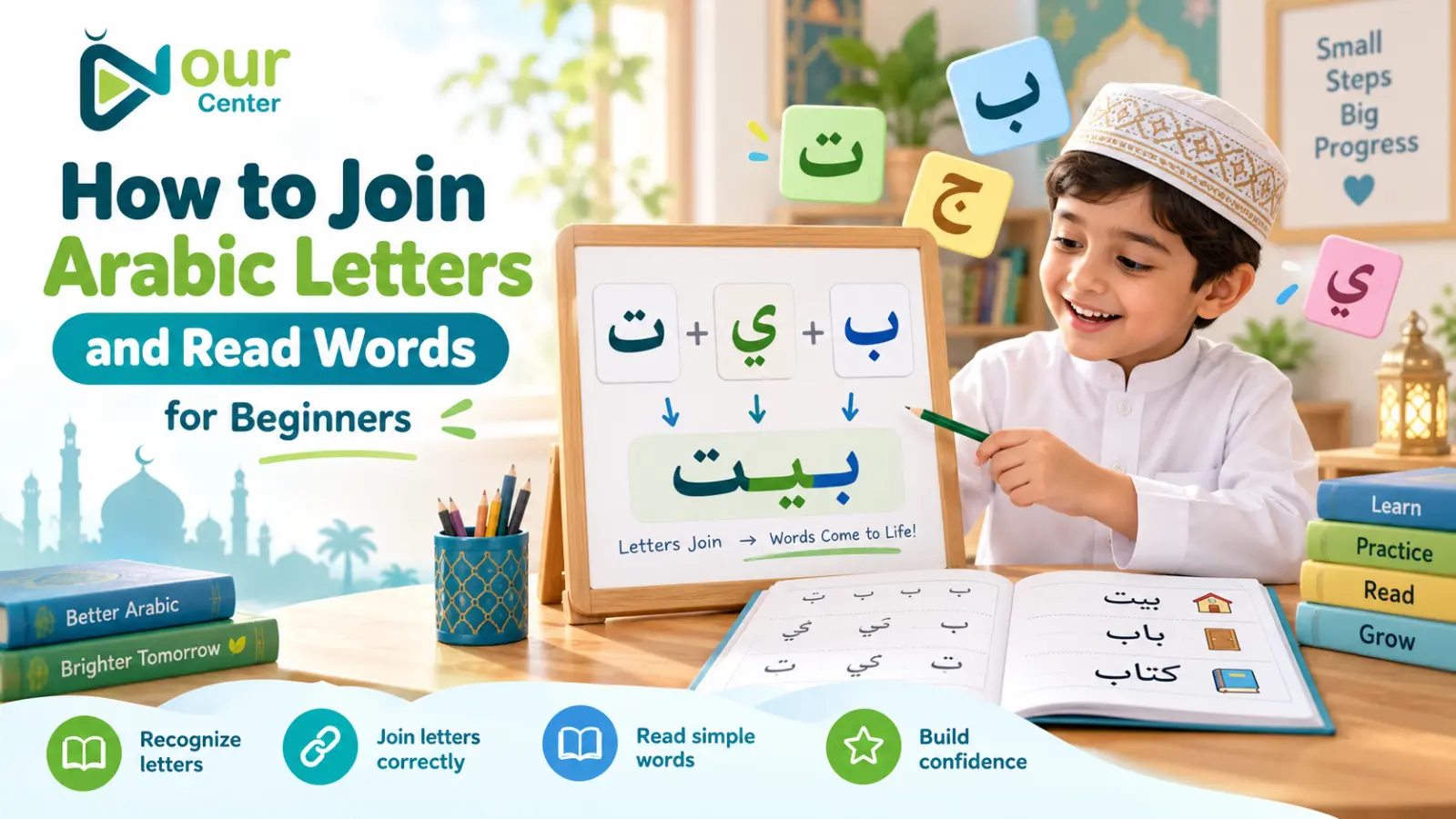
Learn how to join Arabic letters and read words step by step, understand initial, medial, and final letter forms, identi...
Read Article →