
Safeer in Tajweed for Beginners: Understanding the Whistling Sound of Arabic Letters
Learn Safeer in Tajweed for beginners, the three Safeer letters, how the whistling sound is produced, common pronunciati...
Read Article →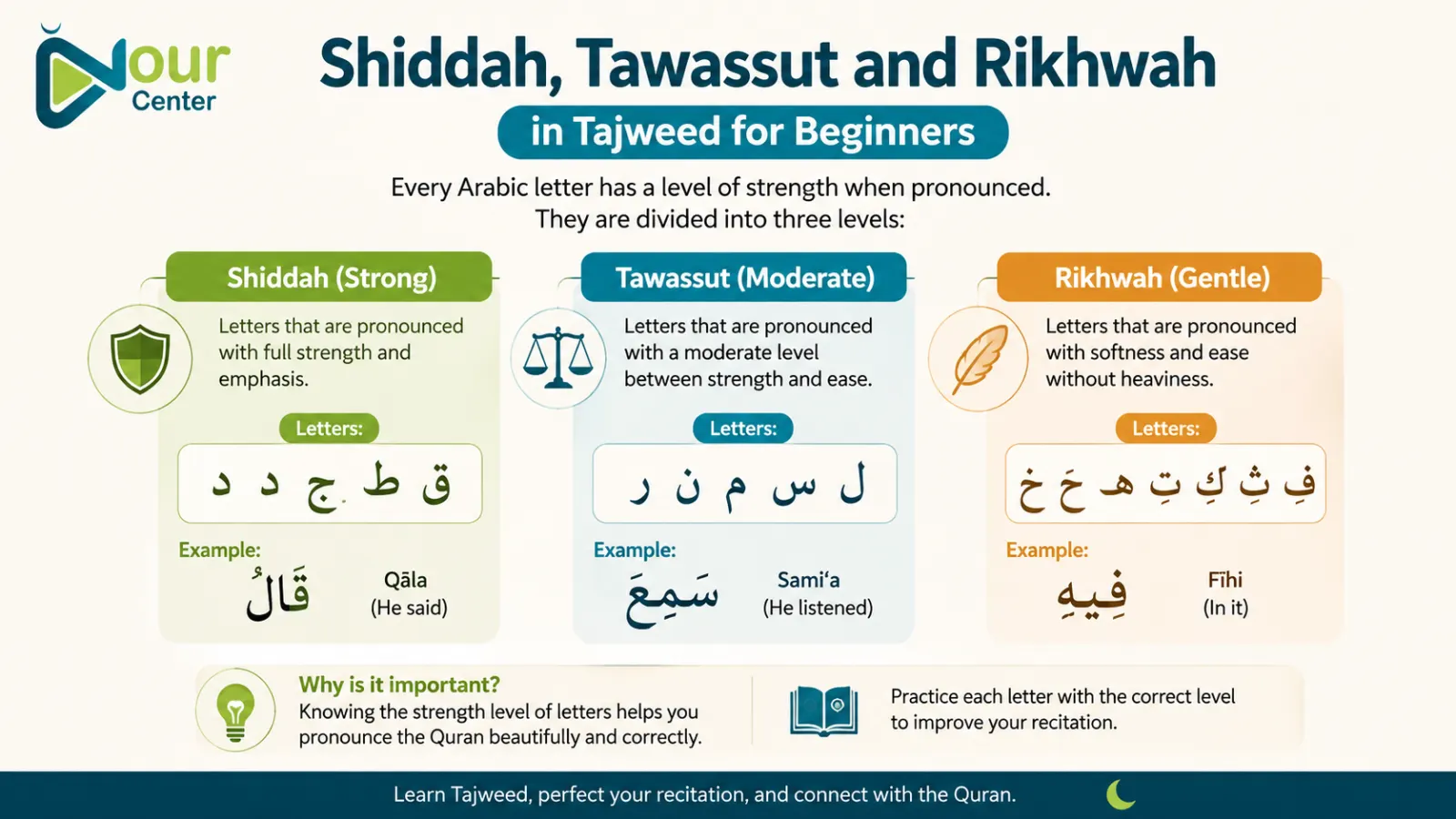
Understanding Sound Flow
Shiddah, Tawassut, and Rikhwah are important characteristics of Arabic letters in Tajweed because they describe what happens to the sound while a letter is being pronounced. Some letters stop the sound strongly. Some allow the sound to continue partially. Others allow the sound to flow more freely.
Shiddah = the sound is strongly stopped. Tawassut = the sound is partially stopped and partially allowed to continue. Rikhwah = the sound is allowed to flow. These characteristics are part of Sifat al-Huruf. They help explain why Arabic letters that may have nearby articulation points can still sound clearly different.
Students who understand Sifat al-Huruf for Beginners will find Shiddah, Tawassut, and Rikhwah easier because these three qualities describe how sound behaves after a letter is formed.
This guide explains Shiddah, Tawassut, and Rikhwah in Tajweed for beginners, their letters, pronunciation differences, common mistakes, and practical exercises for Quran recitation. What Is Shiddah in Tajweed? Shiddah is a characteristic in which the sound is strongly restrained at the articulation point. When a Shiddah letter is pronounced with Sukoon, the sound cannot continue freely through the letter. There is a strong closure or stopping of sound.
Shiddah = sound stops. This does not mean the voice should become louder. It does not mean the letter should be exaggerated. The characteristic comes from the way the articulation blocks the sound. Why Is Shiddah Important? Without correct Shiddah, letters can lose their strength and become unclear. A beginner may accidentally allow too much sound to continue through a Shiddah letter.
This can make the consonant resemble another letter or create an unnecessary extra sound.
Letter clarity. Sukoon pronunciation. Sound control. Quran reading accuracy. Differences between Arabic consonants. Understanding of other Tajweed rules. How Many Shiddah Letters Are There?
أَجِدْ قَطٍ بَكَتْ
Hamzah. Jeem. Dal. Qaf. Ta emphatic. Ba. Kaf. Ta. The learner should practice each letter individually, especially with Sukoon. Why Practice Shiddah With Sukoon? When a letter carries a vowel, the vowel can make the underlying sound behavior less obvious. With Sukoon, the consonant characteristic becomes easier to hear.
Stops completely. Continues partially. Or flows. This makes Sukoon exercises especially useful for learning Sifat.
Hamzah has strong sound restraint. The articulation closes the sound at the glottal area. Beginners sometimes exaggerate this and create excessive throat tension. The Hamzah should remain clear without becoming harsh. Correct Makharij for Beginners provides the foundation for Shiddah because the sound can only stop correctly when the letter is produced from its correct articulation point.
Ba is articulated with the lips. When Ba carries Sukoon, the lips close and the sound is strongly restrained. However, Ba is also one of the Qalqalah letters. This means that when Ba has Sukoon, another Tajweed characteristic may also become noticeable. A learner who studied What Is Qalqalah should remember that Shiddah describes the stopping of sound, while Qalqalah describes the controlled release that follows under its specific condition.
The two characteristics should not be confused.
Qaf is another useful example. The sound becomes strongly restrained at the articulation point. Qaf also has other characteristics, including Tafkhim and Qalqalah under Sukoon conditions. This shows that one Arabic letter can carry several Sifat simultaneously. Correct pronunciation combines them rather than choosing only one.
Kaf is a Shiddah letter, but it is also one of the Hams letters. At first, this may sound contradictory. Shiddah tells us that the sound is stopped. Hams tells us about breath flow. The two characteristics describe different aspects of pronunciation. Students who understand Hams and Jahr in Tajweed for Beginners should remember that breath behavior and sound flow are separate characteristics that can exist together in one letter.
This is why Kaf can have both Shiddah and Hams.
A common beginner mistake is assuming that a strong characteristic requires a louder voice. It does not. Shiddah describes sound restraint. You can pronounce a Shiddah letter quietly and still apply the characteristic correctly. Increasing volume may actually hide the real pronunciation problem.
When beginners release a silent Shiddah letter, they may accidentally add a small vowel. For example, a silent Ta may sound like “ta. ” A silent Kaf may sound like “ka. ” This is incorrect if no vowel is written. The letter should remain silent in the sense of Sukoon while preserving its proper characteristics. What Is Tawassut in Tajweed? Tawassut means moderation or a middle state.
These letters are neither as strongly closed as Shiddah letters nor as freely flowing as Rikhwah letters.
The sound continues partially.
Tawassut = middle sound flow. It provides a bridge between the two extremes. How Many Tawassut Letters Are There?
لِنْ عُمَرْ
Lam. Noon. Ayn. Meem. Ra. These five letters allow a moderate amount of sound continuation. The learner should avoid stopping the sound too sharply or extending it excessively.
Lam allows some continuation of sound. The tongue maintains its articulation, but the sound does not behave like a fully blocked Shiddah letter. Beginners should keep Lam clear and controlled. The sound should not become unnecessarily long.
Noon has Tawassut and is also strongly connected with Ghunnah. This means the learner needs to coordinate more than one characteristic. Tawassut describes sound flow. Ghunnah describes nasal resonance. A learner should not confuse the two. The Noon may have controlled sound continuation while its nasal quality remains according to the relevant rule.
Meem also belongs to Tawassut. Like Noon, it has a natural relationship with Ghunnah. When Meem carries Sukoon, the learner should maintain its articulation without turning it into: A strongly blocked sound. Or an unnecessarily prolonged sound. Its exact pronunciation also depends on Meem Sakinah rules when another letter follows.
Ra belongs to Tawassut. This is useful for beginners studying the Rules of Ra. The sound should not be held excessively. Heavy or light Ra still keeps its Tawassut characteristic. Tafkhim or Tarqiq changes sound quality. Tawassut describes how the sound flows. Different Sifat work together.
Ayn is often difficult for non-Arabic speakers. Correct Makhrij is essential before the learner can accurately apply Tawassut. If Ayn is replaced with another throat sound, the characteristic will also be incorrect. Practice Ayn slowly with teacher correction. What Is Rikhwah in Tajweed? Rikhwah is a characteristic in which sound is allowed to flow through the articulation. Unlike Shiddah, the sound is not completely trapped. Unlike Tawassut, it is not held in a middle state.
Rikhwah = sound flows. This flow should remain controlled. Rikhwah does not mean stretching every letter for a long time. Why Does Rikhwah Matter? If a Rikhwah letter is pronounced too tightly, its characteristic can disappear. The learner may create excessive closure and make the sound unnatural.
Proper Arabic pronunciation. Natural sound flow. Differences between similar consonants. Accurate Sukoon pronunciation. Smooth Quran recitation. Which Letters Have Rikhwah? The letters that are neither Shiddah nor Tawassut belong to Rikhwah in this classification.
The eight Shiddah letters. The five Tawassut letters. Then treat the remaining letters as Rikhwah. This reduces memorization.
Seen is a clear example of sound flow. The sound can continue as long as the airflow is maintained. However, this does not mean Seen should be extended unnecessarily during Quran recitation. The characteristic should be present without becoming exaggerated.
Fa also allows sound continuation. Air passes through the articulation between the lower lip and upper teeth. The learner should maintain a clear Fa while allowing the sound to flow. Do not produce only breath.
Sheen provides another strong example of flowing sound. Beginners can often hear the continuity easily. But overextending Sheen can make recitation artificial. Practice enough to recognize the characteristic, then return to normal timing.
Tha allows the sound to continue between the tongue and teeth. Non-Arabic speakers may replace it with a different consonant. Correct Makharij remains essential. Sound flow cannot compensate for incorrect tongue placement.
Shiddah = sound cannot continue. Rikhwah = sound can continue. Practice a Shiddah letter with Sukoon. Then a Rikhwah letter. Listen carefully. With Shiddah, you feel the sound stop. With Rikhwah, you can maintain the consonant sound. This contrast helps beginners understand the rule quickly.
Tawassut is not as closed as Shiddah. The sound has some continuation. However, it should not flow freely like Rikhwah. This middle position can be more difficult to feel. Teacher demonstration is especially useful.
Rikhwah allows more sound flow. Tawassut allows only moderate continuation. A learner may accidentally overextend Lam, Noon, Meem, Ra, or Ayn and make them resemble Rikhwah behavior. The goal is balance.
This distinction is extremely important. Hams and Jahr describe breath behavior. Shiddah, Tawassut, and Rikhwah describe sound behavior.
Hams + Shiddah. Hams + Rikhwah. Jahr + Tawassut. Other combinations. Do not assume breath and sound must behave identically.
Kaf has Hams. So breath is allowed to flow according to its characteristic. But Kaf also has Shiddah. So the sound itself is strongly stopped. This seems strange until the learner understands that breath and sound are different aspects. Practicing Kaf with a teacher makes the distinction much clearer.
Every Arabic letter has a collection of characteristics.
Hams or Jahr. Shiddah, Tawassut, or Rikhwah. Isti'la or Istifal. Itbaq or Infitah. Other Sifat. These characteristics combine to create the identity of the consonant. This is why studying one Sifah in isolation is useful for training, but final Quran recitation must combine all of them.
Making Shiddah Letters Too Weak
A learner may allow the sound to continue through a Shiddah letter. This removes the strong closure. Practice the letter with Sukoon and listen for a definite stopping of sound.
Holding Shiddah Too Long
Shiddah stops the sound, but beginners may hold the closure unnecessarily. This can interrupt the rhythm of recitation. The closure should be accurate but not exaggerated.
Adding a Vowel After Shiddah
This is especially common with silent consonants. Do not release the letter with an invented vowel. Keep Sukoon clean.
Giving Tawassut Too Much Flow
Tawassut is a middle characteristic. Do not extend its letters like strong Rikhwah examples. The sound should continue moderately.
Stopping Tawassut Like Shiddah
The opposite mistake is also common. The learner blocks Lam, Noon, Meem, Ayn, or Ra too strongly. Practice hearing their moderate continuation.
Making Rikhwah Too Short
A learner may close a flowing consonant too quickly. This can change its quality. Allow the natural sound to pass through the correct articulation.
Extending Rikhwah Excessively
Rikhwah permits sound flow. It does not create unlimited length. During real Quran recitation, the consonant should remain proportionate to the word.
Confusing Sound Flow With Madd
Rikhwah concerns consonants. Madd concerns vowel length. Do not turn a flowing consonant into a long vowel.
Ignoring Makharij
A student may correctly classify a letter as Rikhwah but pronounce it from the wrong place. That still produces incorrect Arabic. Sifat refine Makharij; they do not replace it.
Forgetting Other Sifat
A heavy Rikhwah letter must remain heavy. A Hams Shiddah letter must still have Hams. The complete Arabic letter is a combination of all its correct characteristics.
Ba. Ta. Kaf. Qaf. Pronounce each with Sukoon. Feel where the sound stops. Avoid adding vowels. Then place the letters inside simple Arabic words.
Lam. Noon. Ayn. Meem. Ra. Pronounce each with Sukoon. Try to feel the moderate sound continuation. Do not close them as strongly as Shiddah letters. Do not extend them as freely as Rikhwah letters.
Seen. Sheen. Fa. Tha. Pronounce each with Sukoon. Allow the consonant sound to flow briefly. Then return to natural word pronunciation.
One Shiddah letter. One Tawassut letter. One Rikhwah letter. Listen to all three.
Stop. Middle. Flow. Repeat the exercise with different letters. This builds strong auditory awareness.
Review the three definitions.
Practice Shiddah letters.
Practice Tawassut letters.
Practice Rikhwah letters.
Read a short Quran passage and identify examples.
Review the Shiddah and Tawassut groups.
Practice Shiddah with Sukoon.
Practice Tawassut with Sukoon.
Practice several Rikhwah letters.
Compare sound flow.
Read Quran examples naturally.
Understand Sound Flow
Learn the difference between stopping, moderation, and flowing.
Memorize and practice the Shiddah letters.
Practice the five Tawassut letters.
Practice several clear flowing examples.
Sukoon Comparison
Compare all three categories.
Combine With Hams and Jahr
Notice how breath and sound characteristics work together.
Quran Assessment
Read a passage while a teacher checks Makharij and Sifat.
Stop. Middle. Flow. A teacher can demonstrate three letters and let the child imitate each sound. The technical terms can be added after the difference becomes audible. This makes the topic much easier for young learners.
Adult learners may understand the definitions quickly but struggle to physically produce the correct amount of sound continuation. Short comparison exercises usually work better than long theoretical explanations.
Did the Shiddah letter actually stop? Did Tawassut remain moderate? Did Rikhwah flow without being exaggerated?
At Nour Center, live one-to-one Tajweed lessons can teach these Sifat through direct pronunciation and comparison.
Makharij. Sukoon. Shiddah. Tawassut. Rikhwah. Hams and Jahr. Tafkhim and Tarqiq. General Quran fluency. The teacher can isolate difficult letters and then return them to Quran words and verses.
You recognize Shiddah letters quickly. The sound stops clearly without extra vowels. You recognize the five Tawassut letters. Their sound remains moderate. Rikhwah letters flow naturally. You stop confusing sound flow with breath flow. Your Sukoon pronunciation improves. You can combine several Sifat in one letter. Your teacher corrects fewer pronunciation errors. What Should You Study Next? After Shiddah, Tawassut, and Rikhwah, a useful next topic is Isti'la and Istifal.
These characteristics describe the position and elevation of the tongue during pronunciation. They are closely related to why some Arabic letters sound heavy while most others remain lighter. Studying them provides a deeper understanding of Tafkhim and Tarqiq.
Shiddah, Tawassut, and Rikhwah in Tajweed for Beginners describe how sound behaves during pronunciation.
Shiddah = sound stops strongly. Tawassut = sound continues moderately. Rikhwah = sound flows. These characteristics are different from Hams and Jahr. Hams and Jahr describe breath behavior. Shiddah, Tawassut, and Rikhwah describe sound flow. Correct Makharij remains essential. Do not add vowels to silent letters. Do not exaggerate flowing letters. Do not make Tawassut too strong or too weak.
The best way to learn these characteristics is through listening, comparison, Sukoon practice, Quran examples, and teacher correction.
With regular practice, the differences become natural and help produce clearer, more accurate Arabic letters during Quran recitation.
Note: Comments may require approval before appearing publicly.
Learn Safeer in Tajweed for beginners, the three Safeer letters, how the whistling sound is produced, common pronunciati...
Read Article →
Learn Hams and Jahr in Tajweed for beginners, including their letters, breath flow, sound differences, common mistakes,...
Read Article →
Learn Sifat al-Huruf for beginners, including Hams, Jahr, Shiddah, Rikhwah, Isti'la, Istifal, Itbaq, and other essential...
Read Article →
Learn Idhlaq and Ismat in Tajweed for beginners, the six Idhlaq letters, their pronunciation characteristics, the differ...
Read Article →