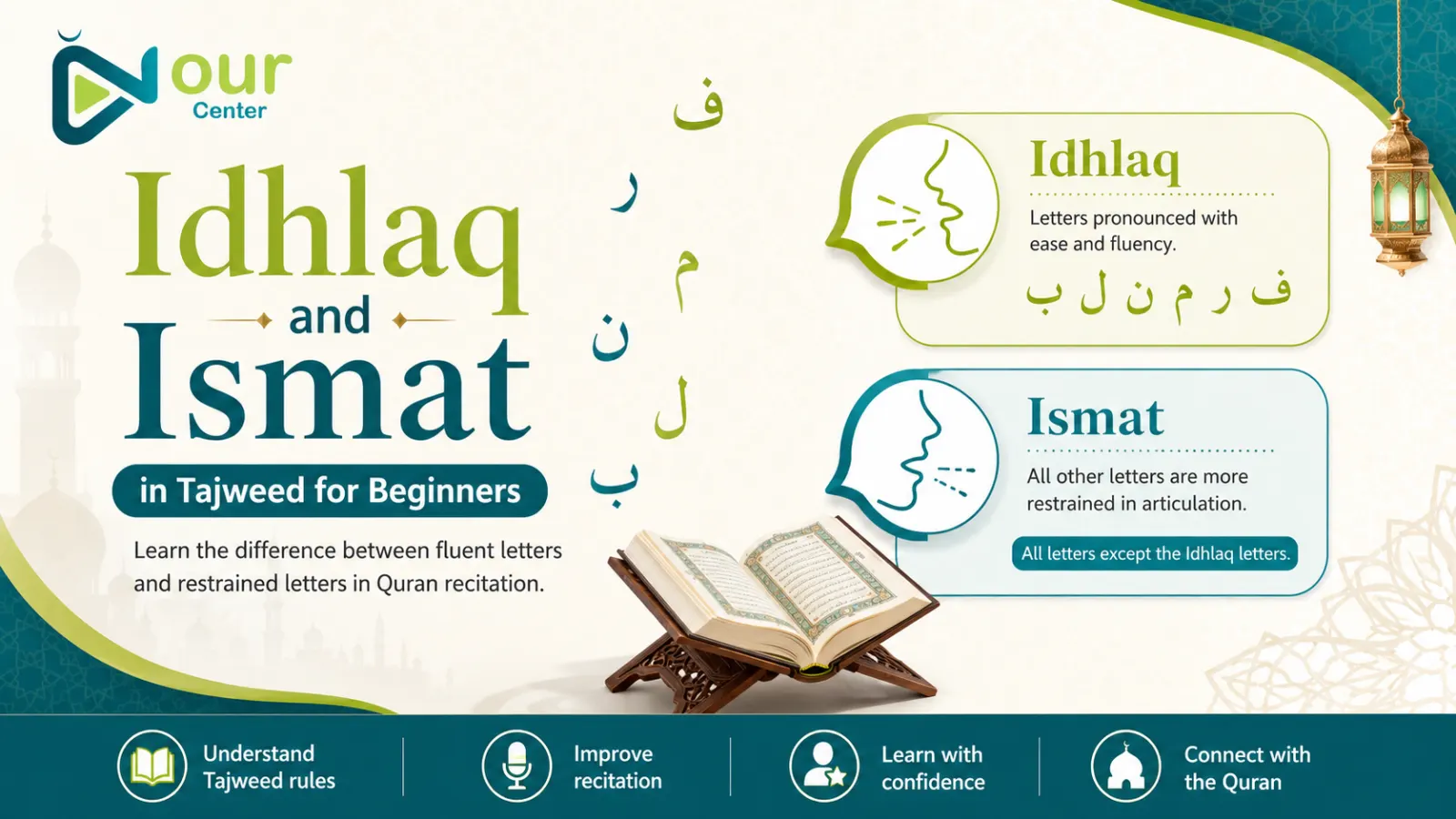
Idhlaq and Ismat in Tajweed for Beginners: Understanding Arabic Letter Characteristics
Learn Idhlaq and Ismat in Tajweed for beginners, the six Idhlaq letters, their pronunciation characteristics, the differ...
Read Article →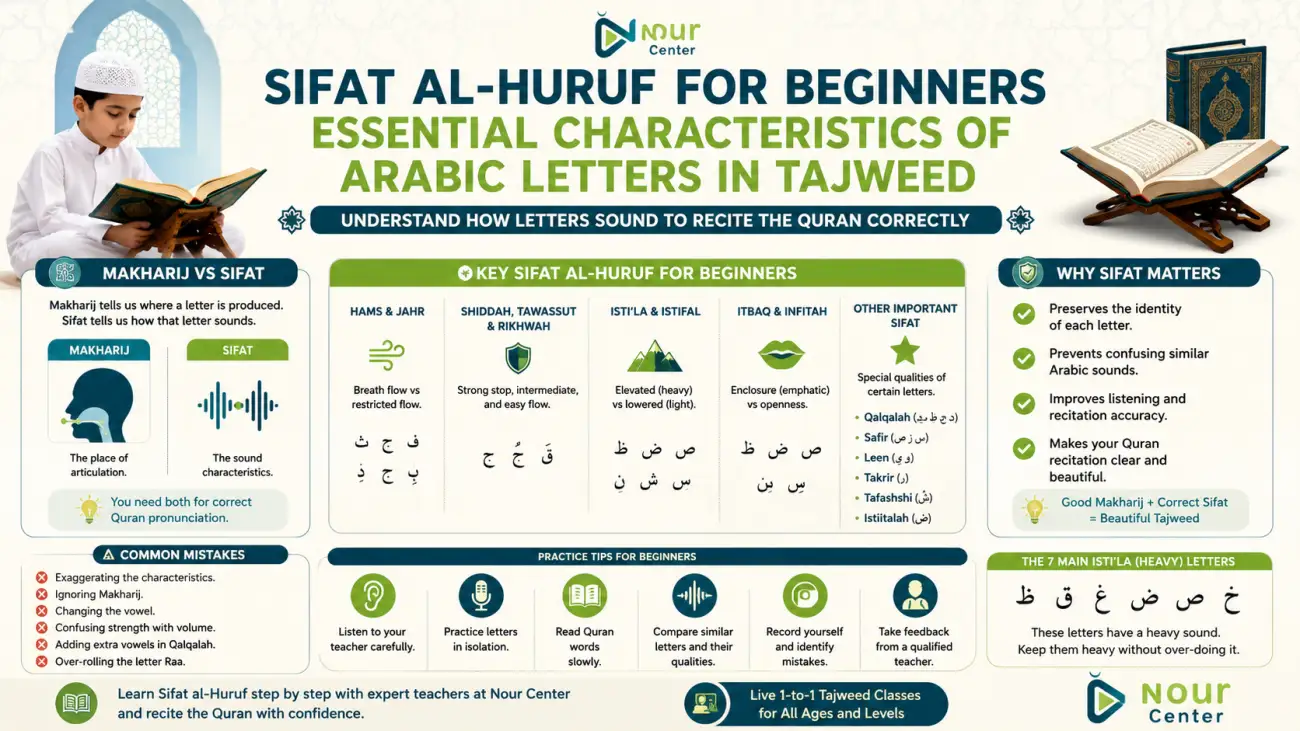
Essential Characteristics of Arabic Letters in Tajweed
Sifat al-Huruf are the characteristics or qualities of Arabic letters in Tajweed. Learning Makharij teaches a student where a letter is produced. Learning Sifat helps the student understand how that letter behaves and sounds when it is pronounced correctly. This distinction is extremely important. Two Arabic letters may come from nearby articulation areas but remain clearly different because they have different sound characteristics.
A learner who focuses only on the articulation point may therefore pronounce a letter from approximately the correct place while still giving it the wrong quality.
Sifat al-Huruf helps correct this problem. For beginners, the topic can initially seem complicated because traditional Tajweed books discuss several pairs of characteristics and several additional qualities. The easiest way to approach the subject is gradually. First understand the purpose of Sifat. Then study the most important contrasting qualities. After that, learn the characteristics that apply to particular groups of letters.
This guide introduces Sifat al-Huruf for beginners, including Hams and Jahr, Shiddah and Rikhwah, Tawassut, Isti'la and Istifal, Itbaq and Infitah, Qalqalah, Safir, Leen, Takrir, Tafashshi, and other important concepts.
What Does Sifat al-Huruf Mean? Sifat means characteristics or qualities. Huruf means letters. Sifat al-Huruf therefore refers to the pronunciation characteristics of Arabic letters. These qualities help explain why one letter sounds different from another even when the two letters may be articulated from nearby areas. For example, one consonant may allow the breath to flow. Another may restrict it. One may have a stronger sound. Another may have more continuous airflow.
One may be naturally heavy. Another may be naturally light. These differences are part of the identity of the Arabic letters. Why Are Sifat Important in Tajweed? Correct Sifat helps preserve the identity of Quranic letters. Without these qualities, beginners may confuse similar sounds.
Ta sound too much like Dal. Seen sound too much like Sad. Kaf sound too close to Qaf. Tha sound too similar to other tongue-tip sounds. Heavy letters too light. Light letters too heavy. The correct articulation point is essential, but it is only part of accurate pronunciation. Students who understand Makharij for Beginners will find Sifat al-Huruf easier because Makharij explains where a letter is produced while Sifat explains how that letter sounds.
Makharij and Sifat should not be treated as competing subjects. They work together.
Where is the letter produced?
What characteristics appear when the letter is produced? A learner needs both. If the articulation point is wrong, the letter may change. If the articulation point is approximately correct but the characteristics are wrong, the letter can still sound inaccurate.
Correct position. Correct airflow. Correct sound strength. Correct heaviness or lightness. Correct release. Correct surrounding vowels. Are Sifat Permanent? Many Sifat taught in this subject are inherent characteristics associated with the letters. They help define how those letters naturally behave. Other pronunciation qualities can depend more strongly on context. For beginner study, it is useful to understand that Sifat al-Huruf primarily focuses on characteristics that help distinguish one letter from another.
This is different from rules such as Madd or Noon Sakinah, where pronunciation may change because of surrounding letters. A strong foundation in Basic Tajweed Rules helps beginners apply Sifat al-Huruf without losing control of vowels, Sukoon, Madd, and other recitation basics.
Many important Arabic letter characteristics are taught in contrasting pairs.
Hams and Jahr. Shiddah and Rikhwah. Tawassut as an intermediate quality. Isti'la and Istifal. Itbaq and Infitah. Understanding these contrasts helps the learner hear what each characteristic means. What Is Hams? Hams involves the flow of breath during the pronunciation of particular letters. A learner can often notice that air continues to escape while a Hams letter is pronounced. This does not mean deliberately blowing strongly. The airflow should result naturally from the correct articulation.
If the learner exaggerates the breath, the consonant may sound unnatural. The purpose is to notice whether the breath flows as part of the letter's normal pronunciation.
Hams helps distinguish letters that may otherwise sound too similar. A beginner who blocks the breath in a Hams letter may accidentally make the sound stronger or closer to another consonant.
Clear articulation. Accurate consonant identity. Natural Quran pronunciation. Better listening discrimination. The learner should hear the difference before attempting complicated technical analysis.
Choose a letter taught as having Hams. Pronounce it slowly. Notice whether breath flows. Do not add a vowel unless you are intentionally practicing the letter with a vowel. Then compare the sound with a letter whose breath is more restricted. This comparison trains the ear. What Is Jahr? Jahr is commonly taught as the opposite of Hams. The breath does not flow in the same way during the pronunciation of Jahr letters.
This does not mean holding the breath forcefully. The difference comes from how the articulation restricts airflow. A learner should avoid turning the concept into physical tension. Correct Jahr should result from accurate pronunciation.
Hams = noticeable breath flow. Jahr = breath flow is more restricted. The objective is not to memorize definitions only. The learner should hear and feel the difference during pronunciation. A teacher can alternate examples so the student begins recognizing the two categories by sound.
Some beginners exaggerate Hams until the letter sounds breathy and weak. Others pronounce every consonant with the same airflow. The solution is not to force the breath. Return to the correct Makhrij. Listen to a teacher. Repeat the sound naturally. Then notice the characteristic. What Is Shiddah? Shiddah refers to strong restriction or stopping of the sound during pronunciation. In letters characterized by Shiddah, the sound does not continue freely through the articulation point.
This creates a strong, controlled consonant quality. Beginners should not confuse Shiddah with shouting or excessive force. The characteristic comes from the way the sound is held at the articulation point.
A Shiddah letter can be pronounced quietly and still retain its characteristic. Volume is separate from Tajweed quality. This is similar to Tafkhim. A letter does not become heavy because it is loud. Likewise, it does not become Shiddah simply because the reader applies more force. The articulation itself creates the characteristic. What Is Rikhwah? Rikhwah involves continued sound flow rather than the complete restriction associated with Shiddah.
The sound can continue through the articulation point for a period of time.
Again, this does not mean stretching the letter randomly. The learner should simply recognize that the sound behavior differs from the tightly restricted quality of Shiddah.
Shiddah = sound is strongly restricted. Rikhwah = sound can continue. Listening to paired examples helps significantly. Beginners should not try to understand these concepts only from written descriptions. Tajweed is an oral science. Sound demonstration is essential. What Is Tawassut? Tawassut means an intermediate condition. Some letters are neither fully characterized by Shiddah nor by complete Rikhwah. Their sound behavior falls between the two.
Strong restriction. Intermediate flow. Continued flow. Learning the categories by sound can be easier than memorizing technical terminology first.
Without understanding the intermediate category, a beginner may force a letter into one of two extremes. The student may block the sound too much. Or allow it to flow too freely. Tawassut teaches balanced articulation. This is particularly important when refining letters that sound generally correct but still lack natural Arabic quality. What Is Isti'la? Isti'la is associated with elevation of the back portion of the tongue and produces a fuller, heavier sound quality.
The letters of Isti'la form the main group of consistently heavy letters studied in beginner Tajweed. This quality is closely connected with Tafkhim. Students who studied Heavy and Light Letters in Tajweed for Beginners have already encountered Isti'la and Istifal in practice, even before learning the broader Sifat framework.
Kha. Sad. Dad. Ghayn. Ta emphatic. Qaf. Za emphatic. These letters should maintain their characteristic heaviness. However, the degree of heaviness can vary depending on the surrounding vowel and specific context. Beginners should first focus on preserving the basic heavy identity. What Is Istifal? Istifal is the contrasting quality associated with letters that do not have Isti'la. The tongue does not rise in the same way, and the sound generally remains lighter.
Most Arabic letters belong to this broader light category. The beginner should avoid allowing heaviness from an Isti'la letter to spread into neighboring Istifal letters. Isti'la vs Istifal
Isti'la = elevated, fuller sound. Istifal = lower, lighter sound quality.
Isti'la = loud. Istifal = weak. Both types require clear and accurate articulation. The difference is sound quality.
Beginners often create heaviness by lowering their voice or moving the entire jaw backward. That is not the goal. Correct heaviness should come from proper articulation. If the learner uses excessive facial tension, the letter may sound distorted. Teacher correction is especially useful here. What Is Itbaq? Itbaq is another characteristic associated with a smaller group of emphatic letters.
It involves a more enclosed or compressed relationship between parts of the tongue and the upper mouth during pronunciation.
This gives the affected letters an especially strong emphatic quality. Beginners do not need to master every anatomical detail immediately. The practical goal is to recognize that some heavy letters have an additional characteristic that makes them more emphatic than other heavy letters.
Not every heavy letter has the same degree of emphasis. This is why some Isti'la letters can sound more strongly emphatic than others. Itbaq contributes to this distinction. A learner should therefore avoid treating every heavy letter as though it had exactly the same mouth position. Correct Tajweed becomes more refined as these differences are learned. What Is Infitah? Infitah is commonly taught as the opposite of Itbaq.
The same enclosure or compression associated with Itbaq is not present.
Most Arabic letters fall into the Infitah category. Again, the beginner should focus first on hearing and producing the correct sound rather than memorizing long anatomical definitions.
Itbaq = stronger enclosure or emphasis in its letters. Infitah = more open articulation in the contrasting group. These qualities contribute to the unique identity of Arabic consonants. What Is Qalqalah as a Sifah? Qalqalah is also discussed among the distinctive characteristics of certain letters. It involves a controlled release when one of the Qalqalah letters has Sukoon.
Qaf. Ta emphatic. Ba. Jeem. Dal. The sound should be released clearly without adding a complete vowel. Learners who have already studied Qalqalah in detail should recognize how Sifat al-Huruf brings that rule into the wider system of letter characteristics.
One of the most common mistakes is turning the release into: Fathah. Kasrah. Dammah. Qalqalah should preserve the consonant while making its release audible. The learner should not create another syllable. What Is Safir? Safir is a characteristic often described as a whistle-like quality. It appears in specific Arabic letters. The sound has a distinctive sharpness that helps identify those consonants. A beginner should not deliberately whistle. The characteristic should emerge naturally from correct articulation.
If the learner forces the sound, it can become exaggerated.
Safir helps distinguish certain consonants from nearby tongue sounds. A learner who loses the characteristic may make the letter sound dull or too similar to another consonant. Teacher listening is useful because the learner may not accurately judge the amount of sharpness in their own pronunciation. What Is Leen? Leen refers to softness or ease in specific Waw and Ya conditions. It differs from ordinary Madd.
The sound flows softly and becomes especially noticeable in certain stopping conditions.
Beginners may first encounter Leen while learning Madd and Waqf. Sifat al-Huruf helps place this sound within the broader characteristics of Arabic pronunciation.
Leen and Madd should not be treated as identical. Both can involve Waw or Ya. However, the vowel patterns are different. Madd uses its specific long-vowel conditions. Leen has a different preceding vowel relationship and softer sound. The learner should follow Quran examples rather than identifying the rule only from the letter itself. What Is Inhiraf?
Inhiraf refers to a characteristic in which the sound inclines or deviates from a direct articulation path in particular letters.
This is a more advanced concept for many beginners. The most important practical lesson is that some letters have unique sound behaviors beyond simple airflow or heaviness. A teacher can introduce Inhiraf after the learner has strong basic Makharij. What Is Takrir? Takrir is associated with Ra and the natural tendency of the tongue to repeat or vibrate. This characteristic is important because the learner must recognize it without exaggerating it.
Arabic Ra can involve a controlled tongue movement. But beginners should avoid rolling Ra repeatedly. One clear Ra should not become several repeated R sounds. Takrir and the Rules of Ra Students who study heavy and light Ra also need to control Takrir. Whether Ra is heavy or light, excessive rolling remains incorrect.
Correct Ra articulation. Correct Tafkhim or Tarqiq. Controlled tongue movement. No unnecessary repetition. This is one reason Ra often requires individual teacher feedback. What Is Tafashshi? Tafashshi is a characteristic strongly associated with the letter Sheen. The sound spreads in a distinctive way during pronunciation. Beginners should hear correct Sheen repeatedly. If the sound is too restricted, its natural quality may be lost. If it is exaggerated, the pronunciation can become unnatural.
Correct articulation produces the characteristic more reliably than trying to imitate the description alone. What Is Istitalah? Istitalah is traditionally associated with the letter Dad. It describes a particular extension or length of the articulation area during the production of Dad. Dad is one of the most challenging Arabic letters for many non-Arabic speakers. Beginners should not attempt to reproduce Istitalah by simply stretching the sound. Correct Dad needs careful tongue placement and teacher correction.
Dal. Za. An overly heavy D-like sound. Another consonant from their native language. Its Makhrij and Sifat need to work together. A teacher can first establish the correct tongue placement and then refine the characteristic.
Ghunnah is a nasal resonance strongly associated with Noon and Meem. A learner who studied Ghunnah in Tajweed for Beginners has already seen how a sound characteristic can shape the quality of Noon and Meem without changing their basic letter identity. This is a useful way to understand Sifat generally. The characteristic belongs to the sound. But the letter remains the same letter.
A learner may memorize every Sifah and still pronounce incorrectly if the articulation point is wrong.
Knowing Qaf is heavy does not fix an incorrect Qaf Makhrij. Knowing Hams does not fix an incorrectly positioned tongue. Knowing Safir does not fix a poorly articulated Seen. Knowing Takrir does not fix an English-style R. Makharij and Sifat must be practiced together.
The letter quality must also remain separate from the vowel. A heavy consonant still needs a correct Fathah, Kasrah, or Dammah. A Hams consonant should not gain an extra vowel because breath flows. A Shiddah consonant should not gain an added sound during release. Each Tajweed layer must remain controlled.
Sifat often become easier to hear when a consonant has Sukoon because the learner is not distracted by a strong following vowel.
Hams. Shiddah. Rikhwah. Qalqalah. However, the learner must not add an artificial vowel after the silent consonant.
Memorizing Without Listening
Hams. Jahr. Shiddah. Rikhwah. Isti'la. Istifal. But still fail to produce the sound. Sifat is not only theoretical information. The learner must hear each quality. Then imitate it. Then apply it during Quran reading.
Exaggerating Every Characteristic
When beginners discover a new characteristic, they often overdo it. Hams becomes excessive breath. Tafkhim becomes an extremely deep voice. Safir becomes deliberate whistling. Takrir becomes repeated rolling. Qalqalah becomes a full vowel. Good Tajweed is controlled. Correct characteristics do not need theatrical exaggeration.
Ignoring Makharij
The learner may concentrate so strongly on the characteristic that the articulation point moves. This defeats the purpose. Always return to the letter's Makhrij first. Then apply the Sifah.
Changing the Vowel
A characteristic should not unnecessarily distort the Harakah.
Heavy letters should not turn Fathah into a different vowel. Hams should not add a breathy vowel. Shiddah should not create an extra Dammah or Fathah on release. Protect the vowel.
Confusing Strength With Volume
Some Sifat involve stronger sound behavior. That does not mean shouting. A letter can retain its characteristic at a moderate or soft recitation volume. Practice quietly to check whether the quality remains.
Learning Too Many Categories at Once
Sifat al-Huruf can become overwhelming if a beginner tries to memorize every quality in one lesson.
Makharij review. Hams and Jahr. Shiddah, Tawassut, and Rikhwah. Isti'la and Istifal. Itbaq and Infitah. Then distinctive individual qualities. This allows the learner to build gradually.
Choose one example from each category. Listen to your teacher. Pronounce the letters without exaggeration. Notice the airflow. Compare. Repeat. Then use the letters inside simple Quran words. The comparison is more valuable than reading long definitions repeatedly.
Use letters with Sukoon.
Stops strongly. Flows. Or falls between the two. Keep the consonant clean. Do not add a vowel. Then compare the pronunciation in connected Quran reading.
Use heavy and light letter pairs.
Qaf and Kaf. Sad and Seen. Heavy Ta and ordinary Ta. Listen to the quality difference. Do not increase volume. Then practice both in Quran words.
A mirror can help with some visible articulation habits, but it has limitations.
Excessive jaw movement. Unnecessary lip tension. Overly dramatic mouth positioning. However, many important Sifat cannot be judged visually. Sound remains the primary guide. Use a mirror as support, not as a substitute for listening.
Record a small set of letters and words.
Is my Hams excessive? Is my heavy letter actually heavy without being loud? Does my Qalqalah contain an extra vowel? Am I rolling Ra repeatedly? Is my Sheen clear? Does my Dad sound distinct? Compare the recording with a reliable teacher model. Recording can reveal habits that are difficult to hear while reciting.
Review one pair of characteristics.
Practice isolated letters.
Compare contrasting letters.
Read Quran words containing the letters.
Read a short phrase naturally. Do not try to practice every Sifah every day. Focus on one small group.
Review Makharij for the target letters.
Practice Hams and Jahr.
Practice Shiddah, Tawassut, and Rikhwah.
Practice heavy and light qualities.
Practice one distinctive Sifah such as Qalqalah or Safir.
Read Quran naturally.
Understand Makharij vs Sifat
Practice several letters and identify where they come from and how they sound.
Focus on airflow.
Shiddah, Tawassut, and Rikhwah
Focus on sound restriction and flow.
Isti'la and Istifal
Practice heavy and light letters.
Itbaq and Infitah
Refine emphatic articulation.
Special Characteristics
Review Qalqalah, Safir, Leen, Takrir, or Tafashshi.
Quran Application
Read a short passage while the teacher identifies which Sifat need correction. Sifat al-Huruf for Kids Children do not need to memorize a large Sifat chart before improving pronunciation. A teacher can introduce the qualities through contrasts.
Breathy vs less breathy. Strong stop vs flowing sound. Heavy vs light. One release vs repeated rolling. The child listens. Repeats. Then gradually learns the Arabic terminology. Sound should come before complicated theory. Should Kids Memorize the Technical Names? The names become useful over time. However, a child who can correctly produce a heavy Qaf and light Kaf has already achieved something important even if they cannot define Isti'la and Istifal.
The terminology can be attached to an existing sound skill later. This approach keeps beginner Tajweed practical.
Adults often enjoy understanding why letters sound different. Technical explanations can therefore be motivating. But adults should avoid allowing theory to replace repetition. A student may understand Hams perfectly in words yet still pronounce the letter incorrectly. The mouth needs training as much as the mind. Use the explanation to guide practice. Can Sifat al-Huruf Be Learned Without a Teacher? Books and articles can explain the categories. Audio lessons can demonstrate sounds.
These are useful resources. However, Sifat is highly dependent on listening.
Hams is exaggerated. Jahr is weak. Shiddah is released incorrectly. A heavy letter is too light. Qalqalah has become a vowel. Ra is over-rolled. Dad is being replaced by another consonant. A qualified teacher can identify these differences much more quickly.
Many Sifat errors are subtle. The student may feel that the pronunciation is correct because the general letter is recognizable. A teacher can hear whether the sound quality is actually accurate.
Airflow. Tongue pressure. Release. Heaviness. Sound continuity. Nasal resonance. This is especially important before incorrect habits become deeply established.
At Nour Center, live one-to-one Tajweed lessons can introduce Sifat according to the learner's current Quran reading level.
Makharij. Short vowels. Sukoon. Heavy and light letters. Qalqalah. Ghunnah. Ra. General recitation fluency. Then the student can work on the Sifat that most affect their pronunciation. One learner may need Hams practice. Another may struggle with heavy letters. Another may over-roll Ra. Another may need stronger distinction between Shiddah and Rikhwah. Personalized correction keeps the lesson practical.
Letters from similar articulation areas become easier to distinguish. Hams appears naturally without excessive breath. Jahr letters remain firm. Shiddah sounds controlled. Rikhwah flows without being stretched unnaturally. Heavy letters remain heavy without increasing volume. Light letters remain light. Qalqalah no longer creates extra vowels. Ra is not rolled excessively. Your teacher corrects fewer letter-quality errors. Most importantly, Quran words begin sounding clearer and more natural. What Should You Study After Sifat al-Huruf?
Sifat al-Huruf is a broad subject. After this beginner overview, it is useful to study the main characteristic groups separately.
Hams and Jahr. Shiddah, Tawassut, and Rikhwah. Isti'la and Istifal. Itbaq and Infitah.
Safir. Qalqalah. Leen. Inhiraf. Takrir. Tafashshi. Istitalah. This approach allows each sound quality to receive focused practice.
Sifat al-Huruf for Beginners helps explain how Arabic letters should sound, while Makharij explains where those letters are produced. Both are essential for accurate Quran pronunciation.
Hams and Jahr. Shiddah and Rikhwah. Tawassut. Isti'la and Istifal. Itbaq and Infitah. Other distinctive qualities include Qalqalah, Safir, Leen, Inhiraf, Takrir, Tafashshi, and Istitalah. Do not try to memorize everything in one day. Start with one contrasting pair. Listen carefully. Practice isolated letters. Compare sounds. Apply them in Quran words. Then return to natural recitation. Avoid exaggerating the characteristics. Hams should not become excessive blowing. Tafkhim should not become shouting.
Qalqalah should not create an extra vowel. Takrir should not become repeated rolling. Sifat should refine the identity of each Arabic letter, not distort it. With regular practice, careful listening, and qualified teacher correction, Sifat al-Huruf becomes a powerful tool for clearer, more accurate, and more confident Quran recitation.
Note: Comments may require approval before appearing publicly.
Learn Idhlaq and Ismat in Tajweed for beginners, the six Idhlaq letters, their pronunciation characteristics, the differ...
Read Article →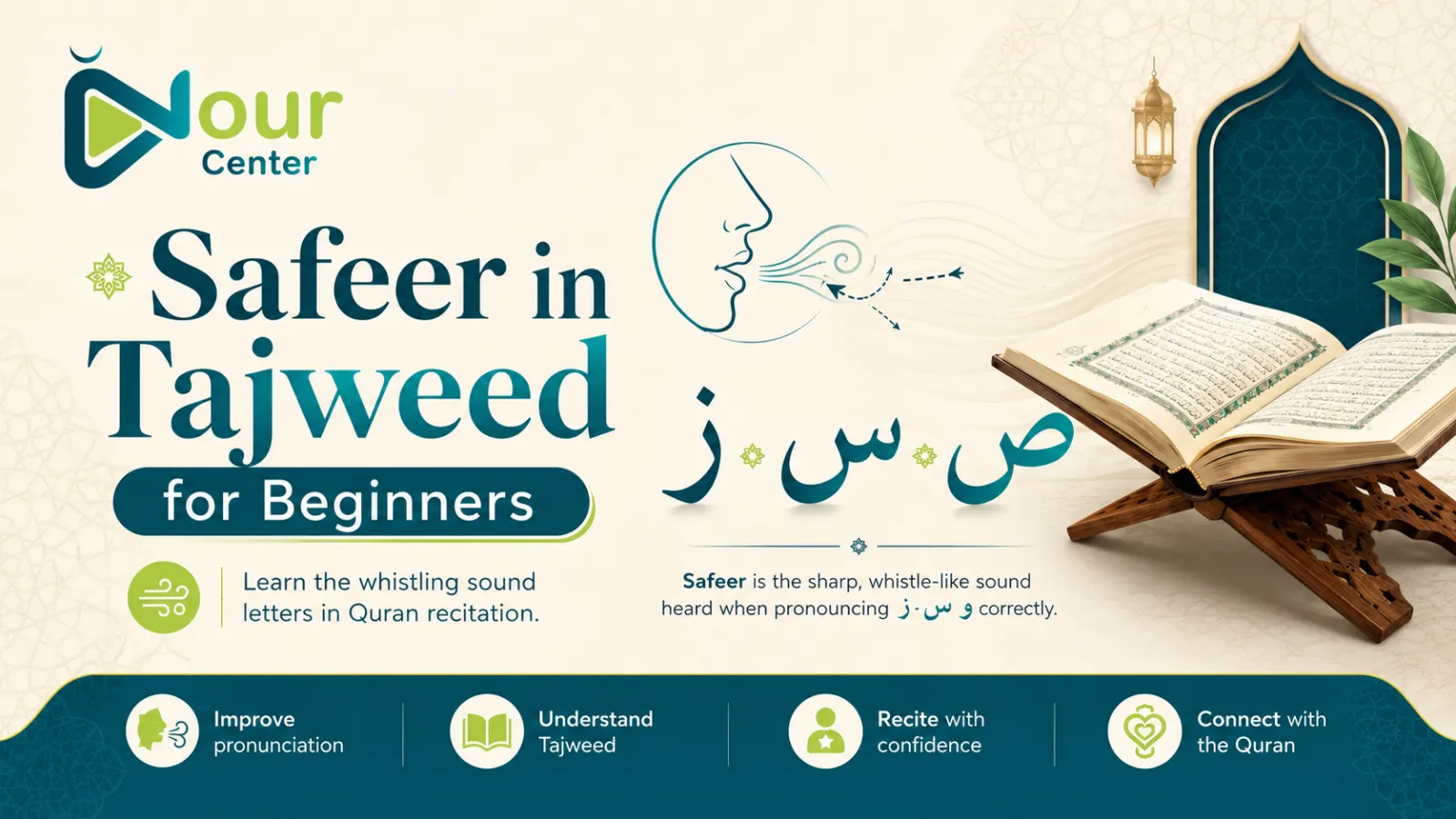
Learn Safeer in Tajweed for beginners, the three Safeer letters, how the whistling sound is produced, common pronunciati...
Read Article →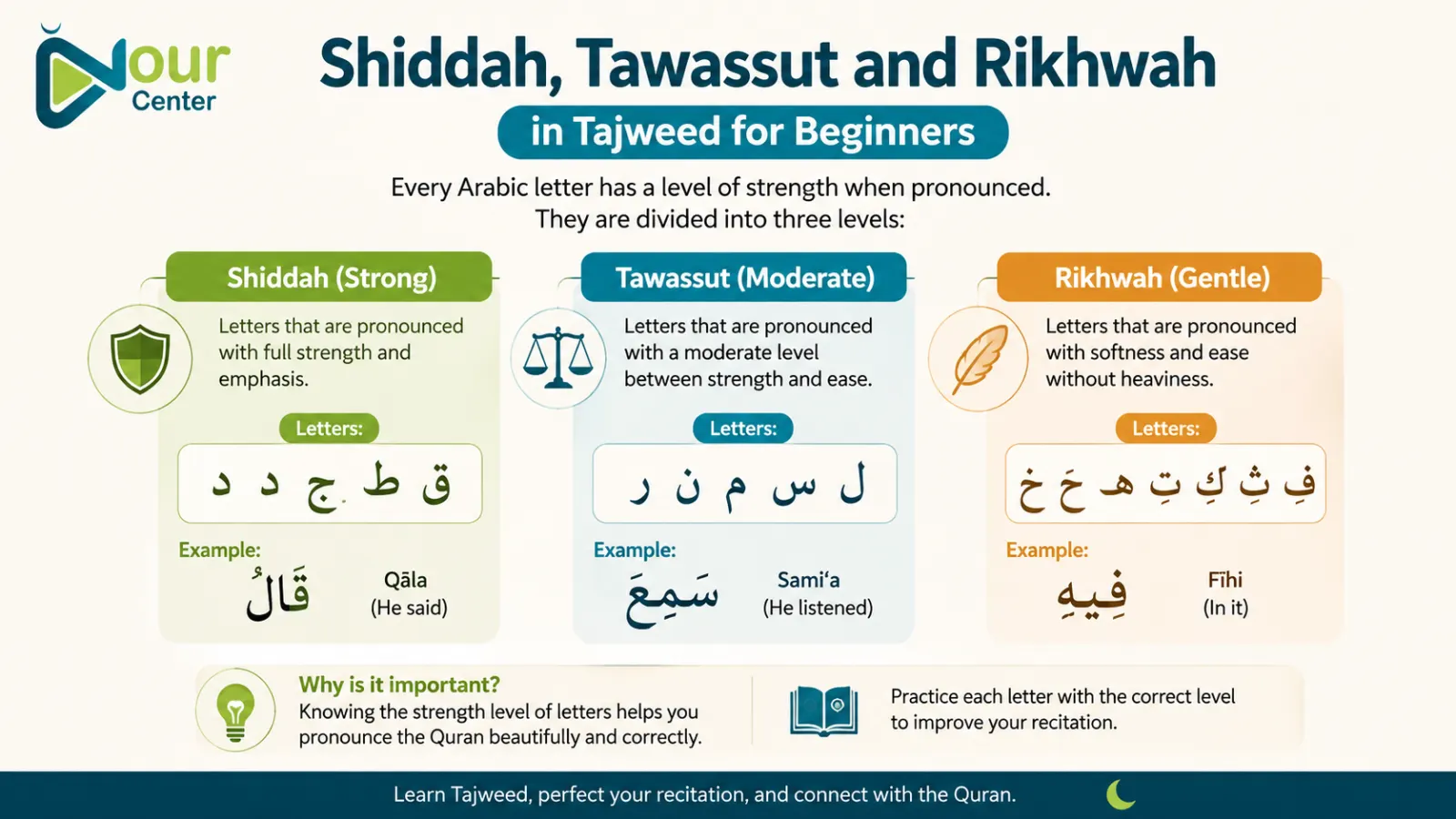
Learn Shiddah, Tawassut, and Rikhwah in Tajweed for beginners, how sound stops or flows through Arabic letters, common m...
Read Article →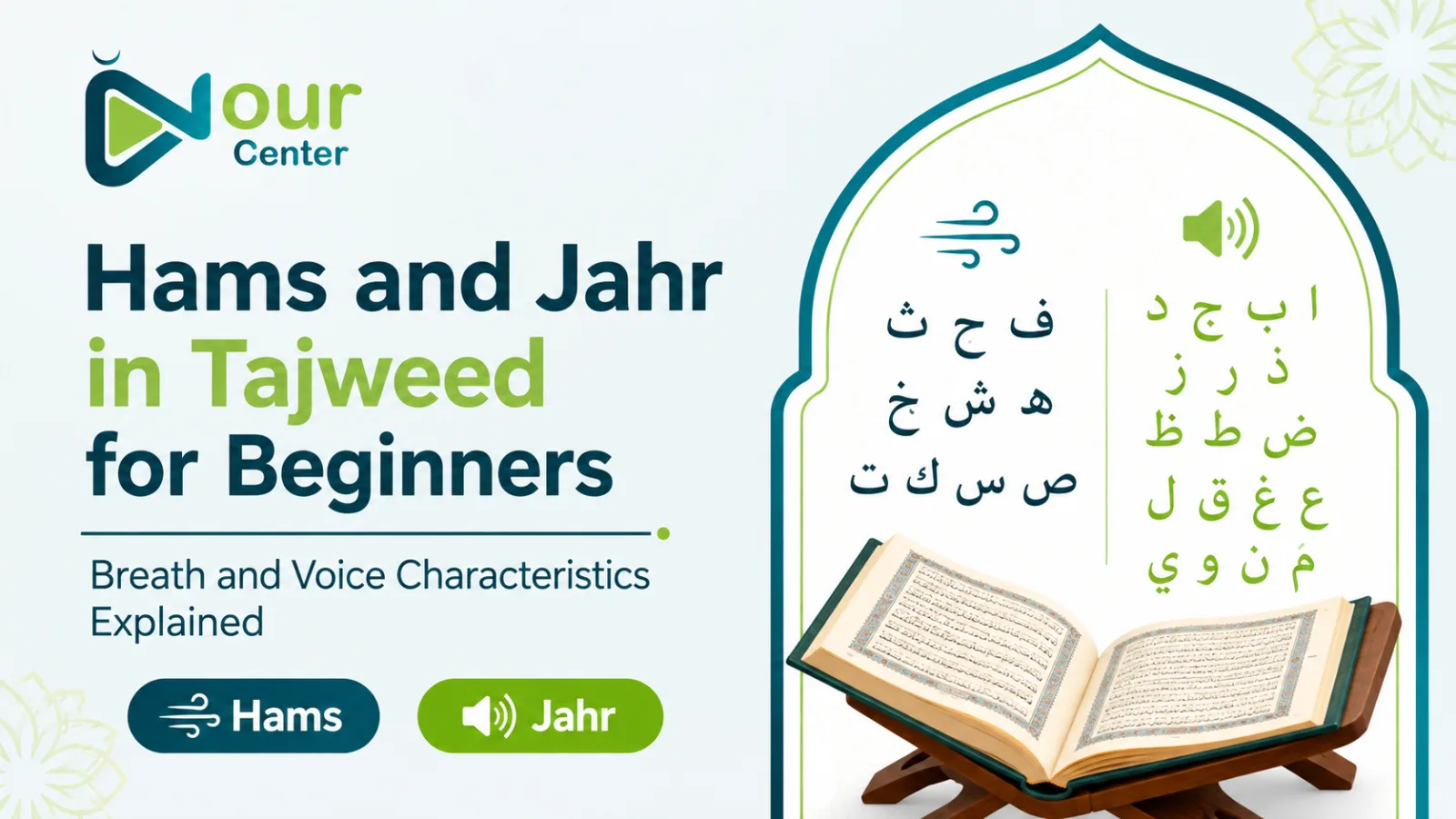
Learn Hams and Jahr in Tajweed for beginners, including their letters, breath flow, sound differences, common mistakes,...
Read Article →