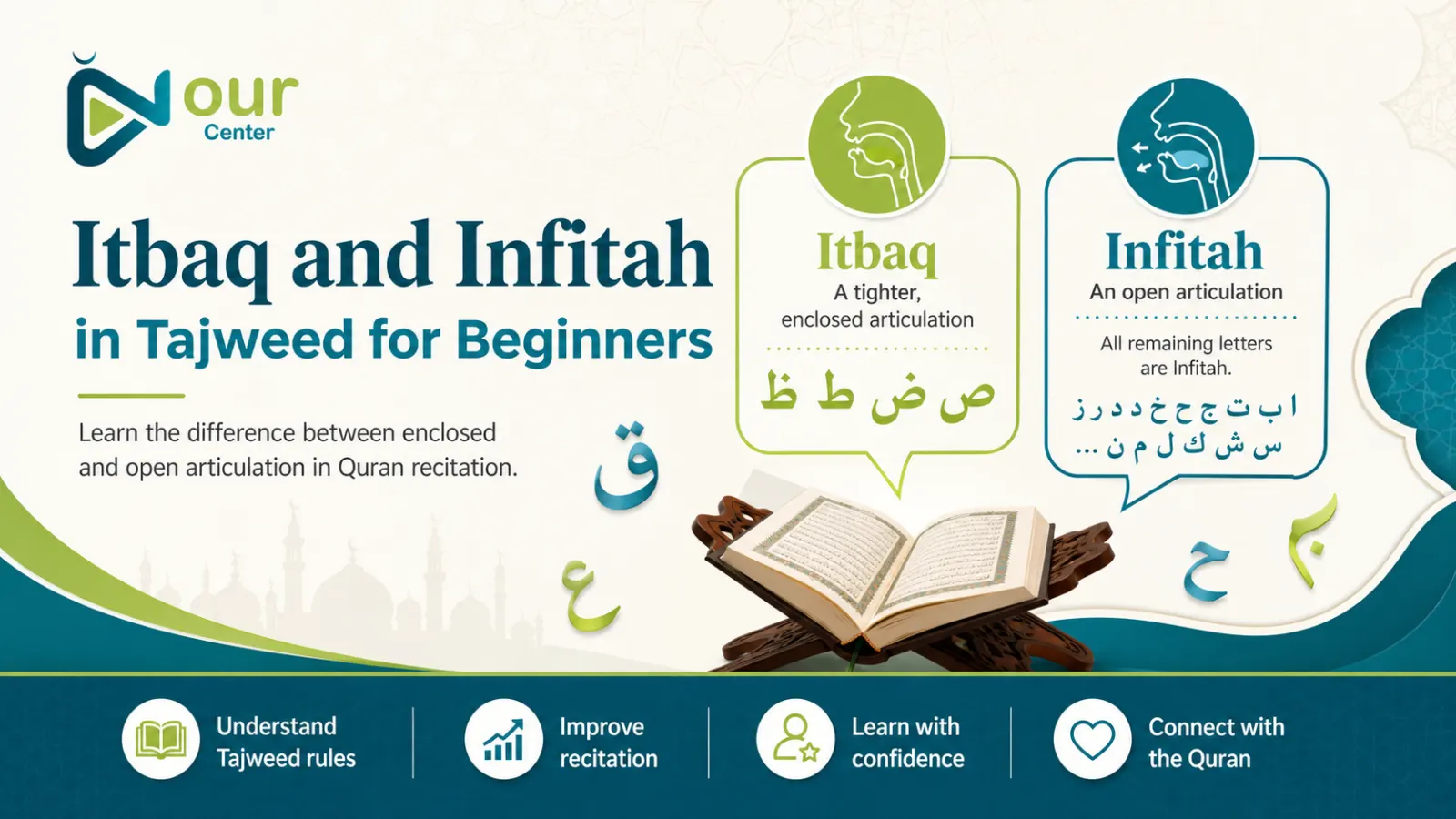
Itbaq and Infitah in Tajweed for Beginners: Understanding Tongue Contact and Openness
Learn Itbaq and Infitah in Tajweed for beginners, the four Itbaq letters, tongue position, heavy pronunciation, common m...
Read Article →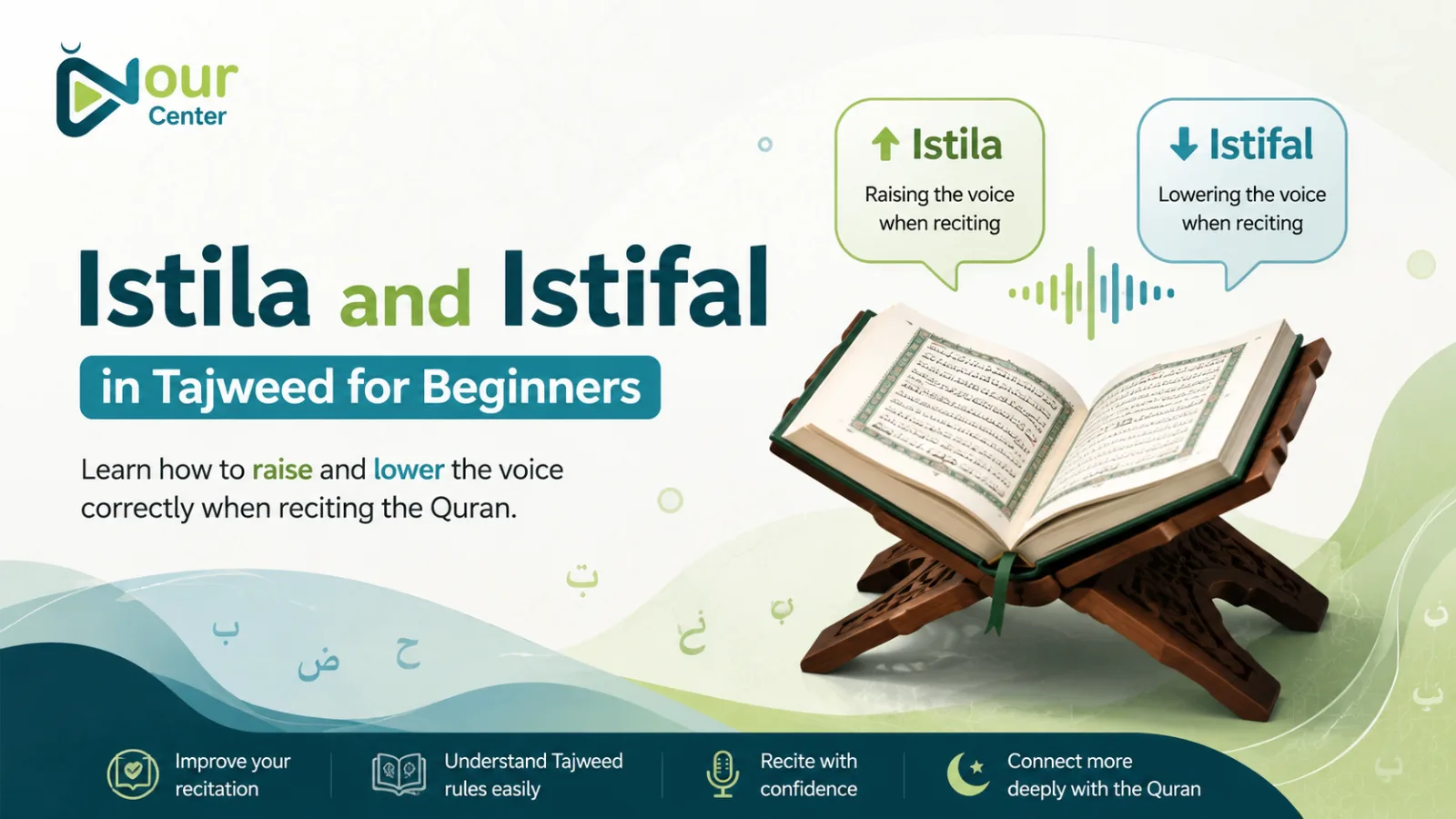
Understanding Heavy and Light Tongue Position
Isti'la and Istifal are important characteristics of Arabic letters in Tajweed because they help explain why some consonants have a naturally fuller sound while most others have a lighter quality. The key difference involves the position of the tongue during pronunciation.
Isti'la = part of the tongue rises toward the upper palate. Istifal = the tongue remains lower and does not rise in the same way. The seven Isti'la letters are naturally associated with Tafkhim. The remaining letters are classified under Istifal in this paired characteristic. This topic provides a deeper explanation of heavy and light pronunciation.
Instead of only memorizing which letters sound heavy, the learner begins to understand the physical reason behind that sound quality.
Students who understand Sifat al-Huruf for Beginners will find Isti'la and Istifal easier because these two qualities are part of the system that describes how Arabic letters behave during pronunciation. This guide explains Isti'la and Istifal in Tajweed for beginners, the seven Isti'la letters, tongue position, Tafkhim, common mistakes, and practical Quran exercises. What Is Isti'la in Tajweed? Isti'la means elevation.
In Tajweed, it describes the elevation of the tongue toward the upper palate during the pronunciation of specific letters.
This elevation contributes to a fuller and heavier sound.
Isti'la = tongue rises. The learner should not force the entire tongue upward. The elevation occurs according to the natural articulation of the letter. Correct pronunciation should remain relaxed and controlled. How Many Isti'la Letters Are There?
Kha. Sad. Dad. Ghayn. Ta emphatic. Qaf. Za emphatic.
خُصَّ ضَغْطٍ قِظْ Beginners should memorize the group and practice each letter carefully. Why Are Isti'la Letters Heavy? The raised tongue position changes the resonance of the mouth. This creates the fuller sound associated with Tafkhim. However, Isti'la and Tafkhim are related but not identical terms. Isti'la describes a permanent letter characteristic. Tafkhim describes the heavy sound quality produced in pronunciation. The seven Isti'la letters are therefore fundamentally associated with heaviness.
Isti'la and Tafkhim Understanding Heavy and Light Letters in Tajweed for Beginners helps explain the practical result of Isti'la because the seven elevated letters form the main group of consistently heavy Arabic letters.
Isti'la = tongue elevation. Tafkhim = resulting heavy sound quality. This physical connection makes heavy pronunciation easier to understand. Does Isti'la Mean Raising the Entire Tongue? No. Beginners sometimes overcorrect by pulling the whole tongue backward and upward. This creates tension and can distort the vowel. The tongue should follow the natural Makhrij of the letter. The characteristic elevation happens without exaggerated movement.
Correct Makharij for Beginners remains essential because Isti'la cannot compensate for placing the tongue in the wrong articulation point.
What Is Istifal in Tajweed? Istifal is the opposite characteristic. It describes lowering the tongue rather than elevating it toward the upper palate in the way associated with Isti'la.
Istifal = tongue remains lower. The majority of Arabic letters belong to this category. They generally have a lighter sound quality unless another specific Tajweed rule affects them. Does Istifal Mean Weak Pronunciation? No. A light letter should remain clear and strong enough to preserve its identity.
Weak. Unclear. Quiet. Incomplete. The letter must still be articulated correctly. The difference concerns tongue position and sound quality. Which Letters Have Istifal? All Arabic letters other than the seven Isti'la letters are classified as Istifal in this paired characteristic.
Memorize the seven Isti'la letters. Then remember that the remaining letters are Istifal. This reduces the amount of memorization required. Isti'la in Kha Kha is a throat letter with a heavy quality. The tongue elevation contributes to the full sound. Beginners sometimes make Kha too weak. Others make it excessively harsh. Correct Kha should remain clear and heavy without unnecessary force. Isti'la in Sad Sad is one of the clearest heavy consonants.
It combines several important characteristics.
Correct articulation. Isti'la. Tafkhim. Other relevant Sifat. Sad should remain clearly different from Seen. Making it too light can cause confusion between the two letters. Isti'la in Dad Dad is one of the more difficult Arabic letters for many learners. Its Makhrij and Sifat must work together. Simply making the sound deep does not create correct Dad. Teacher correction is particularly important.
The learner should develop the articulation first and then preserve the natural elevated quality.
Isti'la in Ghayn Ghayn is another heavy throat letter. The learner should avoid making the throat overly tense. The tongue elevation and throat articulation should work naturally. A strong, controlled sound is better than an exaggerated one. Isti'la in Emphatic Ta The emphatic Ta is heavy and should remain clearly distinct from ordinary Ta. This difference is an excellent training example for Tafkhim and Tarqiq.
Heavy emphatic Ta. Light Ta. Listen carefully to the tongue and sound differences. Isti'la in Qaf Qaf is articulated from the back of the tongue and is naturally heavy. Beginners may weaken it until it resembles Kaf. A strong Makharij foundation helps preserve Qaf. The learner should not rely only on heaviness. The articulation itself must remain correct. Isti'la in Emphatic Za This letter is also naturally heavy.
Non-Arabic speakers may replace it with lighter sounds because the articulation is unfamiliar.
Teacher comparison helps the learner hear the full quality while maintaining the correct tongue position.
Just like Tafkhim, Isti'la should not be confused with volume. The learner can pronounce an Isti'la letter quietly and still maintain the correct tongue elevation and heavy quality. Speaking louder does not fix an incorrect tongue position.
A heavy letter is not automatically a long letter. Do not extend the consonant simply because its sound is full. Madd controls vowel length. Isti'la describes a letter characteristic. The two are different.
When an Isti'la letter carries Fathah, the heavy quality is easy for many beginners to hear. However, the learner should avoid broadening the Fathah too much. The vowel must remain accurate. Heavy consonant does not mean distorted vowel.
Dammah already requires lip rounding. When combined with an Isti'la consonant, learners may exaggerate both features. Keep the Dammah natural. Maintain the heavy consonant. Do not force the mouth.
Kasrah can make Isti'la letters more difficult because learners may lighten them too much. The seven letters do not lose their basic Isti'la characteristic simply because Kasrah appears. The degree of Tafkhim may sound different, but the consonant remains part of the heavy group. This is an important beginner principle. Isti'la and the Levels of Tafkhim Advanced Tajweed study may discuss different levels of Tafkhim depending on vowels and surrounding conditions.
Beginners do not need to memorize every level immediately.
Recognize the seven letters. Keep them heavy. Maintain correct Makharij. Keep the vowels accurate. Advanced refinement can come later.
Istifal letters generally have a lighter sound quality. This is closely related to Tarqiq. However, not every detail of Tarqiq is explained only by Istifal. For example, Ra and the Lam in Allah have special context-dependent rules. A letter may belong to Istifal as a basic characteristic while receiving heavier pronunciation in a specific context. This is why Tajweed should be studied as a system rather than one isolated rule.
Ra is not one of the seven Isti'la letters. Its heavy or light quality depends on specific conditions. Students who have studied Rules of Ra in Tajweed for Beginners should remember that Ra can receive Tafkhim in some contexts without becoming one of the permanent Isti'la letters. This is an important distinction.
Lam is also generally an Istifal letter. Ordinary Lam remains light. However, the Lam in the name Allah may be heavy in certain contexts. Again, context-dependent Tafkhim does not turn Lam into an Isti'la letter. Permanent letter characteristics and contextual pronunciation rules are different concepts. Isti'la vs Tafkhim These terms are often linked.
Isti'la = an inherent characteristic involving tongue elevation. Tafkhim = heavy sound quality. All seven Isti'la letters are associated with Tafkhim. But some non-Isti'la letters may receive Tafkhim under specific rules, such as Ra or the Lam in Allah. This distinction gives the learner a more precise understanding of Tajweed.
Istifal = inherent lowering characteristic. Tarqiq = lighter sound quality. Most Istifal letters are pronounced lightly. But specific contextual rules need separate study. The concepts overlap without being identical.
The heavy quality of Isti'la letters can influence how a vowel sounds to the ear. Beginners may accidentally exaggerate that effect. The vowel should remain itself. Fathah remains Fathah. Kasrah remains Kasrah. Dammah remains Dammah. The consonant is heavy. The vowel should not be transformed into a different vowel.
A learner may pronounce a heavy letter correctly but allow the heaviness to spread into neighboring light consonants. This is a common problem.
Heavy letter. Then light letter. The second letter should return to its own proper quality. Practice the transition slowly. This develops independent control. Isti'la and Shiddah, Tawassut, and Rikhwah Students who understand Shiddah, Tawassut, and Rikhwah in Tajweed for Beginners should remember that tongue elevation and sound flow describe different characteristics and can combine within the same Arabic letter. For example, Qaf has Isti'la and Shiddah. Sad has Isti'la and Rikhwah.
This shows again that each letter carries several Sifat simultaneously. Isti'la and Hams Some Isti'la letters also have Hams. Kha and Sad are examples.
The tongue rises. The letter is heavy. Breath still flows according to Hams. Do not assume all heavy letters restrain breath. Each Sifah answers a different question. Isti'la and Jahr Other Isti'la letters have Jahr. The learner should not try to create one identical pronunciation pattern for all seven letters. They share Isti'la, but other Sifat differ. This is why every letter still needs individual practice.
Isti'la and Qalqalah Qaf and emphatic Ta are Isti'la letters and are also Qalqalah letters.
Tafkhim. Correct Isti'la. Qalqalah. Correct Makhrij. All at the same time. One rule does not replace another.
Making Every Letter Heavy
After studying Isti'la, some beginners begin raising the tongue too often. This makes Istifal letters unnecessarily heavy. Memorize the seven Isti'la letters carefully. Do not guess.
Making Isti'la Letters Too Light
This can make the letter resemble a different consonant.
Sad becoming like Seen. Qaf becoming too close to Kaf. Emphatic Ta becoming like ordinary Ta. Practice heavy-light comparisons.
Using the Throat Instead of the Tongue
A learner may try to make every heavy consonant deep by tightening the throat. This is incorrect. Isti'la is strongly connected with tongue elevation. Use the proper Makhrij. Do not create unnecessary throat pressure.
Pulling the Tongue Too Far Back
Exaggerated tongue retraction can distort pronunciation. The movement should remain natural to the letter. Teacher feedback helps because the learner may not feel that the tongue is overworking.
Distorting Kasrah
Heavy consonants with Kasrah can be challenging. Do not turn Kasrah into a different vowel simply to preserve heaviness.
Correct heavy consonant. Correct Kasrah.
Making Istifal Letters Weak
Istifal means lower tongue position. It does not mean weak pronunciation. Light consonants should remain fully articulated.
Confusing Isti'la With Ra Tafkhim
Ra can be heavy without being one of the seven Isti'la letters. Do not add Ra to the permanent Isti'la group. Learn its separate rules.
Confusing Isti'la With Lam Tafkhim
The Lam in Allah may become heavy in certain contexts. That does not make Lam one of the Isti'la letters. Contextual heaviness and inherent characteristics are separate.
Ignoring Other Sifat
Qaf is not only heavy. Sad is not only heavy. Every letter has multiple characteristics. The learner should gradually combine them.
Studying Only the Letter List
Memorizing خُصَّ ضَغْطٍ قِظْ is useful. But pronunciation is the real goal. The student must hear and produce the elevated sound inside Quran words.
Fathah. Dammah. Kasrah. Sukoon. Listen to how the letter remains part of the heavy group while the vowel changes. Then place each letter inside Quran words.
Sad vs Seen. Qaf vs Kaf. Emphatic Ta vs Ta. Heavy letter vs nearby light letter. Listen first. Then repeat. The ear often learns the difference before the tongue masters it.
Pronounce a clear Isti'la letter slowly. Notice the back or body of the tongue rising. Then pronounce a light Istifal letter. Notice the difference. Do not exaggerate the motion. The purpose is awareness rather than physical force.
Review the seven Isti'la letters.
Practice them with Fathah.
Practice them with Kasrah and Dammah.
Compare heavy and light pairs.
Read a short Quran phrase.
Review Isti'la and Istifal definitions.
Practice Kha, Sad, and Dad.
Practice Ghayn, emphatic Ta, Qaf, and emphatic Za.
Compare Isti'la and Istifal letters.
Record yourself.
Repeat teacher corrections.
Understand Tongue Elevation
Listen to heavy and light examples.
Memorize the Seven Letters
Learn خُصَّ ضَغْطٍ قِظْ.
Practice With Fathah
Keep heaviness without distorting the vowel.
Practice With Dammah and Kasrah
Maintain the consonant identity.
Heavy vs Light Pairs
Compare Sad and Seen, Qaf and Kaf, and emphatic Ta and Ta.
Combine With Other Sifat
Notice Hams, Jahr, Shiddah, and Rikhwah alongside Isti'la.
Quran Reading Assessment
Read a passage while the teacher checks heavy and light pronunciation. Isti'la and Istifal for Kids
Tongue rises = heavy group. Tongue stays lower = light group. The teacher can demonstrate a heavy letter and a light letter. The child listens and repeats. The technical names Isti'la and Istifal can be added gradually. Should Children Memorize the Seven Letters? Yes, once they are ready. But memorization should be connected to pronunciation. A child who knows the list but pronounces Sad like Seen still needs sound practice.
Use small groups and repeated Quran examples.
Adults often understand the theory quickly but may carry pronunciation habits from their native language.
Make Qaf too light. Replace emphatic letters. Overuse throat tension. Spread heaviness through a whole word. Teacher comparison and recording help correct these habits. Can Isti'la Be Learned Without a Teacher? You can memorize the seven letters independently. You can also listen to reliable models. However, self-correction can be difficult because the learner may not notice: Incorrect tongue elevation. Excessive heaviness. Vowel distortion. Weak Makharij. Heaviness spreading into light letters.
A teacher can identify these issues immediately.
Sad and Seen. Qaf and Kaf. Emphatic Ta and Ta. Listen afterward.
Is the heavy letter clearly full? Did I distort the vowel? Did the light letter remain light? Did I make the whole word heavy? Repeated recordings show improvement over time.
At Nour Center, live one-to-one Tajweed lessons can teach Isti'la and Istifal through direct articulation and listening practice.
Makharij. Tongue position. Tafkhim. Tarqiq. The seven Isti'la letters. Heavy-light contrasts. Other Sifat. Quran reading fluency. The teacher can isolate difficult letters and then return them to Quran words and verses.
You recognize the seven Isti'la letters immediately. Heavy letters sound naturally full. You no longer rely on volume. Kasrah remains correct on heavy letters. Light letters remain light. Qaf and Kaf are clearly different. Sad and Seen are clearly different. Heaviness does not spread into neighboring letters. You understand why Ra and Lam can sometimes be heavy without being Isti'la letters. Your teacher corrects fewer Tafkhim errors. What Should You Study Next?
After Isti'la and Istifal, a useful next topic is Itbaq and Infitah. These characteristics describe whether the tongue creates a more enclosed relationship with the palate or remains more open. The four Itbaq letters are among the strongest heavy letters. Studying this pair helps explain why some Isti'la letters sound even fuller than others.
Isti'la and Istifal in Tajweed for Beginners help explain the physical foundation of heavy and light Arabic pronunciation.
Isti'la = tongue elevation. Istifal = tongue remains lower.
Kha. Sad. Dad. Ghayn. Emphatic Ta. Qaf. Emphatic Za.
خُصَّ ضَغْطٍ قِظْ The remaining letters belong to Istifal in this paired classification. Do not confuse heaviness with loudness. Do not force the whole tongue backward. Do not distort vowels. Do not make light letters weak. Do not treat heavy Ra or the heavy Lam in Allah as permanent Isti'la letters. Correct Makharij and Sifat must work together.
With regular listening, comparison, Quran practice, recording, and qualified correction, Isti'la and Istifal become natural parts of accurate Arabic pronunciation.
Note: Comments may require approval before appearing publicly.
Learn Itbaq and Infitah in Tajweed for beginners, the four Itbaq letters, tongue position, heavy pronunciation, common m...
Read Article →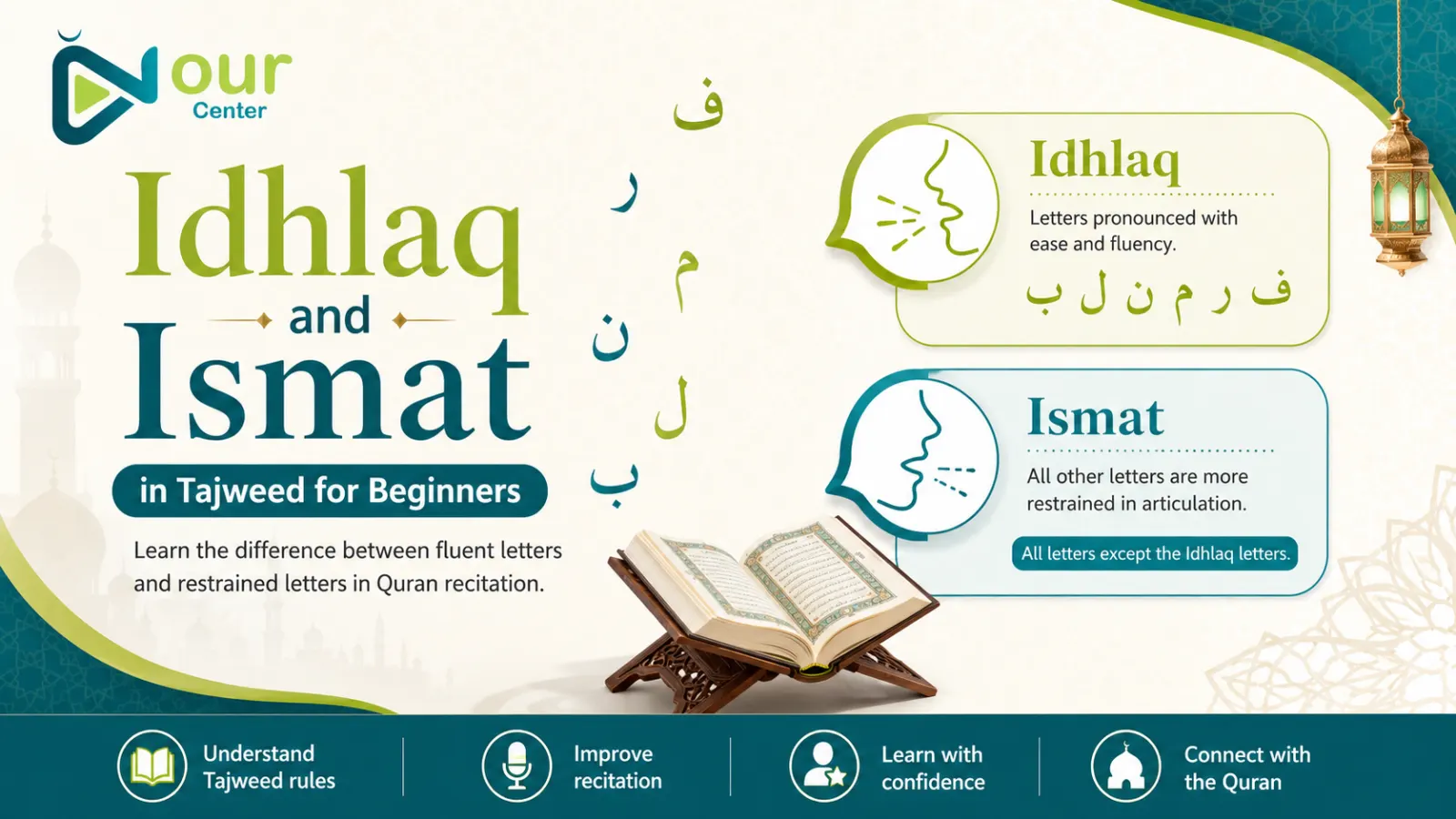
Learn Idhlaq and Ismat in Tajweed for beginners, the six Idhlaq letters, their pronunciation characteristics, the differ...
Read Article →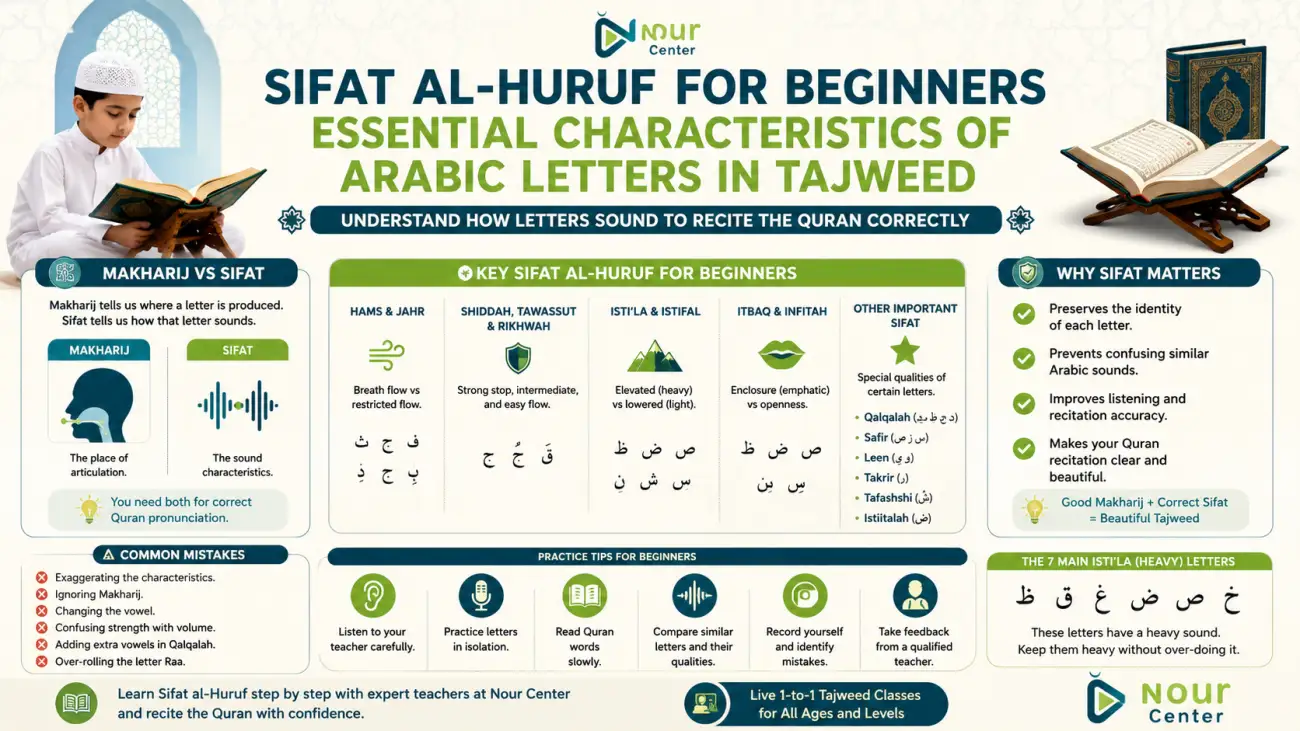
Learn Sifat al-Huruf for beginners, including Hams, Jahr, Shiddah, Rikhwah, Isti'la, Istifal, Itbaq, and other essential...
Read Article →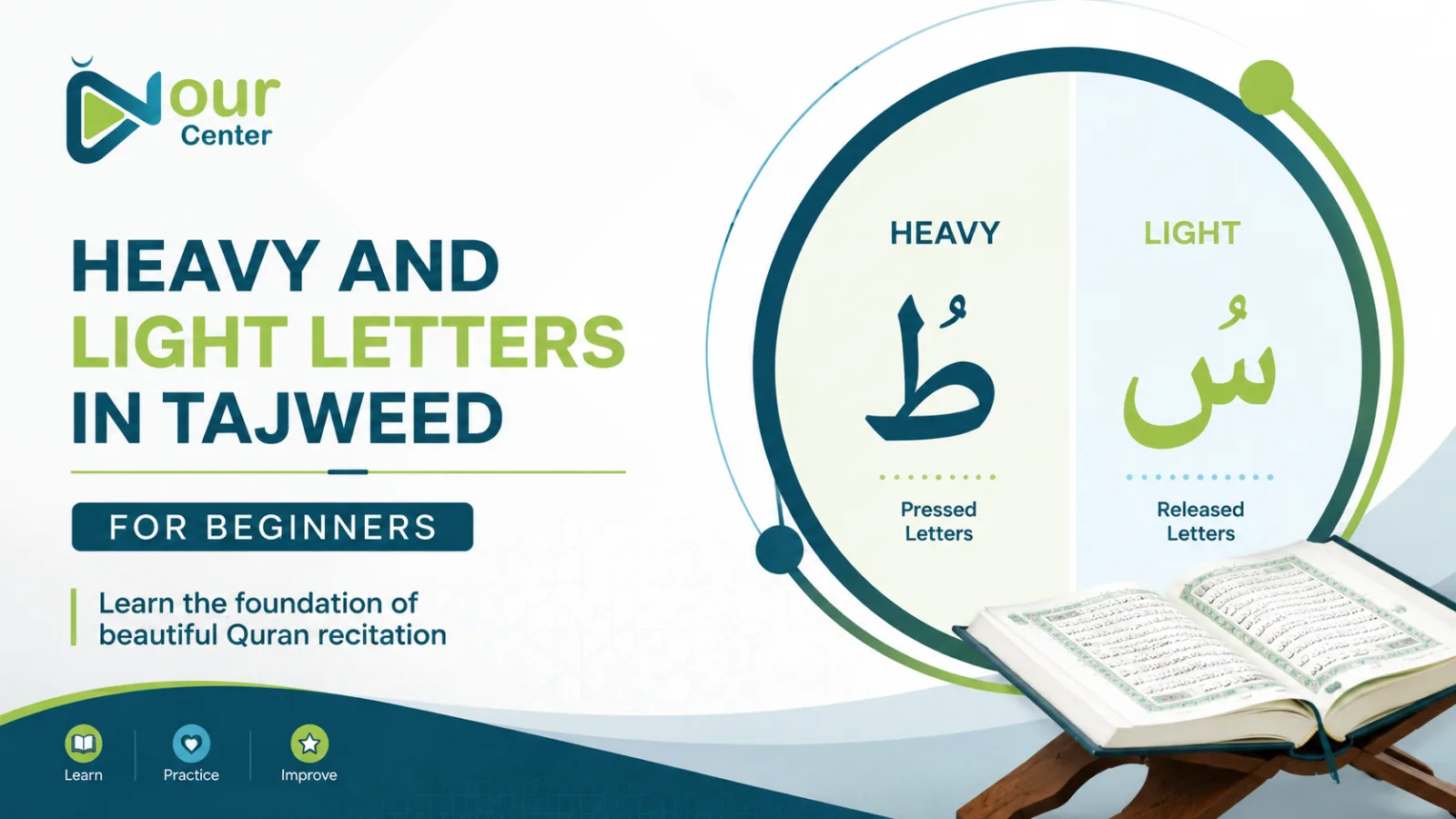
Learn heavy and light letters in Tajweed for beginners, including Tafkhim, Tarqiq, the heavy Arabic letters, rules of Ra...
Read Article →