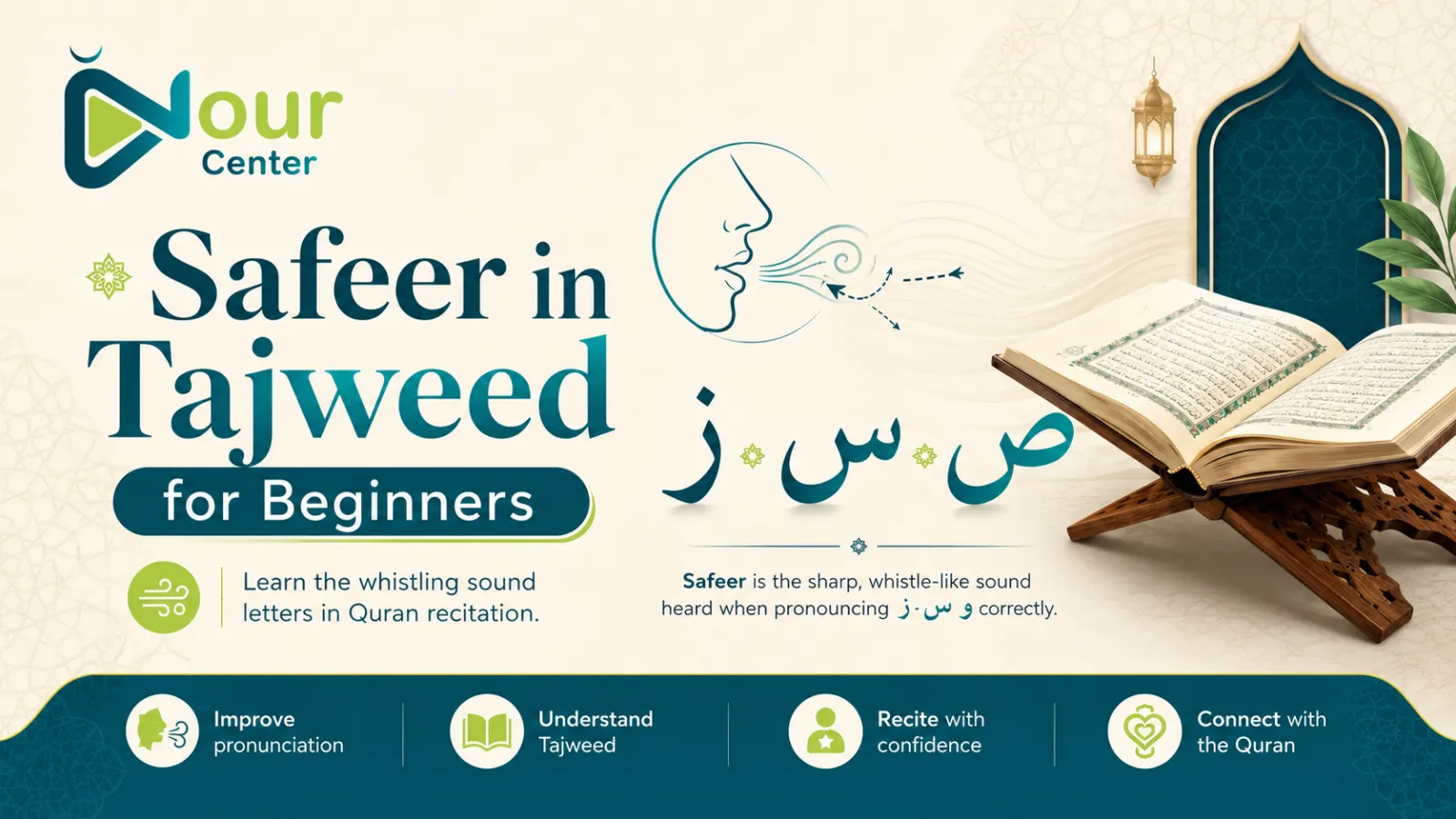
Safeer in Tajweed for Beginners: Understanding the Whistling Sound of Arabic Letters
Learn Safeer in Tajweed for beginners, the three Safeer letters, how the whistling sound is produced, common pronunciati...
Read Article →
How to Pronounce Every Letter
Arabic Letter Sounds for Beginners is the natural next step after learning to recognize the Arabic alphabet. Knowing that a symbol is Ba, Ta, Ayn, Qaf, or Dad is useful.
You need to know how each letter actually sounds. This is especially important for non-Arabic speakers because several Arabic consonants do not have exact equivalents in English or other common languages. Beginners may recognize a letter correctly but still replace its sound with the nearest sound from their native language.
Qaf may become Kaf. Ha may be confused with Ha from the throat. Sad may become Seen. Dad may become Dal. Ayn may disappear completely. Arabic pronunciation becomes much easier when each letter is learned through three things: Its written shape. Its sound. Its articulation point. Students who completed Arabic Alphabet for Beginners should now focus on connecting every familiar letter shape with its correct Arabic sound instead of relying only on letter names.
This guide explains Arabic letter sounds for beginners, how to pronounce all 28 letters, which sounds are easiest and most difficult, how similar letters differ, and how to practice pronunciation step by step.
Correct pronunciation affects both communication and reading. In Arabic, changing one consonant can create a completely different word. Two letters may look similar. Two letters may sound similar to a beginner. But they are still separate Arabic sounds. This becomes especially important when reading the Quran, where preserving the identity of every letter is a central part of accurate recitation. Even for students learning conversational Arabic, strong pronunciation makes listening and speaking easier.
Recognize words more accurately. Repeat vocabulary more clearly. Understand native speakers more easily. Read unfamiliar words. Improve Quran recitation. Reduce dependence on transliteration. Build better speaking habits from the beginning.
One of the first things beginners should understand is the difference between: The name of a letter. And the sound of the letter.
ب is called Ba.
بَ بِ بُ بْ The consonant remains Ba, while the vowel mark changes the complete sound. Therefore, memorizing the alphabet names is only the first stage. Real reading means recognizing the consonant immediately and combining it with the correct Harakah.
Transliteration uses Latin letters to represent Arabic sounds. It can be helpful temporarily.
kh
خ
gh
غ But these English letter combinations do not teach the real Arabic articulation. Two different learners may pronounce “kh” completely differently. Some Arabic letters also have no natural English equivalent. For this reason, transliteration should gradually disappear as your Arabic reading improves.
Arabic script. Teacher audio. Direct imitation. Articulation practice. These provide a much stronger foundation.
Makharij are the articulation points of Arabic letters. They explain where a sound is produced.
The lips. The front of the tongue. The middle of the tongue. The back of the tongue. The throat. Other oral areas. Correct Makharij for Beginners is especially useful for students learning Arabic letter sounds because difficult consonants become easier when the learner understands where the sound should originate. Instead of trying to imitate a mysterious sound, you know what part of the mouth or throat should be involved.
Let us go through the Arabic alphabet one letter at a time. The descriptions below are beginner guides. They should support listening and teacher correction rather than replace them.
Alif needs careful explanation because its pronunciation role changes according to context.
ا In actual Arabic reading, Alif may function with Hamzah or as part of a long vowel pattern. The glottal sound associated with Hamzah resembles the brief catch in the throat heard between the two parts of the English expression: uh-oh. Do not assume every Alif represents the same sound in every word. As you progress into Harakat and Madd, the difference becomes clearer.
Ba is usually easy for English speakers.
b The two lips come together.
بَ بِ بُ The sound should be clean and not exaggerated.
p Arabic Ba is voiced.
Ta is a light Arabic consonant.
t But learners should listen carefully to the Arabic articulation rather than relying completely on English pronunciation. The tongue works near the upper front teeth and gum area.
ط This distinction becomes important later.
think The tongue approaches or slightly comes between the front teeth.
s t
f Practice the actual tongue placement rather than guessing from transliteration.
ت ث The two letters should remain clearly different.
Jeem is commonly taught with a sound similar to the English: j
jump Pronunciation can vary across spoken Arabic dialects, but Quranic and formal Arabic instruction should follow the pronunciation model taught in the course. For beginners learning Quranic Arabic, listen carefully to the teacher rather than copying regional speech habits.
This is one of the first genuinely unfamiliar letters for many non-Arabic speakers. ح is a breathy throat sound.
h The sound is produced deeper in the throat.
خ
ه ح خ These three letters require separate practice.
Kha is produced from the upper throat area.
ح English does not have a perfect equivalent. Some beginners compare it loosely with the sound in certain pronunciations of words from German or Scottish speech. But Arabic Kha should be learned directly from an Arabic model.
k
h
d It is articulated near the front part of the mouth.
ض Dad. One of the most common beginner mistakes is treating Dad simply as a heavier Dal. They are distinct letters.
this
those
ث
ث — like the unvoiced “th” ذ — like the voiced “th” Beginners should practice the pair together.
Arabic Ra is different from the typical English R. The tongue tip approaches the area behind the upper front teeth. The sound should be clear and controlled. Do not automatically produce a long repeated roll. Students later studying Tajweed learn that Ra can also be heavy or light depending on context. For basic Arabic pronunciation, the first goal is the correct Arabic articulation.
z
zoo
س Seen. Zay has a voiced quality. Seen has a different airflow pattern.
س ز to hear the contrast.
s It has a sharp, light sound. Do not make it heavy.
ص Sad. This pair is one of the most important pronunciation contrasts for beginners.
sh
ship It is produced using the middle area of the tongue. The sound has a broader spreading quality than Seen.
س ش The difference should remain obvious.
Sad is a heavy Arabic consonant. It is not simply a louder Seen.
س ص Seen is light. Sad is heavy and fuller. The tongue position and resonance change. Beginners often pronounce Sad too lightly because their language has no equivalent emphatic consonant. Do not solve this by shouting. Learn the actual tongue position.
Dad is one of the most distinctive Arabic letters. It can be difficult for non-native learners. The side of the tongue plays an important role in its articulation with the upper molar area.
d or a “heavy d.” Its articulation is different from Dal. Students should learn this letter slowly with direct teacher correction.
ت
ت ط Both involve a tongue articulation toward the front of the mouth, but emphatic Ta has a fuller sound quality. Do not make the difference only by increasing volume. The heaviness comes from tongue configuration and resonance.
This is another heavy Arabic consonant. It is related in articulation to the front teeth and tongue while maintaining an emphatic quality.
ذ ز ض The safest method is teacher-led comparison. Practice the sound slowly before placing it inside words.
Ayn is one of the most challenging Arabic letters for many beginners. English does not have a direct equivalent. It is articulated from the middle region of the throat.
Ignore it. Replace it with a vowel. Replace it with Hamzah. Use a sound that is too deep or harsh. Ayn should be learned through listening and careful throat articulation. Do not strain. The sound becomes easier with repeated practice.
Ghayn comes from the upper throat region. It has a distinct voiced quality. Learners sometimes compare it loosely with a French-style R, but this is only an approximation. The Arabic sound should be learned directly.
خ غ Kha and Ghayn are articulated in related throat areas but differ in their sound characteristics.
f The lower lip approaches the upper front teeth. This sound is usually easy for beginners.
ب
ق
Qaf is an important Arabic sound that many non-native speakers replace with Kaf. It is produced using the back of the tongue toward the upper palate. The sound is deeper and heavier than Kaf.
ك ق Kaf is lighter and more forward. Qaf is produced farther back. Do not rely on volume to create the difference.
k It is generally easier for English-speaking learners. However, it should remain clearly different from Qaf.
ك ق Many beginners need time before the distinction becomes automatic.
l but students should learn the correct tongue position rather than assume every English L is equivalent. The tongue contacts the area near the upper teeth and gums. Lam is normally light. Specific contexts in Quran recitation can affect the Lam in the name Allah, but that belongs to a more advanced Tajweed discussion.
m The lips come together. This sound is usually familiar to beginners. When studying Quran recitation later, students will learn additional rules connected with Meem and nasal resonance.
m sound.
n The tongue works near the upper front teeth and gums. Noon also has a natural nasal quality. Later Tajweed study introduces detailed rules involving Noon Sakinah and Tanween. For beginner Arabic pronunciation, learn a clear and stable Noon first.
ح
h
home
ه ح until the difference becomes easy to hear.
Waw can function differently according to context.
w It may also participate in long vowel or Leen patterns depending on surrounding vowels. At the alphabet stage, beginners should first recognize its consonantal sound. Later lessons will explain its vowel roles.
y
yes It can also participate in long vowel and Leen patterns. The exact role depends on Harakat and the word structure. For beginners, start by learning its consonant sound and written forms. Which Arabic Letters Are Hardest for Beginners? Difficulty depends on the learner's native language.
ح خ ص ض ط ظ ع غ ق ر These letters should not be avoided. They should be practiced frequently in short sessions. Ten minutes of focused pronunciation each day can be more useful than one long practice session once a week.
Arabic pronunciation becomes much easier when similar letters are trained in pairs.
س ص Seen is light. Sad is heavy. Do not create Sad by simply saying Seen louder.
ت ط The ordinary Ta is light. The emphatic Ta is heavy.
د ض These letters should not share the same articulation. Dad needs its distinctive side-of-tongue articulation.
ذ ظ Both involve the tongue near the teeth. But the emphatic letter has a heavier sound quality.
ه ح The first is lighter. The second is produced more deeply in the throat.
ح خ Both involve the throat, but Kha has a rougher upper-throat quality.
ك ق Kaf is lighter. Qaf comes from farther back and has a heavier quality.
ء ع These are frequently confused. Hamzah is a glottal stop. Ayn comes from a different throat region and has its own sound.
خ غ They share a related articulation region. Kha has a different breath quality. Ghayn is voiced.
Contrast training is one of the fastest ways to improve pronunciation.
س — ص ت — ط د — ض ه — ح ح — خ ك — ق ث — ذ خ — غ ء — ع Say one letter. Then the other. Return to the first. Listen carefully. This forces the ear to recognize the distinction.
Pronunciation is not only a mouth skill. It is also a listening skill. If two letters sound identical to you, producing them differently will be difficult. Therefore, spend time listening.
Seen. Sad. Seen. Sad. Without showing you the letters. Try to identify which is which. This strengthens auditory discrimination.
When you are speaking, your voice sounds different from how it sounds in a recording. Recording makes pronunciation problems easier to notice. Choose five difficult letters. Record yourself. Listen. Compare with your teacher.
Is Qaf becoming Kaf? Is Sad becoming Seen? Is Ha becoming ordinary Ha? Is Ayn disappearing? Is Ra excessively rolled? Repeat the exercise after several days. You will often hear measurable improvement.
Difficult Arabic consonants do not require pain.
ح ع غ
خ you may be using too much pressure. Correct Arabic pronunciation is precise, not violent. Likewise, heavy letters are not produced by shouting. Relax the jaw. Follow the articulation point. Use controlled airflow. Listen carefully.
Once you can produce the consonant, short vowels allow you to read real syllables.
بَ Ba with Fathah. بِ Ba with Kasrah. بُ Ba with Dammah. The letter remains Ba. The Harakah changes the vowel that follows it. The same principle applies across the Arabic alphabet. This is why the next step after letter sounds is mastering Harakat.
A common beginner habit is adding an automatic vowel after a consonant. For example, the learner sees a letter with Sukoon but pronounces an extra: a i
u This can change the word. Arabic reading requires careful attention to written vowel marks. Sukoon teaches the learner to pronounce a consonant without adding a short vowel after it.
These three Harakat turn individual letter knowledge into actual reading.
بَ بِ بُ and do the same with the other letters, the alphabet begins functioning as a real sound system.
Alif, Ba, Ta, Tha... Arabic reading requires instant sound recognition.
After individual pronunciation becomes stable, practice simple combinations.
Consonant + Fathah. Consonant + Kasrah. Consonant + Dammah. Then introduce a second letter. Begin with easy letters before combining multiple difficult sounds. The goal is to reduce hesitation.
Once two-letter and three-letter combinations become manageable, move into short Arabic words. Do not worry about vocabulary meaning during every pronunciation exercise. Some reading practice should focus only on decoding. Other lessons can focus on meaning. Separating the skills temporarily helps beginners progress faster.
Students whose goal is Quran reading should eventually connect Arabic pronunciation with Tajweed. However, they should not skip basic letter recognition and reading. Basic Tajweed Rules should refine a learner's Arabic pronunciation after the student can identify letters, Harakat, and simple reading patterns with reasonable confidence.
Makharij. Letter characteristics. Madd. Qalqalah. Ghunnah. Stopping. Other Quran recitation rules. This sequence prevents beginners from becoming overwhelmed.
Structured Qaida lessons can be helpful for learners who need a gradual bridge between individual sounds and Quran reading. Students who need repeated practice combining Arabic letter sounds with vowels and reading patterns may benefit from Noorani Qaida for Kids because its progressive lessons move from letters toward increasingly complex Quran-reading structures. Although often used with children, the underlying progressive method can also benefit complete adult beginners.
Young learners can become tired when practicing unfamiliar mouth and throat positions.
Three difficult letters. Short repetition. A simple game. A reading activity. Then stop. The goal is consistency, not exhaustion. A child who practices a difficult sound for five focused minutes daily may improve more than a child forced through a long pronunciation drill.
Show the letter. Say the letter name. Produce its sound. Let the child imitate. Compare it with a similar letter. Find it in a simple word. Return to it the next day. Visual and auditory repetition together create stronger memory.
ع ح ق ض ط Correcting all five repeatedly in one session may create frustration. Choose one or two priority sounds. Improve them gradually. Keep the rest under observation. Effective learning is progressive.
Adults can often understand technical explanations more easily. Use that advantage.
Where should my tongue be? Is this sound from the throat? Is it heavy or light? Am I using the lips correctly? Am I replacing it with an English sound? Then combine physical understanding with audio imitation. Understanding without listening is incomplete. Listening without correction can also preserve mistakes.
Review five easy Arabic letters.
Practice two difficult letters.
Compare one similar pair.
Read letters with Fathah, Kasrah, and Dammah.
Read a few short combinations.
Record yourself and listen. Repeat the routine regularly.
Review all recently learned letters.
Makhrij practice.
Difficult-letter contrasts.
Harakat practice.
Short-word reading.
Recording and correction notes. Keep the session focused. Long sessions are not automatically better.
Lips and Easy Front Sounds
ب م ف
Front Tongue Letters
Practice several letters involving the front tongue area.
Similar Light and Heavy Sounds
س ص ت ط د ض
ه ح خ ع غ with teacher audio.
ك ق
Ra and Other Difficult Sounds
Work on controlled Arabic Ra and review weak areas.
Read random letters and simple vowel combinations without alphabetical order. Then repeat the plan with harder examples.
Pronouncing Every Letter Through English
English can help explain familiar sounds. But Arabic has its own articulation system.
b t th d r and other Latin symbols. Learn the Arabic sound itself.
Saying Qaf Like Kaf
This is extremely common.
ك ق The back of the tongue is more involved in Qaf. Listen to them side by side.
Saying Sad Like Seen
Seen and Sad must remain distinct. Seen is light. Sad is heavy. Practice without increasing volume.
Saying Emphatic Ta Like Ordinary Ta
ت ط The heavy letter needs its characteristic full sound.
Saying Dad Like Dal
Dad is not simply a heavy Dal. Its articulation must be learned separately.
ع because they cannot find an equivalent in English. Do not skip the letter. Start with slow throat practice. Even imperfect attempts can improve with correction.
Making Throat Letters Too Harsh
Correct pronunciation should not cause unnecessary strain. Do not squeeze the throat forcefully. Precise articulation is more important than intensity.
Over-Rolling Ra
Arabic Ra should not automatically become a long trill. Use a controlled tongue movement.
Ignoring the Difference Between Ha and Ha
ه ح are different. Practice them as a pair until your ear recognizes both.
Looking Only at the Letter Name
ق = Qaf does not guarantee correct Qaf pronunciation. Move quickly from names to sounds.
Never Practicing Random Order
A learner may pronounce the alphabet perfectly from beginning to end but hesitate when letters appear randomly. Use flashcards. Read random letters. Real words do not appear in alphabet order.
Avoiding Recording
Students often believe their pronunciation sounds one way when it actually sounds different. Recording reveals habits that are difficult to notice while speaking.
Practicing Only Isolated Letters
Syllables. Words. Sentences. Quran reading. Do not remain at the isolated-letter stage forever.
Moving Too Fast
Pronunciation habits become harder to correct after they are deeply established. Spend enough time creating a reasonably accurate foundation. Speed comes later.
Waiting for Perfect Pronunciation Before Reading Words
The opposite extreme is also unhelpful. You do not need perfect advanced pronunciation before reading simple words.
Recognition. Pronunciation. Reading. Together. Teacher correction can continue while you progress.
You can recognize letters randomly. You know their basic sounds without saying the letter name first. You distinguish Seen and Sad. You distinguish Ta and emphatic Ta. You distinguish Dal and Dad. You distinguish Kaf and Qaf. You distinguish ordinary Ha and throat Ha. You attempt Ayn instead of deleting it. Your Ra sounds more controlled. You depend less on transliteration. You can read letters with Harakat. You can combine sounds into simple words.
Your teacher needs to repeat fewer corrections. You recognize pronunciation mistakes when listening to your own recording. The final goal is automatic recognition.
ق and produce Qaf without consciously thinking about the English letter Q.
At Nour Center, one-to-one online Arabic lessons can help beginners build pronunciation through direct teacher feedback.
Letter recognition. Letter sounds. Makharij. Similar-sound comparison. Harakat. Sukoon. Connected forms. Simple word reading. Quranic Arabic preparation.
ع ح خ غ ق ص ض ط ظ A teacher can hear whether the student is using the correct sound and provide a focused correction rather than asking the learner to repeat blindly.
Different learners struggle with different letters. An English speaker may have one set of difficulties. A French speaker may have another. A child exposed to Arabic at home may recognize some sounds naturally. Another student may be starting from zero. One-to-one teaching allows the lesson to spend more time on the exact sounds the learner needs. What Comes After Arabic Letter Sounds?
Once you can recognize the 28 Arabic letters and produce their basic sounds, the next step is learning how short vowels change those sounds.
Fathah, Kasrah, and Dammah.
Harakat transform isolated consonants into readable syllables.
Sukoon. Shaddah. Tanween. Joining Arabic letters. Reading Arabic words. Quranic Arabic vocabulary. This creates a logical path from the alphabet to real reading.
Arabic Letter Sounds for Beginners are the foundation of accurate Arabic reading and speaking. Knowing the 28 letter names is not enough.
How each letter sounds. Where it is articulated. Which letters sound similar. Which letters are heavy. Which sounds come from the throat. How vowels affect consonants. How sounds combine into words.
ح خ ع غ ق ص ض ط ظ Do not permanently replace them with English approximations. Use transliteration only as temporary support. Listen frequently. Compare similar sounds. Practice slowly. Record yourself. Use Harakat. Move into simple words. Receive teacher correction. The goal is not to pronounce every difficult Arabic letter perfectly on the first day. The goal is steady improvement until the correct sound becomes natural.
With regular listening, repetition, Makhrij practice, and guided correction, the Arabic alphabet changes from a list of unfamiliar symbols into a complete sound system that you can use confidently for Arabic reading, Quranic Arabic, and Quran recitation.
Note: Comments may require approval before appearing publicly.
Learn Safeer in Tajweed for beginners, the three Safeer letters, how the whistling sound is produced, common pronunciati...
Read Article →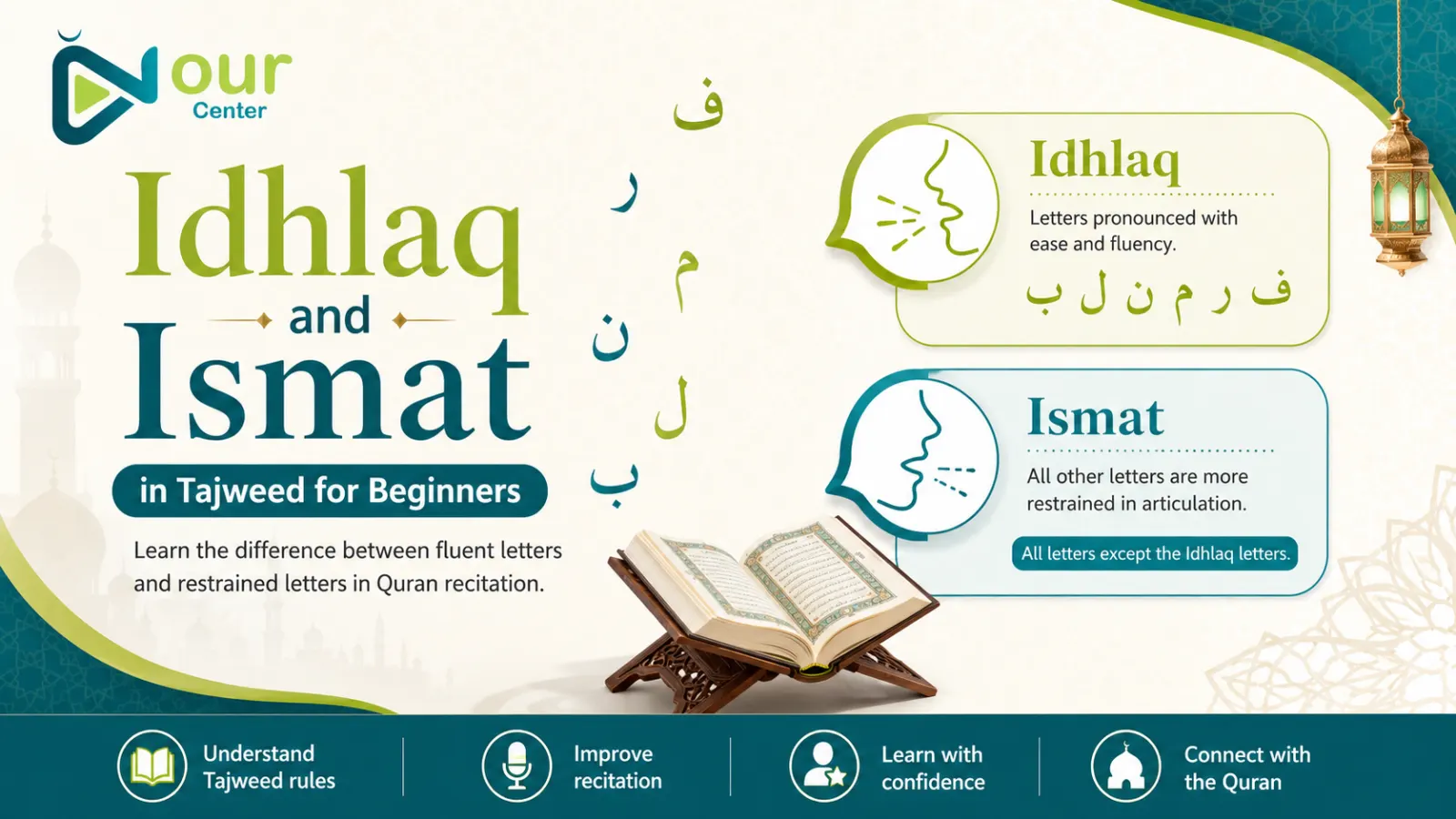
Learn Idhlaq and Ismat in Tajweed for beginners, the six Idhlaq letters, their pronunciation characteristics, the differ...
Read Article →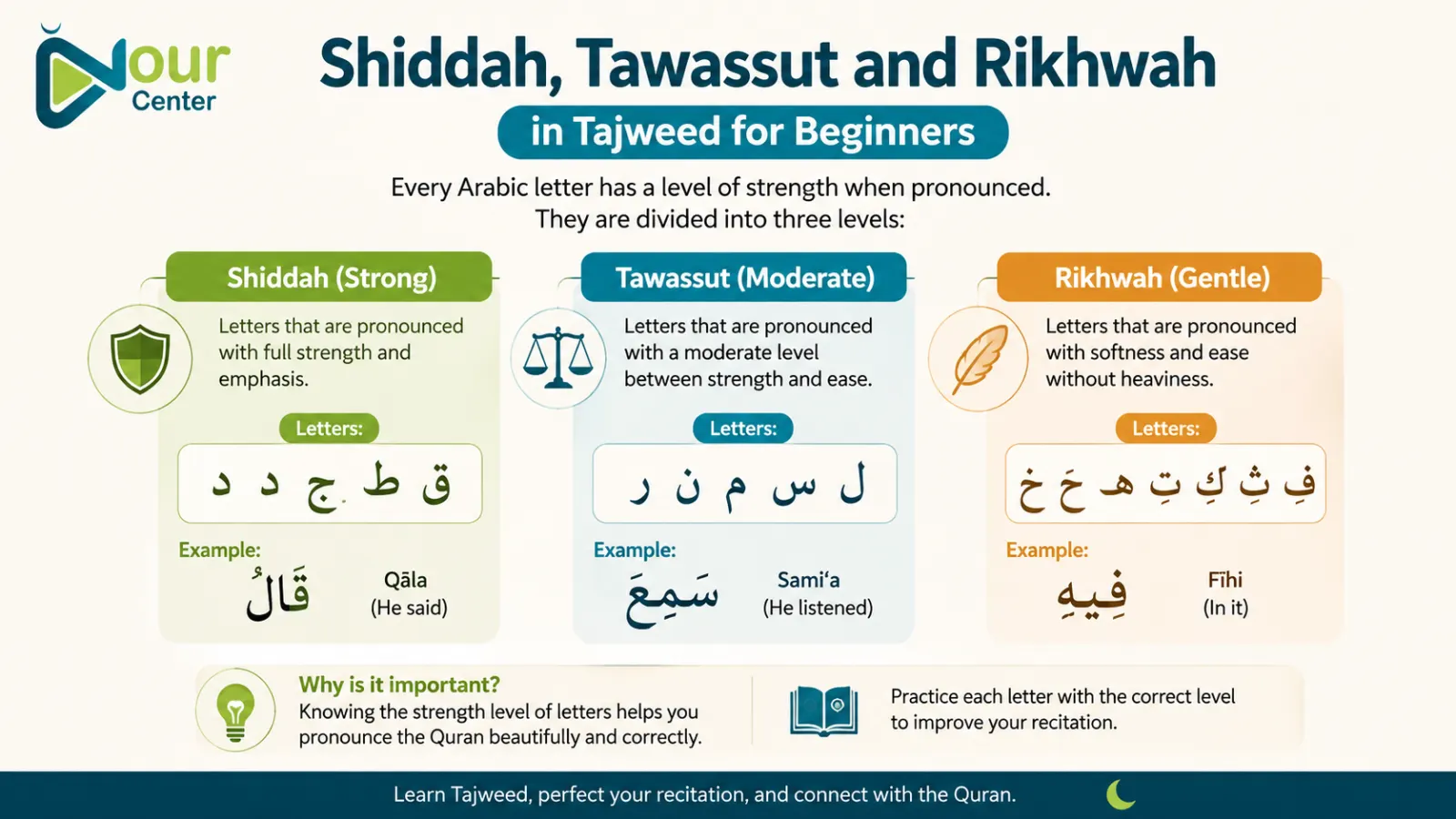
Learn Shiddah, Tawassut, and Rikhwah in Tajweed for beginners, how sound stops or flows through Arabic letters, common m...
Read Article →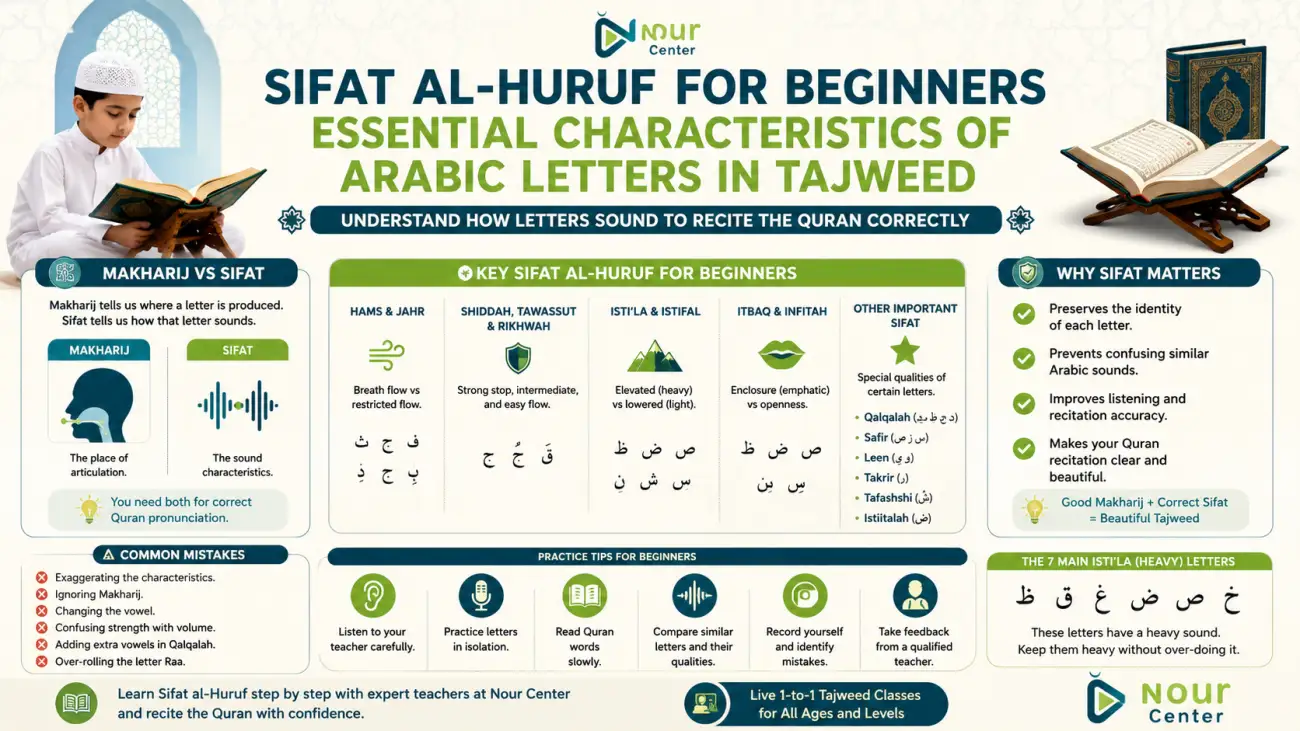
Learn Sifat al-Huruf for beginners, including Hams, Jahr, Shiddah, Rikhwah, Isti'la, Istifal, Itbaq, and other essential...
Read Article →