
How to Read Arabic Words for Beginners Step by Step
Learn how to read Arabic words for beginners step by step by combining connected letters, Harakat, Sukoon, Shaddah, and...
Read Article →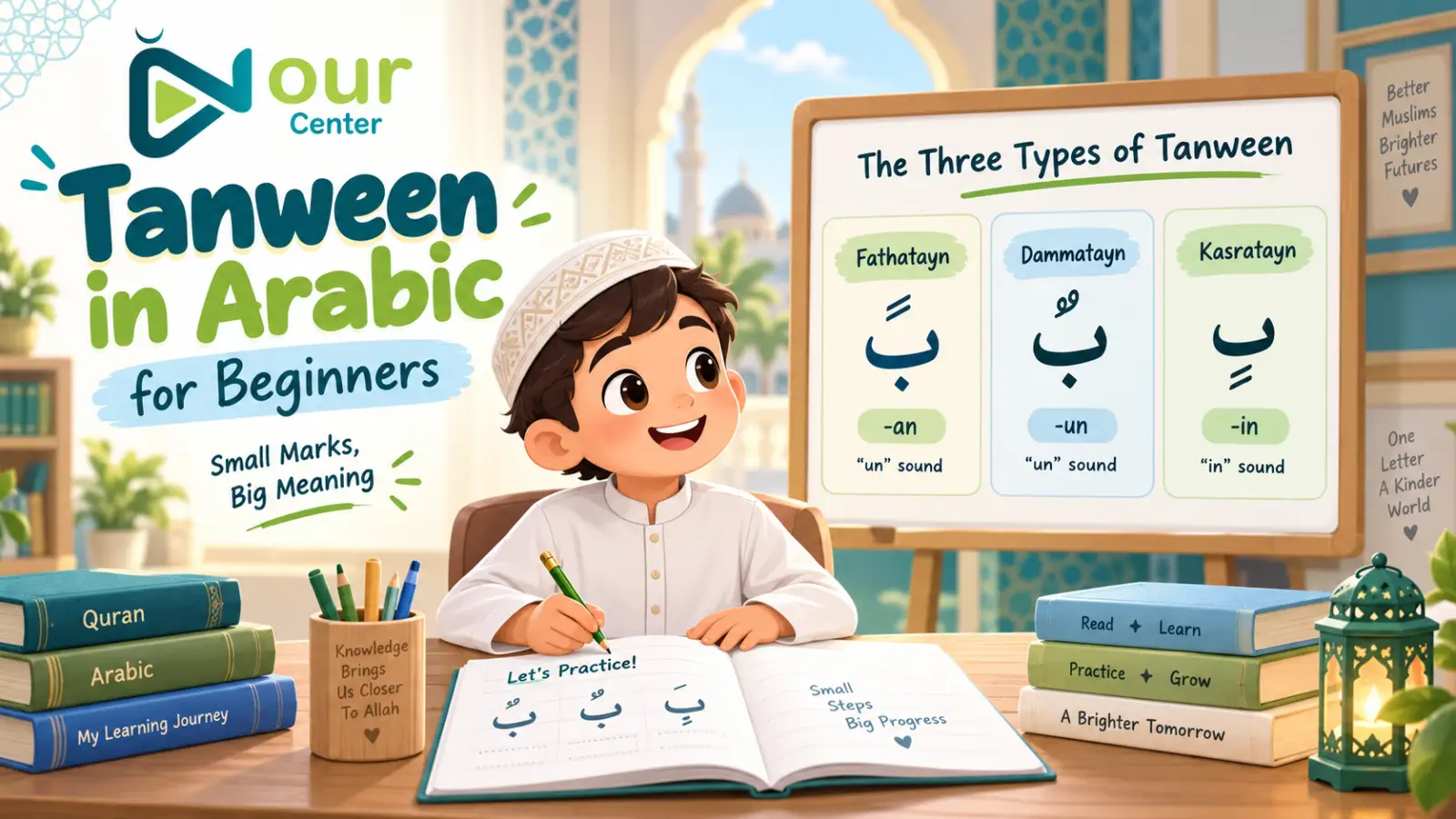
Fathatain, Kasratain, and Dammatain
Tanween in Arabic for Beginners is an important step after learning the basic Harakat, Sukoon, and Shaddah. By this stage, a beginner should already recognize the three basic short vowels: Fathah. Kasrah. Dammah. Tanween builds directly on these familiar vowel sounds. Instead of one vowel mark, Tanween is commonly written using doubled vowel marks.
Fathatain. Kasratain. Dammatain. They create a short vowel followed by an n-like sound at the end of the word when Tanween is pronounced.
Fathah → short a. Fathatain → short an. Kasrah → short i. Kasratain → short in. Dammah → short u. Dammatain → short un. Students who understand Arabic Harakat for Beginners will find Tanween easier because Fathatain, Kasratain, and Dammatain are closely related to Fathah, Kasrah, and Dammah but add a final n-like sound.
This guide explains Tanween in Arabic for beginners, how all three forms work, how to pronounce them, how Tanween differs from an actual Noon, where beginners make mistakes, and how to practice Tanween before moving into connected Arabic reading.
What Is Tanween in Arabic? Tanween is a grammatical and pronunciation feature in Arabic that appears as doubled vowel marks.
ً — Fathatain ٍ — Kasratain ٌ — Dammatain In pronunciation, Tanween adds an n-like sound after the short vowel.
-an
-in
-un The letter Noon is not normally written as a separate consonant in the basic Tanween spelling. Instead, the n-like ending is represented by the doubled vowel marks. What Does Tanween Mean? The term Tanween is connected with the idea of adding a Noon-like sound.
Nunation. The word itself does not mean that an actual Noon letter must be written. The pronunciation includes a final n-like sound even though the written form uses the doubled vowel mark.
Read the short vowel. Then add the n-like ending.
Fathatain. Kasratain. Dammatain. Each corresponds to one of the three basic short vowels.
Fathah → Fathatain. Kasrah → Kasratain. Dammah → Dammatain. The visual and sound relationship helps beginners learn the three forms quickly. What Is Fathatain? Fathatain is the doubled Fathah form.
ً
-an For example, when Fathatain appears at the end of a word, the learner hears a short Fathah-type vowel followed by an n-like sound.
-aaaan
-an-na The ending should remain controlled and natural.
Short a + n.
Long aa + n. Fathatain does not automatically create Madd. The short vowel should remain short unless another reading rule applies. This distinction is important because beginners sometimes see the extra written marks and assume the sound must be much longer. It is not.
Fathatain is usually written above the final letter. In many common Arabic spellings, an additional Alif may appear with Fathatain. However, Arabic spelling includes situations where that extra Alif is not written. For example, words ending in certain letter structures can follow different orthographic patterns. A complete beginner does not need to memorize every spelling exception immediately.
Recognize Fathatain. Produce the -an ending correctly. Later spelling lessons can explain the details. Fathatain and the Extra Alif
Why is there sometimes an Alif after a word with Fathatain? The extra Alif is part of the common written pattern for many words ending in Fathatain. However, that Alif should not automatically be pronounced as an extra long vowel. The reader follows the Tanween pronunciation rather than simply reading every visible letter as a separate long sound.
This is a good example of why Arabic reading requires learning patterns rather than treating each symbol independently.
What Is Kasratain? Kasratain is the doubled Kasrah form.
ٍ
-in
Short i + n. The Kasrah remains short.
ee-n unless another separate reading structure requires that length.
Kasratain appears below the Arabic consonant. This makes it visually easy to connect with ordinary Kasrah, which also appears below the letter.
ِ
ٍ The first is Kasrah. The second is Kasratain. The doubled mark indicates the Tanween ending.
Pronounce the consonant. Add the short Kasrah sound. Finish with the n-like Tanween sound. Keep the sound connected. Do not insert a pause between the vowel and the n-like ending. The pattern should feel like one smooth ending. What Is Dammatain? Dammatain is the doubled Dammah form. It is written above the consonant.
ٌ
-un
Short u + n. Like the other types of Tanween, Dammatain should be pronounced smoothly rather than broken into separate pieces.
ُ
ٌ The first is Dammah. The second is Dammatain. Both appear above the letter. But Dammatain indicates the added n-like ending. Beginners should practice them side by side until recognition becomes automatic.
Keep the Dammah short. Use natural lip rounding. Then add the n-like ending. Avoid exaggerating the final sound.
oooon The vowel should remain short.
This comparison makes the system easy.
َ Short a.
ً Short an.
ِ Short i.
ٍ Short in.
ُ Short u.
ٌ Short un. Once learners understand this relationship, Tanween becomes much less intimidating. It is not a completely new vowel system. It builds on the short vowels already learned.
Choose a simple Arabic consonant.
Fathatain. Kasratain. Dammatain.
-an. -in. -un. Then choose another letter. Repeat. The purpose is to make the visual mark and sound automatic. Tanween vs an Actual Noon One of the most important beginner concepts is the difference between: Tanween.
A written Noon. Tanween produces an n-like sound in pronunciation. But a separate letter Noon is not normally written as part of the Tanween mark.
Vowel mark + n-like ending.
ن These are related in sound but are not identical in writing or grammatical function.
The ending produced by Tanween includes a Noon-like sound. This is why Quran Tajweed lessons discuss Tanween together with Noon Sakinah in several rules. But a beginner should not immediately replace every Tanween mark with a mentally written Noon. Learn the Tanween mark as its own reading pattern. Then later Tajweed lessons can explain the relationship in greater detail.
Students who have studied Sukoon in Arabic for Beginners will also benefit because Tanween introduces a final sound pattern that must be read accurately without inserting extra vowels. Sukoon taught you to avoid adding a vowel after a consonant when none is written. Tanween teaches another important form of control. You need to pronounce exactly the vowel and n-like ending shown by the Tanween mark. Do not add another vowel afterward.
-an-a -in-i -un-u The sound should finish cleanly.
Students who have studied Shaddah in Arabic for Beginners should remember that Shaddah doubles a consonant, while Tanween adds an n-like ending to a short vowel sound. This distinction is essential.
Doubles the consonant.
Adds nunation to the vowel ending. They may both look visually like something has been doubled. But their functions are completely different. Do not confuse them.
ّ
ً ٍ ٌ
Double the consonant.
Read the short vowel plus n-like ending. A beginner should be able to explain this difference clearly before moving into more advanced reading.
Tanween does not automatically make the vowel long. Fathatain is not a long Alif sound. Kasratain is not automatically a long Ya sound. Dammatain is not automatically a long Waw sound.
-an -in -un The vowels remain short unless another rule or letter structure changes the timing.
Tanween normally appears at the end of words. This makes it especially important for learning how Arabic words finish. Beginners who previously practiced only internal syllables now need to pay close attention to word endings. The final mark can change the pronunciation significantly. Therefore, do not look only at the first letters of a word. Train yourself to read from beginning to end.
A learner may recognize the word shape and stop reading before noticing the doubled vowel mark. This is common when students try to read too quickly.
Slow down. Look at the final consonant. Check its vowel mark.
Fathah? Kasrah? Dammah? Fathatain? Kasratain? Dammatain? Then read. With practice, this becomes automatic.
Beginner textbooks and Quranic Arabic materials often include vowel marks. This makes Tanween visible. In many ordinary modern Arabic texts, short vowel marks may be omitted. Native and advanced readers infer pronunciation from grammar and context. Beginners should first practice with vocalized material. Do not worry if advanced Arabic books look less marked. That stage comes later.
Tanween also has a grammatical role. It commonly appears with many indefinite nouns and adjectives and can reflect grammatical case endings. At the beginner reading stage, however, there is no need to master the entire case system before learning pronunciation.
How Tanween looks. How it sounds. How to distinguish the three forms.
Fathatain. Kasratain.
Dammatain. Reading first. Grammar analysis later.
Quranic Arabic uses Tanween frequently. A learner who recognizes the three forms automatically has a much easier time reading vocalized Quranic text. Later Tajweed rules also depend on what letter follows Tanween.
Izhar. Idgham. Iqlab. Ikhfa. But those are separate Tajweed rules. A beginner studying Arabic reading should first master the basic Tanween sound. Then advanced recitation rules can be layered on top.
In ordinary beginner Arabic reading, Tanween is pronounced with an n-like ending. In Quran recitation, the exact treatment of that sound can change depending on the following letter. This is why Tajweed groups Tanween with Noon Sakinah in several rules. However, do not let advanced rules make the basic reading lesson confusing.
Recognize Tanween. Read it accurately.
Study what happens before different following letters. This sequence is much easier.
In Quran recitation, stopping at the end of a word can affect how certain Tanween endings are pronounced. These details belong to the study of Waqf and Tajweed. A complete beginner does not need to master all stopping rules during the first Tanween lesson. The main goal here is connected beginner reading. Learn the basic Tanween forms first. Stopping rules can be added later.
Start with easy consonants. Read several examples containing Fathatain.
Correct consonant. Short Fathah. Final n-like sound. No extra vowel afterward. Then move to more difficult Arabic consonants.
Use the same method.
Consonant. Short Kasrah. Final n-like sound. Do not make the Kasrah long. Do not separate the n-like ending as though it were a new syllable.
-un sound. Use natural lip rounding for Dammah. Then complete the n-like ending smoothly. Do not exaggerate the lips. Do not extend Dammah.
Once all three forms are familiar, mix them.
Fathatain. Kasratain. Dammatain. in that order. Use random examples.
Kasratain. Fathatain. Dammatain. Dammatain. Kasratain. Fathatain. This forces the eye to read the actual mark.
Compare one vowel mark with its Tanween form.
Fathah vs Fathatain. Kasrah vs Kasratain. Dammah vs Dammatain.
Does this ending contain the n-like sound? This is excellent for visual discrimination.
Tanween usually appears on a final letter. The final form of the Arabic consonant may look different from its isolated alphabet shape.
The connected final form.
The Tanween mark. This is a useful bridge into more advanced connected word reading. Do not practice Tanween only on isolated alphabet forms. Move into real connected words as soon as the basic pattern is understood.
At first, practice with letters you already pronounce comfortably. This allows you to focus on the Tanween rather than fighting with the consonant.
ح خ ع غ ق ص ض ط ظ This prevents pronunciation skills from becoming separated from reading skills.
The Tanween mark does not change the Makhrij of the base consonant.
A Qaf with Dammatain must still be Qaf. A Dad with Kasratain must still be Dad. An Ayn with Fathatain must still be Ayn. Do not weaken difficult consonants because your attention is focused on Tanween.
Correct consonant. Correct ending.
Reading Tanween as a Normal Harakah
A student sees Fathatain but reads only a Fathah. The final n-like sound disappears.
-a
-an until the distinction becomes obvious.
Adding an Actual Extra Noon Letter Mentally
Tanween has an n-like sound. But that does not mean the learner should rewrite every word with an extra Noon. Learn the written mark as it appears. The sound and spelling system are related but not identical.
Making Fathatain Too Long
-aan The Fathah remains short.
-an naturally.
Making Kasratain Too Long
-een. Keep the vowel short.
Making Dammatain Too Long
-oon. Keep Dammah short. Then add the n-like ending.
Adding an Extra Vowel After Tanween
-an-a -in-i -un-u because they are uncomfortable ending on the n-like sound. Stop cleanly. Do not invent another vowel.
Confusing Tanween With Shaddah
Shaddah doubles a consonant. Tanween adds nunation to a vowel ending. Students who have studied Shaddah in Arabic for Beginners should remember that Shaddah doubles a consonant, while Tanween adds an n-like ending to a short vowel sound. Keep this distinction clear.
Ignoring the Final Mark
Beginners sometimes focus only on the word's consonants. Read all the way to the final mark. The last vowel can be essential.
Reading Every Final Double Mark as the Same Sound
The three Tanween forms differ.
-an
-in
-un Look carefully.
Guessing From Word Shape
Do not assume the ending based on familiarity. When the text is vocalized, read the mark that is actually written.
Relying on Transliteration
-an -in -un
ً ٍ ٌ Use the Arabic script directly.
Forgetting Correct Letter Pronunciation
Tanween does not replace Makhrij. A badly pronounced consonant remains incorrect even if the Tanween ending is perfect. Continue pronunciation practice.
Overthinking Grammar Too Early
Why Dammatain here? Why Kasratain there? Those are useful grammar questions. But first become fluent at reading the marks. Grammar explanations are easier after decoding becomes automatic.
Confusing Tanween With a Long Vowel
The double mark does not mean double vowel length. This is one of the most important timing corrections.
Trying to Apply Advanced Tajweed Too Soon
Quranic Tanween rules are important. But a complete beginner should first know what Tanween is. Do not try to memorize Izhar, Idgham, Iqlab, and Ikhfa before you can reliably identify the three Tanween forms. Build the foundation first.
Choose one easy consonant.
Fathatain. Kasratain. Dammatain. Repeat three times. Then switch to another consonant. Continue until the three endings feel automatic.
Fathatain. Kasratain. Dammatain. Place Arabic examples into the correct column. This is useful for children and visual learners.
-an -in -un in random order attached to consonants. Without looking at the page, identify which Tanween type you heard. This improves auditory recognition.
ً ٍ ٌ Read each immediately.
“Fathatain.” “Kasratain.” “Dammatain.” during real reading. Move directly to the sound.
Record ten Tanween examples. Listen carefully.
Did I add the final n-like sound? Was the vowel short? Did I add another vowel after it? Did I confuse -in and -un? Was the base consonant accurate? Then repeat incorrect examples.
Review Fathah, Kasrah, and Dammah.
Practice Fathatain.
Practice Kasratain.
Practice Dammatain.
Mix all three randomly.
Review the three basic Harakat.
Practice Fathatain examples.
Practice Kasratain and Dammatain.
Randomize the three forms.
Read short connected words.
Record and correct mistakes.
Understand the Concept
Learn that Tanween adds an n-like sound to the short vowel.
Practice the -an ending.
Practice the -in ending.
Practice the -un ending.
Compare All Three
Randomize the three forms.
Connected Words
Read Tanween in fully vocalized beginner words.
Harakat. Sukoon. Shaddah. Tanween. Then prepare for more connected Arabic reading.
Children usually understand Tanween quickly when they already know the three basic Harakat.
“One Fathah gives a short a sound. Two Fathah marks give the Tanween ending an.” Then repeat the pattern for Kasrah and Dammah. Keep the explanation visual. Let the child hear the ending repeatedly.
Fathah → a. Fathatain → an. Kasrah → i. Kasratain → in. Dammah → u. Dammatain → un. This creates a simple memory pattern. Once the child understands it, move directly into reading.
Match the single vowel to its Tanween form. Find the Tanween. Sort words into -an, -in, and -un groups. Listen and choose the correct mark. Read a random Tanween card. Short activities make repeated practice easier.
Adults often understand Tanween in one explanation. The main work is making recognition automatic.
Random marks. Connected final forms. Difficult consonants. Short words. Listening. Recording. Move beyond definitions quickly. Reading practice creates fluency. Can I Learn Tanween Without a Teacher? Yes, the basic system can be understood independently.
Long vowels instead of short vowels. Missing n-like endings. Extra vowels. Incorrect consonant pronunciation. Confusion between Tanween forms. Later Tajweed application. Even short live correction can prevent repeated mistakes. How Long Does It Take to Learn Tanween? Many students understand the three forms quickly because they already know the three basic Harakat. The challenge is automatic recognition. You have learned Tanween well when you no longer need to think: “Two Kasra marks means Kasratain.”
-in. This automatic response develops through repetition. How Do I Know I Understand Tanween?
Recognize Fathatain immediately. Recognize Kasratain immediately. Recognize Dammatain immediately. Pronounce -an correctly. Pronounce -in correctly. Pronounce -un correctly. Keep all three vowels short. Add the n-like ending. Avoid adding another vowel afterward. Distinguish Tanween from Shaddah. Distinguish Tanween from ordinary Harakat. Recognize Tanween on connected final letters. Read Tanween inside simple Arabic words. Avoid dependence on transliteration. At this stage, you are ready to move more deeply into connected Arabic words.
Students who need structured practice with Tanween may benefit from Noorani Qaida for Kids because its progressive exercises combine vowel marks, Sukoon, Shaddah, Tanween, and connected reading. This structured approach helps students see that Arabic reading rules are not isolated topics. Each lesson connects to the next. Alphabet. Harakat. Sukoon. Shaddah. Tanween. Connected reading. The learner gradually moves from recognizing individual symbols to reading complete Arabic words.
At Nour Center, one-to-one online Arabic lessons can teach Tanween through structured reading and pronunciation practice.
Fathatain. Kasratain. Dammatain. Harakat review. Sukoon review. Shaddah review. Short vowel timing. Correct n-like endings. Connected letters. Word reading. Preparation for Quranic Arabic. Preparation for Tajweed. Students who need structured practice with Tanween may benefit from Noorani Qaida for Kids because its progressive exercises combine vowel marks, Sukoon, Shaddah, Tanween, and connected reading. The lesson can be adjusted according to whether the learner is: A child. An adult. A complete beginner.
A Quran-reading student. A learner returning after a long break.
A student may understand Tanween perfectly in theory but still produce: -aan
-an. Another may read Fathatain correctly but forget the n-like ending with Dammatain. Another may confuse Kasratain with an ordinary Kasrah. A teacher can identify the exact problem and give targeted repetition. This saves time.
The Arabic alphabet. Letter sounds. Fathah. Kasrah. Dammah. Sukoon. Shaddah. Tanween. The next major challenge is no longer learning individual symbols. It is combining all of those skills inside connected Arabic words. The learner needs to recognize a letter even when its shape changes because of connection. They also need to process the vowel marks without stopping after every consonant. This is where real reading fluency begins. What Should You Study After Tanween?
How to Join Arabic Letters and Read Words.
Why Arabic letters connect. Initial letter forms. Medial letter forms. Final letter forms. Letters that do not connect forward. How to identify familiar letters inside words. How to blend sounds into readable Arabic. This is the natural next stage because you already know the main beginner reading marks. Now it is time to combine them inside complete words.
Fathatain. Kasratain. Dammatain.
Fathah gives a short a sound. Fathatain gives an -an ending. Kasrah gives a short i sound. Kasratain gives an -in ending. Dammah gives a short u sound. Dammatain gives an -un ending. Tanween adds an n-like sound. It does not normally require a separately written Noon. Tanween is not Shaddah. Shaddah doubles a consonant. Tanween modifies the vowel ending. Tanween is not Madd. The vowels normally remain short.
-an into -aan. -in into -een. -un into -oon. Do not add another vowel after the Tanween ending. Practice the three forms randomly. Use connected words. Preserve the correct pronunciation of the base consonant. Move gradually from isolated examples into real Arabic reading. With regular practice, the three Tanween forms become automatic. Once that happens, you have learned most of the fundamental marks required to begin combining Arabic letters into complete words.
The next step is learning how Arabic letters join together and how to read those connected forms confidently.
Note: Comments may require approval before appearing publicly.
Learn how to read Arabic words for beginners step by step by combining connected letters, Harakat, Sukoon, Shaddah, and...
Read Article →
Learn how to learn Arabic online with a practical step-by-step plan covering the alphabet, pronunciation, reading, vocab...
Read Article →
Learn Quranic Arabic for beginners step by step, build essential Quran vocabulary, understand common word patterns, reco...
Read Article →
Learn Shaddah in Arabic for beginners, understand how doubled consonants are pronounced, how Shaddah works with Harakat...
Read Article →